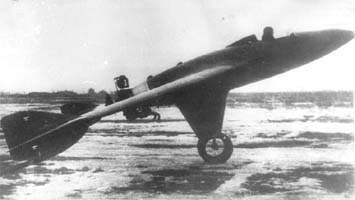
Practical work on the development of a “tailless” aircraft began at the Oskonbyuró (Bureau for Special Constructions of the VVS RKKA) in Moscow at the beginning of 1933. The group led by Grojovski had previously tried to venture into this type of apparatus, but the large number of “gaps” did not allow it to seriously engage in the development of such a complex task. In particular, the issues related to the achievement of the necessary stability in flight became more complex.
Grojovski also clearly understood the need to start with experimental models. Only phased development would allow the necessary experience to be obtained, but this principle was foreign to the bureau’s way of working. Since its creation, all the works conceived by the group under the direction of Grojovski had a practical nature, designed so that once the tests were completed, they could go directly into service.
In those years attention began to be paid to a new type of aerial combat: the demolition of the enemy plane by ramming. In Russia this method was popularized by the pilot Nesterov and received the name “Taran”. Generally the “Tarán” was carried out placing the own plane at 6 o’clock from the enemy and cutting its tail planes or wing tips with the propeller. In the best of cases, the attacking aircraft landed with a damaged propeller, in many others it ended up destroyed along with its opponent. The “Taran” method was promoted during the first stage of the Great Patriotic War, when German aviation had air superiority. Many Soviet pilots rammed their planes into the enemy in those unequal combats.
Grojovski decided to study the possibility of building a plane specialized in ramming. It was a matter of designing a model capable of inflicting great damage on the enemy plane without great damage to its own. The result of this work was an aircraft without analogues for the time that received the name G-39 from the institute and the nickname “Cockroach” (Russian: Гроховский Г-39 “Кукарача”).
As a basis for Grojovski ‘s thought, an example without tail planes was designed. Along the entire leading edge of the wing, a “knife” was installed, a thin, sharp sheet of high-strength steel. In the bow, the installation of a long bar with sharp edges was foreseen, which was to protect a pneumatic cannon. Between this bar and the wing consoles a fine steel cable was installed. It was thought that at the moment of impact, either with the cable or with the edge of the leading edge, the enemy’s tail would be destroyed.
In general, the G-39 repeated Cheranovski ‘s flying wing schemes. The short, cigar-shaped fuselage featured an enclosed bubble-like cockpit forward. In front of the windshield was an armored plate.
The wing had a 38º leading edge camber and ended in vertical surfaces inserted into the trailing edge. The tips of the wings inclined downwards.
At the rear of the fuselage, within a semicircular indentation in the wing, the propeller was located in a drive configuration. The engine was installed at the rear of the fuselage using a special system that allowed it to rotate the engine from its horizontal to vertical position. In this way, the variable pitch propeller was converted from a driver to a tractor and generated the necessary lift to allow vertical takeoff.
The landing gear of the G-39 featured four wheels. The main units featured long landing gear covered by a thin fairing and attached to the wing root, at the point of junction with the fuselage. The other two wheels were located in the lower part of the wingtip vertical surfaces.
From the drawing stage of the new model and by virtue of its appearance, the designers named it “Cockroach”.
Among the novelties incorporated in the development of the model was the introduction of vertical takeoff capability. The idea of such a possibility had been presented by Grojovski in his work “Installation of a power unit in the middle zone of the fuselage”. With this decision the technical task was to develop a tailless ramming aircraft capable of vertical takeoff and landing. The general conception of the new plane was patented by Grojovski on February 25, 1935.
Despite its technological novelty, the new model was based on a body of documented discoveries, calculations, patents, and innovations. On the other hand, there was the trust of the group in the intuition of their boss. Even without the necessary technical preparation and unable to explain how and why, Grojovski always ended up being right, even in those cases in which “science” suggested that his ideas were theoretically incorrect. For this reason, the new task did not raise doubts as to its success, neither in the bureau workers, nor in the invited specialists, and soon the new G-39 model began to take shape on the drawing sheets.
The task was presented with its specifications, but the bureau group lacked knowledge and experience for its development. A group of specialists, VF Bolkhovitinov, SG Kozlov and A. Ye Kaminov were contracted for the conception of the project.
The development and construction of the “Cockroach” was carried out in difficult conditions. The invited specialists could dedicate only their free time to the design, mainly at night. The model was not registered in any development plan, so it had no allocation of material resources.
The construction was carried out in the workshops of the TsAGI. Getting a new engine was impossible, so they had to be content with the underpowered 100-hp M-11, removed from another aircraft. To build the fuselage they had to use leftover materials from other productions. The shortage of qualified personnel was constantly felt. The lack of specialized equipment in the TsAGI workshops made it necessary to simplify the project.
The closed cockpit was replaced by an open one with a windshield. The semicircular slit in the wing, in the position of the propeller, was replaced by a rectangular one. As a result of this modification, the triangular wing ended up becoming a swept wing and its trailing edge a large horizontal stabilizer with a large area and span.
The prototype lacked the ramming equipment, neither the wing knives, nor the installation of the nose system with pneumatic cannon could be installed in the conditions of the workshop.
Another feature that seems to disappear in this prototype was the possibility of vertical takeoff. At least no evidence is collected to show that it was ever tried by the participants in the tests.
The TsAGI workshops were commonly visited by Valeri Pavlovich Chkalov. He had been entrusted with the task of testing the plane and for this reason he considered it mandatory to know the apparatus at the assembly stage. Under his advice, the cabin was set up and the equipment and instruments were placed in the correct position.
At the end of the spring of 1935 the “Cockroach” left the workshops for the development of the tests. Seeing him on the track, Chkalov commented:
- “Oh! It actually looks like a cockroach. I’ll try it.”
However, flying the “Cockroach” proved impossible. The G-39 ran down the runway increasing its speed but in no case did it get up on the runway. Chkalov, not giving up, raced the plane up and down the runway failing to get it airborne until the fuel ran out.
Irritated and addressing the plane’s designers, he blurted out:
- “A real Cockroach and Cockroaches don’t fly! Somewhere you miscalculated or overthought, distinguished!”
The failure of the G-39 can be explained by a series of causes:
The low motor power;
The position of the propeller in relation to the fuselage, the wing and the fairings of the main landers contributed to diminish the effect of the propeller;
The low quality of the construction of the plane;
With all these problems against, the “Cockroach” was unable to take flight.
But Grojovski did not give up his efforts and, not without the help of some important people in the VVS, managed to have the “Cockroach” project included in the official plan of the NKTP Experimental Institute. For this he had to abandon the idea of the vertical takeoff. Work on such a “progressive” model would not have received support.
The contract with the invited specialists was not renewed. Grojovski put his replacement VD Urlapov in charge of development, taking into account that the project already existed and the experience had been accumulated to take on the job. Three months later in the Soviet press would appear:
“The experimental institute of the Narkomtyazhprom in Leningrad begins the development of a model of a flying wing with a 100-hp engine. This plane can carry four passengers and fly at a speed of 220 km/h. In a period of two and a half months the plane should be ready to participate in the all-Soviet race organized by the newspaper “Pravda”, the Central Committee of the Komsomol and the Council of OSOVIAJIM . “
From this moment the development of the G-39 disappeared without a trace. All information about its development has disappeared. Neither was it clear about his fate in contacts with the institute’s workers during that time. Possibly all this is linked to the process that followed the dissolution of the institute and the repression linked to the arrest of MN Tukhachevaski.
G-39
Powerplant: 1 × 100 hp M-11
Wingspan: 6.80 m
Wing area: 14.20 m²
Length: 8.84m
Height: 3.16m
Empty weight: 520 kg
Maximum takeoff weight: 698 kg
Accommodation: 1
 All Aero