Work on the multifunctional aircraft Grokhovsky G-38 (Russian: Гроховский Г-38) began in the summer of 1934 at the request of the VVS leadership. The collective of the experimental institute headed by Grojovski took up the task.
The new model, also known as “Light Cruiser – 2” or LK-2 was developed under the direct supervision of the head of the VVS Ya. I. Alksnis and the deputy commissioner MN Tukhachevsky.
The general conception of the model was assigned to VF Rentel, who designed a monoplane aircraft with a double tail cone configuration and mixed wood and metal construction, retractable gear, 28-meter wingspan and capacity for three crew members. The results of the calculations with the selected engines showed that the model would not be able to compete even with contemporary fighters. Its speed barely reached 300 km/h. The armament, composed only of 7.62 mm machine guns, was also considered poor.
PA Ivensen, a 25-year-old engineer, who had previously worked for was recruited to lead the project group. After familiarizing himself with the results of Rentel’s work, Ivensen confirmed that for the selected design 300 km/h was a limit, but a solution could be found capable of raising this value to 500 km/h.
After three intense days of redesign, the project group made a significant group of modifications. The wingspan was reduced by 1/3 of the original, being fixed at just over 14 meters, increasing the wing loading and with it the speed. This introduced a new problem by increasing the landing speed to 125 km/h. instead of the 90 km/h demanded in the requirements.
Notwithstanding, the opinion of Valeri Pavlovich Chkalov played a decisive role in defining that “…the greatest advantages must be obtained in the air and not at one’s own aerodrome. You need advantages in speed and maneuver to win. There will be little need to land if they knock you down easily, but if you succeed you will land at any speed…”.
Apart from Ivensen, specialists were invited to work on the G-38
MV Orlov – Head of the resistance department of the SNII (Samoliotni NII) of the GVF
AK Martynov – TsAGI Professor of Aerodynamics
VN Belyaev – Professor at TsAGI specialized in resistance of materials and loads
VI Korovin – Aeronautical Designer
AF Epishev – Specialist in strength calculation and static tests
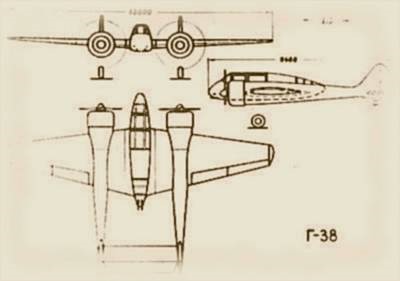
The G-38 was designed as a double-fuselage aircraft, of mixed construction, with great use of wood. Only the central gondola, intended for the crew, was made of metal. Control surfaces were fabric covered.
The wing was strengthened, allowing it to withstand heavy loads and even considering the possibility of hanging bombs, rockets and auxiliary fuel tanks on it. It was built in wood with a honeycomb structure and plywood covering.
The 800 hp Gnôme – Rhône 14Krsd engines were located in the wing centerplane and were continued in the oval section tail cones, tapering towards the tail end, built on a wooden structure and covered in plywood.
The landing gear was of the conventional type with a tail skid. The main units retracted backwards, being stored inside the motor nacelles.
The central gondola housed a crew of three, with the navigator located in the bow and pilot and radio operator seated back to back.
The G-38 was designed with an armament of two ShVAK cannons and two ShKAS machine guns firing forwards, another two ShKAS machine guns operated by the navigator in the nose cabin and a last pair operated by the radio operator, defending the rear. There were also two AG-TB 40.8 mm grenade launchers. Under the central gondola bombs could be located on external supports.
A scale model of the G-38 was built, which was blown in the TsAGI wind tunnel, showing the possibility of reaching a top speed of 550 km/h. The carpenters who worked on this model took such pains to polish it that the model was commonly called “the piano.”
In December 1934 the conceptual project of the “Light Cruiser” was finished. The new model surpassed in all its characteristics the similar models of AN Tupolev Mi-3 (ANT-21) , Mi-3D (ANT-21bis) and DIP (ANT-29).
MN Tukhachevsky, after getting acquainted with this project, declared the G-38 the “main object of aviation technique in the rearmament of the RKKA”. He especially demanded to increase the acceleration of development, stressing the state importance of the creation of this aircraft and promised, in case of successful flight tests, to recommend its creators to receive state awards and decorations. In two and a half months, a life-size model was finished, which was exhibited in a hangar at the Moscow Central Airfield, located in the Jodymka field. This mock-up was visited and analyzed by the commissar of heavy industry GK Ordzhonikidze, the head of the VVS Already. I. Alksnis , MN Tukhachevski and a significant number of senior Red Army officers.
Among the visitors was the test pilot Valeri Pavlovich Chkalov. After carefully reviewing the plane, he ended by saying to Grojovski:
- “Excellent machine. Prepare it soon. The first flight is mine.”
The plans were quickly sent to the Leningrad Factory No.47, which operated under the Grokhovsky Institute. The G-38 prototype was nearly complete by the end of 1936. With the restructuring of the experimental institute and its change of subordination all the works were cancelled.
In 1937, after the firing squad of Marshal MN Tujachevski, a GUAP commission that visited the institute made the decision that the aeronautical construction at the Grojovski institute was not objective and aimed to destroy the aircraft under development, considered to have little prospect. In front of the workers of the institute, both the G-26 and the G-38 were transferred to one end of the factory airfield, doused with gasoline and burned.
G-38
Engines: 2 Gnôme-Rhône 14 krsd, 800 hp
Wingspan: 13.4m
Wing area: 32.0 m²
Length: 8.8m
Height: 2.9m
Loaded weight: 4500 kg
Wing loading: 160 kg/m²
Power load: 2.8 kg/hp
Speed at sea level: 550 km/h
Landing speed: 125 km/h
Armament: Two ShVAK cannons and six ShKAS machine guns
Bomb load: 500 kg
Accommodation: 3
 All Aero