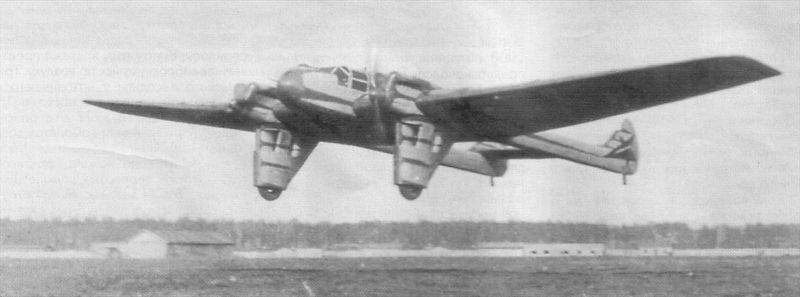
The G-37 troop transport aircraft was obtained as a development of Grojovski’s ideas regarding means of air landing. On this occasion, the transporter plane could be used in different functions, including transporting troops using a special container that was fixed to the bottom of the center plane with capacity for 10-12 soldiers.
The project, originally known as ULK, acronym for Universalnoye Letayuche Krylo or Universal Flying Wing, was [Grojovski|PI Grojovski]] himself, but its design and projection were entrusted to the head of the Leningrad branch of Oskonbyuró IV Titov, production preparation was led by VF Rentel and execution by RM Kalinin.
The Grojovski G-37 (Russian: Гроховский Г-37) was designed as a twin-engined, low-wing monoplane with a double tail cone. The structure was metal and the entire covering of the plane was made with corrugated metal.
The G-37’s wing came from a crashed Tupolev ANT-9. This wing was totally metal with a 4-spar structure and was made up of a centerplane and two consoles. Virtually the entire wingspan of the trailing edge of the consoles was taken up by the ailerons. After removing the ailerons, this wing presented an area of 80.97 m². A central gondola with the cockpit and flat bottom was fixed on the centerplane with a constant chord to allow the fixing of the detachable ventral cargo container.
In order to accommodate the ventral container, the G-37 featured a fixed landing gear with a long length of the landing gear faired in “trousers” with tunnel-type inlets for the oil and water radiators. The wheels were simple and there were no brakes. The suspension of the main landers was by rubber. In winter conditions, the replacement of the wheels with skis was foreseen.
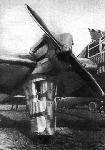
Two M-17 liquid-cooled engines with a power of 680 takeoff hp and 500 nominal hp were selected as power plant, moving 3.15 m diameter fixed-pitch wooden propellers, also inherited from the Túpolev ANT-9. The motor mounts were fixed to the centerplane structure. The bonnets continued in the form of two parallel tail cones, ending in two medium-sized empennages. The empennages were metallic and were integrated into the structure of the cone. The rudders had aerodynamic compensators on the upper part and servo rudders or trimmers on the trailing edge.
The two tail cones were metal, with an oval section that tapered towards the tail and were located on the wing. In the lower rear part, the non-steerable landing skids were fixed and with suspensión was spring steel. Both empennages were joined by a constant chord stabilizer to which the elevator was attached. This stabilizer had a three-beam structure and was fixed to the empennages by means of 4 points in such a way that its angle of incidence could be modified on the ground. Originally the surface of this stabilizer was 10.5 m², but during the tests it was increased by 20%.
The fuel system consisted of tanks in the center of the plane with a capacity for 1000 kg of fuel.
The cockpit with capacity for 1-3 crew members was located in the central gondola, depending on the type of mission. In the bow was located the open cockpit of the gunner with the possibility of installing a pair of Degtiariov light machine guns on a swivel mount. Behind it was the closed cabin for two crew members located side by side. Behind this cabin was a small cargo or baggage compartment in which an additional fuel tank could be installed. The G-37 featured dual flight controls using cables and wires.
The fixing supports of the cabin in the center plane could be used to fix other types of containers or loads, and even to carry up to a ton of bombs.
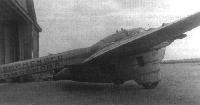
Engineers VA Ryvkin, GS Avdieyev and spouses PS and AF Epishev also participated in the preparation of the landing cabin or container. All from OSOVIAJIM.
Already prior to the construction of the G-37, Grojovski and his collective had worked on the development of a cabin for 12 soldiers, individual containers for paratroopers, tested in a Tupolev TB-1 bomber, and a larger cabin for 17 soldiers, officially named KPS. -17 and known as “buffet”, which was tested on a TB-3.
The project planned various types of cabins depending on the aircraft’s mission, but only one was built, which was completed in Poplidki and attached to the aircraft in Moscow. This cabin was calculated to transport 10 passengers or 12 equipped soldiers or 10 wounded or four stretchers with a nurse.
Its construction was totally metal with corrugated metal covering and side windows. The length of the cabin was about 7 meters with the front hinged, forming an access opening to the right side. The soldiers or passengers were located on both sides on wooden benches, intertwining their legs due to the narrowness of the cabin.
This cabin featured a hatch in the forward part of the floor, which could be used to drop propaganda over enemy territory. This container could be dropped in flight, either due to an aircraft emergency or in the performance of a landing task over an area where it was impossible to land. The cabin descended with the help of a parachute 40 meters in diameter.
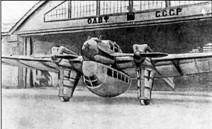
The G-37 was built in the winter of 1933-1934 at the Leningrad Factory No.47, which was subordinate to Grokhovsky ‘s OKB.
The pilot Valeri Pavlovich Chkalov was unable to fly due to the punishment imposed for destroying an airplane. For almost six months he had been forbidden to take flight and for him that had become a true torture. On May 7th he was at the civilian fleet airfield in Leningrad (formerly a hippodrome) and in an open hangar he saw the strange G-37 on the skin of which read “In the name of the Leningrad Komsomol”.
The G-37 was to be tested by AB Yumashiev on May 7, 1934, who had not arrived at the airfield at that time.
Chkalov requested permission to run the G-37 around the runway. Knowing the punishment, they initially declined his request, but at his insistence they decided to authorize it, but warning him that he should only taxi.
Runway runs were run from end to end and Yumashiev was still missing, so Chkalov was cleared to make the first flight.
After takeoff the plane began to oscillate slowly, moving the tail up and down. This movement was increasing and it seemed that the flight would end in disaster, but Chkalov managed to land the plane almost at the end of the runway. After correcting the problem (a bad installation of the tail control cable) the factory tests developed quickly and without complications until June 1, 1934.
On June 12, 1934 Chkalov flew from Leningrad to Moscow, landing at Frunze Central Airfield (formerly Trotsky airfield located on the Khodimka field), where he received designation for further testing. There Grojovski and a group of Oskonbyuró workers were waiting for him. The aircraft was presented to GK Ordzhonikidze, MN Tukhachevski and Ya. I. Alksnis, making a positive impression. Above all, the visitors valued the high flight speed, much higher than that of the Tupolev R-6 that had begun to be produced in series.
During the transfer of the G-37, Chkalov without trying, managed to set an unofficial speed record for twin-engine aircraft. Covering the distance between Leningrad and Moscow in 2 hours and 15 minutes, the plane reached an average speed of 310 km/h. According to Chkalov, the plane could develop a higher speed after adjusting the engines correctly and replacing the old wooden propellers with new ones (these propellers, taken from ANT-9 planes, were exposed to the elements for more than three years, for which they lost between 15 and 20% its effectiveness.
Flight tests were supervised by PA Khrustalev.
Development testing of the G-37 took place during the winter of 1935. The aircraft showed excellent stability and response to controls. The centering and static moments of the tail units were maintained during the tests similar to those of the Túpolev ANT-9 and no vibrations or anomalies were observed in any of the flight regimes. Both the propulsion and fuel systems worked flawlessly throughout the testing period.
The flight characteristics of the G-37 with the cockpit hung under the fuselage deteriorated considerably. Top speed at sea level dropped to 235 km/h, while cruising speed at 2,500 meters was 250 km/h.
At the beginning of 1935 and at the request of the head of the VVS, Yakov Alksnis, new M-17 engines were installed in the G-37, with which performance improved significantly, reaching a maximum speed (without the container) of 375 km/h. These results opened up new prospects for the use of the G-37 as a postal or military reconnaissance aircraft.
In the spring of 1935 the tests of use of the transport cabin were continued with drops of paratroopers through the lower hatch. Among the enthusiasts who took the plunge were Grojovski himself and several members of his collective.
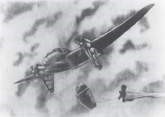
Flight tests of the G-37 continued until November 1936 when the institute led by Grojovski was reorganized.
During testing it became clear that the idea had prospects for practical use, but the capacity of the ULK needed to be increased. Grojovski ‘s task force developed calculations for a version powered by modern M-34N engines and using a thinner, smooth-coated wing instead of the corrugated ANT-9. A model of this version, known as the G-37A, was tested in the VVA Zhukovski wind tunnel, yielding a possible top speed of over 400 km/h.
Unfortunately, these works could not be carried out due to the liquidation of the institute.
Despite the cancellation of the work on the G-37, the investigations carried out by Grojovski and his colleagues were not lost.
Between 1939 and 1940, in the OKB of SV Ilyushin, the conversion of the operational units of the DB-3 bomber would begin into a long-distance landing troop transport plane by adapting a D-20 metal cockpit created by AI Privalov under the fuselage. and designed to transport 10 skydivers.
DK-12 cabins for 12 soldiers were widely used during the Great Patriotic War attached to Il-4 (DB-3F) aircraft.
G-37
Powerplant: 2 × М-17, 680 hp at takeoff and 500 nominal hp
Wingspan: 23.70 m
Wing area: 84.00 m²
Length: 15.20 m
Height: 4.52 m
Empty weight: 3075 kg
Normal flight weight: 5950 kg
Maximum takeoff weight: 6250 kg
Fuel capacity: 650 kg
Maximum speed at sea level: 240 km/h
Maximum speed at altitude: 285 km/h
Landing speed with maximum load: 90 km/h.
Practical range: 1700 km
ROC: 335 m/min
Time to 1000 m: 3 min
Time to 6000 m: 18 min
Practical ceiling: 8050 m
Accommodation: 1 – 3
Payload: 10 passengers, 12 soldiers or 1000 kg of cargo
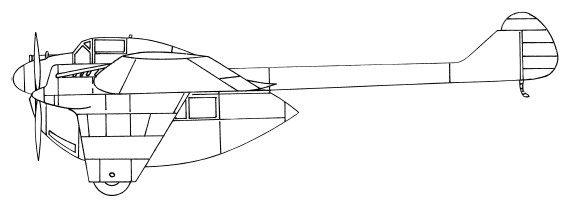
 All Aero