
The Grob/E-Systems/AlliedSignal Egrett was a surveillance aircraft developed in Germany in the 1980s by an international partnership. It was intended to fill a joint Luftwaffe-USAF requirement for a high-altitude, long-duration surveillance platform for treaty verification and environmental monitoring.
Germany’s Grob Aircraft, teamed up with E-Systems and Garrett AiResearch, both in the United States. The name EGRETT comes from a combination of the three companies’ names.

According to the publicly available accounts, the official purpose of the program, which the U.S. Air Force reportedly nicknamed Senior Guardian, was to provide a cheaper alternative to the U-2 Dragon Lady spy plane for both treaty verification and environmental monitoring purposes. In the 1980s, the United States and the Soviet Union were negotiating the terms of what would become the Intermediate-Range Nuclear Forces Treaty (INF) and the Treaty on Conventional Armed Forces in Europe (CFE). INF entered force in 1988, while CFE did not go into effect until 1990. Both required robust verification methods.
The turboprop-powered G-520 Egrett and Strato 1 high-altitude and long-duration research platforms are capable of carrying different electronic payloads in 12 separate compartments (first flown June 1987 in G-500 Egrett form.

Grob and the rest of the team ultimately built total of five aircraft in various versions, starting with the prototype D 450 EGRETT, followed two more D 500 EGRETT II aircraft.
The contractors then modified the D 500s into the final G 520 configuration before building a third of these pre-production planes. Finally, Grob produced a two-seat G 520T trainer version.
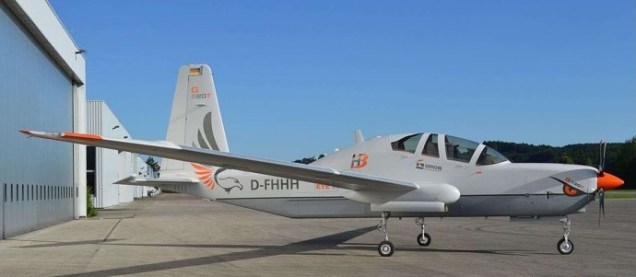
The German manufacturer claims its G 520NG variants has the “lowest operational cost in class.”
The aircraft with its composite airframe was able to carry more than 2,000 pounds of sensors and equipment in any of 12 separate, modular bays, five of which lined the bottom of the fuselage. There was enough room there for turreted day- and night-vision cameras, as well as synthetic aperture radars and other gear.
The G 520 could fly this equipment to an altitude of 50,000 feet. The aircraft has a very narrow cord wing with a span of just more than 108 feet. Depending on the exact load out and flight profile, the plane reportedly could have a range of more than 1,500 miles or loiter over a particular area for up to eight hours.

In the end, the existing prototypes filtered out onto the open market through the original partners. In 1995, Raytheon bought E-Systems, ultimately renaming it as their Intelligence, Information and Services division. The company’s flight test outfit continued flying at least one EGRETT II for some time afterward, providing support to NASA’s Airborne Science Program. According to the Federal Aviation Administration, this aircraft, N520DM, apparently passed to Bear Defense circa 2012.
The D 450 EGRETT aircraft is also still in the U.S. civil registry, listed as N520EG, and property of a company called Gentran Corporation. This Omaha, Nebraska-based “trucking company” has one employee, according to publicly available records. Spotters caught this all-white aircraft in California in 2012 and it does not appear to match the one flying in Indiana earlier in July 2017.

 All Aero