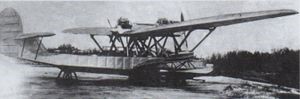
On June 17, 1925, the Scientific Committee of the Directorate of the VVS (UVVS) approved the technical task for the development of an open sea exploration airplane (ROM according to the initials of Razviedchik Otkrytovo Morya) with two Lorraine-Dietrich engines of 450 hp. Almost in parallel OMOS was tasked with creating a hydrofoil to cover this request.
Development of the Grigorovich ROM-1 (in Russian: Григорович РОМ-1) commenced in the summer of 1925. The aircraft was ordered during Summer 1925, the task was considered of high priority. According to the TZ, the hull had to be all metal (aluminum alloy), the wing – wooden. V.B.Shavrov was responsible for hull design, P.D.Samsonov – for wing and powerplant. The hull layout was chosen as simple as possible to avoid complicated procedures.
The ROM owes its name to the initials of Razviedchik Otkrytovo Morya or Open Sea Explorer, but the company internally called it MR-3 (Morskoi Razviedchik – 3) and apparently the Navy also called them MDR-1 (Mosrkoi Dalni Razviedchik – 1), so in literature it is sometimes named in these ways. Shavrov also used the name MR-3 to refer to Grigorovich’s MR-5 model, which has contributed to some confusion, although today there is consensus that this was an error by the author.
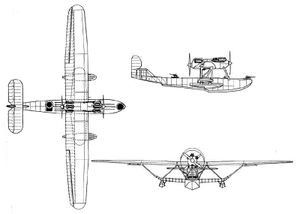
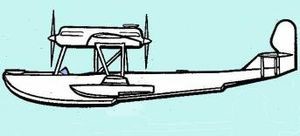
The ROM-1 (ROM = Razviedchik Otkrytovo Morya [Open Sea Reconnaissance]) was a long range maritime reconnaissance sesquiplane flying boat with two engines installed in a tandem nacelle, supported on struts over the hull. The hull was made from aluminum and the wings were made of wood, attached to the sides of the engine nacelle. The water-tight lower wings, attached to the sides of the hull, were installed slightly above the waterline and carried two floats on their tips. The ‘wing box’ included 20 struts. Thickness of the walls was from 1.0mm above the waterline and 1.5…2.0mm below. The tail surfaces had aluminum alloy frames with fabric covering.
The upper wing, built in wood, had a span of 27 meters with a total area of 86.6 m². The two stringers of the upper wing had a trunk-like structure. Initially each of them had a single thickness of 100 mm throughout the span, but later pairs of 60 mm thick were installed. The wing nerves were skeletal in type. In the upper part of the wing from the leading edge to the second spar the covering was plywood covered with fabric and from there only fabric. The upper wing had a Gettingen-426 profile, but a thicker Gettingen-420 profile was used in the area where the supports were attached, so when looking at the model from the front, the variation in wing thickness could be clearly appreciated, which widened towards the center of each half plane.
The lower plane was made entirely of aluminum and, like the helmet, was covered in waterproof coated fabric. The stabilization floats were located in the external section of the intrados, which had a semicircular section in the upper part and a configuration of a reent in its lower part. Fixing to the wing was done by eight small steel supports.
Originally all the joints were caulked with layers of fabric covered with anticorrosive or tar, but here a mistake was made: the tightness was achieved but the thickness of the layers at the seams tried against the finish. Soon all this work would be scrapped and the joints would be covered with waterproof tape, giving the finish more aesthetics.
The bracing between both planes was achieved by means of 20 diagonal supports and two stiffness frames, which was directly reflected in the increased weight of the structure. The inner interalar supports were made of aerodynamically shaped aluminum tubes but the outer ones were made of rectangular profiles.
Samsonov proposed the installation of two 450 hp Lorraine-Dietrich engines, located in tandem and opposite on the centroplane, so that they moved a traction propeller and an impeller. The need to move the engines forward to improve the c of g resulted in the need to locate two steel supports located forward on the hull, just in front of the cockpit.
The ROM-1 crew consisted of four people. In the bow area a gunner was installed operating a pair of Lewis machine guns in a TUR-4 turret with a Herts collimator. Two crew members: pilot and mechanic, sat side by side in an open cockpit, located in front of the wing leading edge and protected by a small windshield. In the rear section of the fuselage, just behind the propeller, there was another defensive position covered by the fourth crew member, operating a pair of machine guns in a TUR-5 turret, which covered the rear hemisphere. A number of bombs could be attached to both sides on Sbr-8 brackets and bomb aiming device in the nose cockpit.
The centering of the hydrofoil was the cause of the biggest headaches. To achieve good stability it was necessary to position the engines well forward, increasing the length of the driving nacelles and installing two new interplane supports not conceived in the original project, which added a little more weight to the construction. Despite this, the rear centering was still outside the permitted limits. This had to be corrected by the crew before take-off by distributing cargo and fuel.
In the process of developing the ROM there were important variations in the request of the military. Despite having approved the project as a reconnaissance aircraft, on May 31, 1927, the Aviatrust requested the possibility of considering the installation of a Type 1915 450 kg torpedo. Grigorovich objected that this installation would bring important changes in the project and the need to use more powerful engines, but finally he would develop a conceptual project with this configuration that is known as MT-1 (MM-3).
Built at GAZ No.3 “Krasni Liotchik” of Leningrad, in order to build the metal hull, it was necessary to prepare the production in Leningrad of the aluminum sheets, pipes and rivets, since the AGOS profiles, which were already being produced, could not be used. In western countries these elements were already manufactured in large quantities but Soviet finances in the 1920s could not afford such expenditures.
On the other hand, a new need also arose: to develop the structural elements of the hydrofoil hull, designed from angles with profiles of 1.5 – 2 mm thick and 800 mm wide. The cross section of the hull had the shape of a pentagon all along with the tip pointing downwards, since a certain angle (12º) was conceived in the keel area. The majority use of straight lines with simplified contours was maintained. The recess had a height of 150 mm and an inclination of up to 45º.
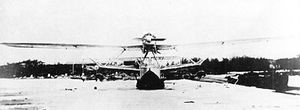
On September 15, 1927, the management of the “Krasni Liotchik” factory declared that the ROM was practically ready, leaving only to stretch the fabric covers and complete the equipment. Already abroad, the hydrofoil was assembled and painted and on September 27 the Aviatrust technical committee gave the green light to the delivery for the flight tests. In parallel the OMOS TsKB was tasked with starting the construction of a second prototype. From this moment on, the first prototype was called ROM-1 (MR-3) and the new prototype ROM-2 (MR-3bis).
In the spring of 1927 static tests were carried out, which showed that in general the construction of the hydrofoil could be characterized as resistant. The wing, however, showed a deflection of 0.3 meters under normal overloads and up to 1.5 meters before breaking, prompting the replacement of the 100mm spars with a 60mm pair. The center plane section was also reinforced. Unfortunately these measures increased the weight of the aircraft by about 600 kg. The ROM-1 suffered from same problem as some other aircraft of D.P.Grigorovich – too rear CG location. To fix the problem engines, fuel tanks and payload were moved forward.
The prototype ROM-1 built at GAZ-3 first flew in the autumn of 1927. The first flights were made in Leningrad, in the immediate vicinity of the Grebni test station.
At conclusion of the flight test pilot L. Giks wrote:
“The take-off from the water took place at a speed of 97 km / h with an ascent speed of 3 meters per second. The flight took place at an altitude of 400 meters. Gliding at a speed of 110 km / h with engines off was stable. The speed recorded on landing was 85 km / h.
During the circle flight the handling was normal. The aircraft responds well to the ailerons, but the rudder surface is insufficient. He responded better in the height shot. Backward centering is felt and the plane finds it difficult to dive. In general, the aircraft is heavy at the controls, which can be explained by the low speed with a very large take-off weight. “
The tests of the model carried out in Leningrad until November 1927 were characterized by the absence of a defined system or program. Grigorovich felt quite uneasy during those days, he took the project with a certain coldness and did not even show up to the tests, something unusual for him. The OMOS had received the order to leave Leningrad and move to Moscow to locate in a factory in Fili where the OPO-3 of the TsKB would be created.
On November 21, 1927, with the beginning of the winter frosts, Dmitri Pavlovich ordered the aircraft to be dismantled, moved to the commander’s airfield, packed the parts in boxes, and shipped to Sevastopol.
At the end of November 1927 the ROM-1 was sent to Sevastopol, where the flight tests were continued.
On February 24, pilot Giks reported:
“Take-off takes place at speeds of 90 – 95 km / h. During the flight you feel pressure on the legs, but not great. I reached the height of 3200 m. At speeds between 80 – 90 km / h the landing is excellent. With a load of 1500 km the maximum speed is 158 – 162 km / h. Ailerons are not very effective. “
In June 1928 it was decided to send the ROM-1 to Taganrog with the aim of making a number of improvements there. Grigorovich arrived in Sevastopol, who was to continue with Giks towards Taganrog, but none of this happened. A couple of months later, upon arriving in Moscow, Grigorovich was arrested.
The work on ROM-1 was continued under the direction of P. D. Samsonov, as representative of the OPO-3. As of August 20, 1928, a series of modifications were made that included the installation of new 2.96 m diameter propellers obtained from a Farman, internal changes in the cabin, addition of 900 × 200 mm wheels (from a Vickers Vernon), which could be installed to facilitate the entry and exit of water, among others.
In Sevastopol the flights were carried out by the pilot S. T. Rybalchuk. After the changes, a certain number of flights were made in which the flight characteristics were not fixed. In the final report, written in the fall of 1928, the pilot wrote:
“The excess weight of the construction does not allow to load the total capacity of fuel for prolonged flights nor the completion of the armament. The weak Lorraine engines of only 450 hp are not sufficient for normal piloting of the airplane at maximum payload. I consider that the ROM-1 in the current state cannot be used in the proposed mission. “
The situation became doubtful, but the opinion had been created that the ROM-1 could not be used as a military model, so it was simply left in the open awaiting decisions from the commanders.
Shortly before the 1929 flying season they remembered ROM-1 again. The prototype was admitted to Factory No.31 in Taganrog for review. Mechanical engineer K. N. Ganulich wrote in the report:
“As a result of the plane being in the open all autumn, the wooden wings have been damaged in such a way that they need to be repaired. The entire interior surface has been filled with water, the coating has become moldy, and the plywood layers have separated at the leading edge. The worst condition is the leading edge and ailerons. The helmet is in good condition. The coating lacquer is fine. “
The ROM-1 repairs were carried out between April and mid-May 1929. The hydrofoil was again flown and sent to Sevastopol. On June 17, 1929, the assistant to the head of the VVS RKKA Ya. I. Alksnis gave the order to conduct state testing of the ROM-1, ROM-2 and MR-5 models.
The tests began in Sevastopol on July 2, 1929. The first attempts, carried out in Golandia Bay, showed that with a center of 30.4% the hydrofoil did not lift the bow. They were forced to return to a base in Najimov Bay, where a person moved into the rear cabin and a 40 kg dead weight was added there. With this, it was possible to move the centering to 35% and it was possible to take off without difficulties, but warming of the engines was appreciated.
At night, when the temperature dropped, Rybalchuk managed to make a flight in which a height of 3470 meters was set. The next day new radiators taken from a Dornier Wal were installed and several flights were made until August 2. A total of 84 flights were executed in ROM-1.
In preparing the report Naval Aviation NII engineer Korovin wrote:
“Poor visibility from the cockpit, hard controls, sensitive pedal pressure on the right leg, complex starting system. Shallow cabin, high deck. Pilots cannot exchange positions in flight. “
It was also found that, with a load of 1305 kg in calm sea, take-off was impossible. The tests had to be carried out with loads of 1135 kg.
On September 19, 1929, a commission, made up of specialists from the NII under the direction of the head of the Black Sea VVS Lavrov, defined that the ROM-1 could only be used in pilot training tasks or as a transition model to operations.
The withdrawal of the ROM-1, as late as 1928, from flight tests was a terrible blow to Grigorovich’s reputation.
The extremists accused him of being a saboteur and wasting the valuable resources of the Soviet state on experiments. On September 1, 1928, Grigorovich was removed from his position and arrested under the accusation of developing anti-Soviet activities within the famous Prompartia case.
Only after the failure of the ROM-1 did Grigorovich come to understand the importance of accuracy in aerodynamic calculations, the resistance of materials and the details of operation. And despite the fact that the evolution of global hydroaviation passed before his eyes and to some extent with his participation, Grigorovich unfortunately drew few useful conclusions for himself from this process.
Grigorovich ROM-1
Engines: 2 × Lorraine-Dietrich 12E W-12, 340 kW (450 hp) each
Crew: 4
Length: 16.0 m (52 ft 6 in)
Wingspan: 28.0 m (91 ft 10 in)
Wing area: 104.6 m2 (1,126 sq ft)
Empty weight: 4,518 kg (9,960 lb)
Max takeoff weight: 5,830 kg (12,853 lb)
Fuel weight: 775 kg
Oil weight: 185 kg
Total load capacity: 1312 kg
Maximum speed: 165 km/h (103 mph, 89 kn)
Cruise: 132 km/h
Range: 800 km (500 mi, 430 nmi)
Endurance: 5 hours
Service ceiling: 3,470 m (11,380 ft)
Time to 1,000 m (3,281 ft): 10 minutes 6 seconds
Time to 2000 m: 25.3 min
Time to 3000 m: 54 min
Takeoff Speed: 118 km/h
Landing Speed: 85 km/h
Landing Roll: 13 sec
Takeoff Roll: 25 sec
Turn time: 80 sec
Wing loading: 56.0 kg/m2 (11.5 lb/sq ft)
Armament: 4 x 7.62 mm (0.300 in) DA machine guns
Crew: 4
 All Aero