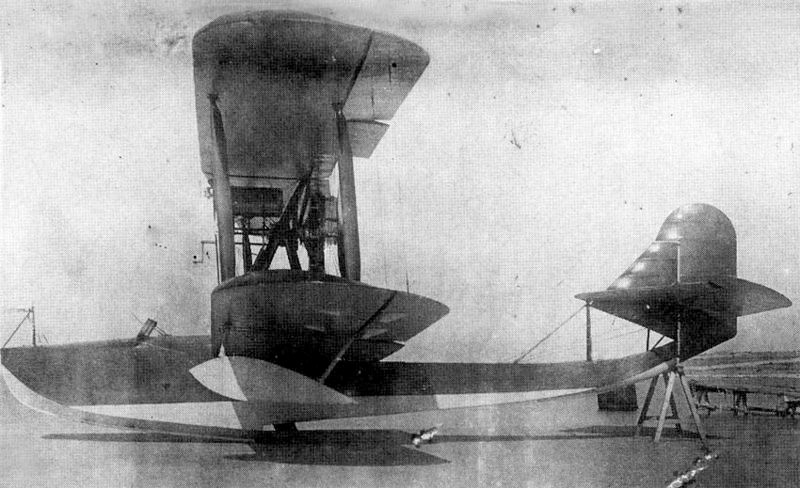
By 1924 the few M-5 and M-20 trainers still in flight condition had aged and needed constant efforts to keep them operational. The possibility of building new models was considered unproductive.
For this reason the 26 of June of 1925 Grigorovich was tasked to develop a flying boat training flight Soviet schools. An easy-to-build, stable in flight and cheap to operate two-seater hydrofoil was required. The new trainer was to replace the M-20 and MU-1 in service.
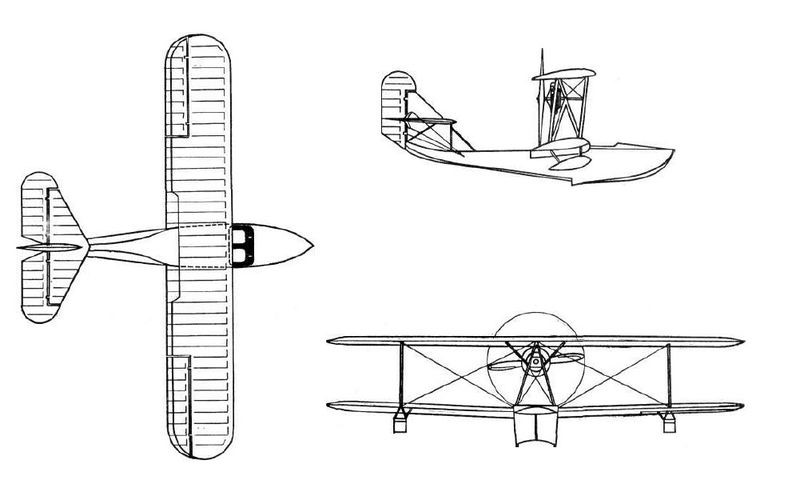
The Grigorovich MUR-1, (Russian: Григорович МУР-1, MUR – Morskoi Uchebnyi Rhône – seaplane trainer Rhône) was developed by the Grigorovich Design Bureau. In order to speed up the development process and facilitate the introduction into production, Grigorovich decided to use the hull of the M-5 (M-20) hydrofoil. The new design would only comprise the wing box and the tail unit. A 120 hp Le Rhône (M-2) engine was selected as the power plant. The MUR-1 differed from the Grigorovich M-5 in that it used a more powerful engine, single bay wings with thicker section, and stronger tail structure to reduce the twisting effect of this area during turns. Speed was increased, but other characteristics suffered. The new model introduced of ailerons on both planes.
The two crew members were located in an open cockpit, seated side by side and protected by a small windshield.
Built at GAZ Factory No.3 Krasni Liotchik of Leningrad, the prototype was completed in 1926. The tests, developed by the pilot TS Zhukov at the end of that year, showed an increase in speed, which was set at 120 km / h, but other indicators were lower than those of the M-5.
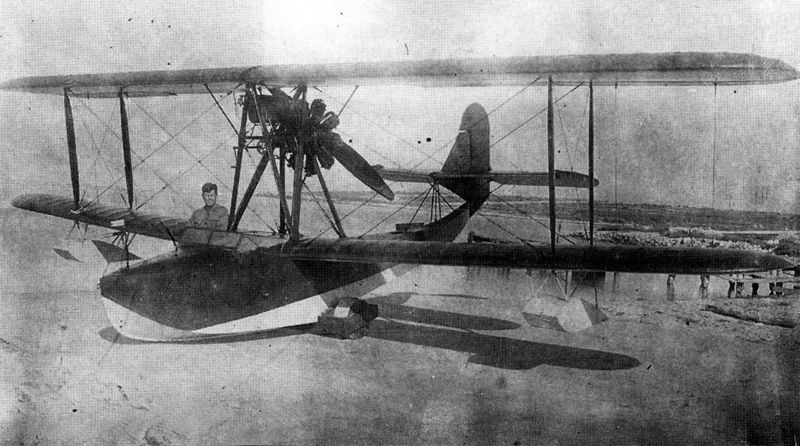
It was found that the center of gravity had been too far back, so that in hydrofoil it lacked stability in the air with a constant tendency to raise the nose. The structural reinforcement of the tail also contributed to this behaviour, which is why it was necessary to place additional weights of about 32 kg in the bow to restore balance.
It was clear that with these “adaptations” the MUR-1 could not reach production. Despite this, the need was such that it was decided to accept prototype in September 1926. In October of that year, TS Zhukov made the first training flight with pilot Rastyagayev on board as a student.
In 1929, when the TsAGI hydrochannel was created, the MUR-1 was used to carry out pressure studies on the hull. For this purpose, it was equipped with membranes with sensors attached to dynamometers with input from TsAGI engineer N.N.Podsevalov, which measured the forces of the water at different points. These experiments would continue with a slightly modified MUR-2 version.
Test flights were conducted 1929-1931 with the intent to test load condition during taxi, takeoff and landing.
Engine: 1 × Le Rhône M-2, 89 kW (120 hp)
Propeller: 2-bladed fixed-pitch wooden
Wingspan: 11.5 m (37 ft 9 in)
Wing area: 33.0 m2 (355 sq ft)
Length: 8.0 m (26 ft 3 in)
Empty weight: 700 kg (1,543 lb)
Gross weight: 1,000 kg (2,205 lb)
Fuel capacity: 124 kg (273 lb)
Total load capacity: 300 kg
Wing loading: 33.3 kg/m2 (6.8 lb/sq ft)
Power load: 8.4kg / hp
Maximum speed: 129 km/h (80 mph, 70 kn) at sea level
Alighting speed: 95 km/h (59 mph; 51 kn)
Range: 360 km (220 mi, 190 nmi)
Endurance: 3 hours
Service ceiling: 3,500 m (11,500 ft)
Take-off distance: 250 m (820 ft) / 22 seconds
Alighting distance: 170 m (560 ft) / 15 seconds
Time to 1,000 m (3,300 ft): 8 minutes
Time to 2,000 m (6,600 ft): 19 minutes
Time to 3,000 m (9,800 ft): 38 minutes
Crew: 2
 All Aero