At the beginning of 1924, a request was received from the Navy leadership to create a new naval reconnaissance flying boat. The technical task, delivered by the VVS Aviation Supply Department on June 13, specified the use of a Liberty engine, which is why the model was called MRL (Russian: Григорович МРЛ-1), after the acronym for Morskoi Razvietchiks motorom Liberty). although it has sometimes been named simply MR-1. In order to carry out this project, the development of an all-metal fighter was cancelled and 10,000 rubles were transferred to Grigorovich.
Work began in Moscow, but the development was moved together with the Grigorovich group to Leningrad.
Concept drawings, plans, and calculations were developed by engineers Piotr Dmitievich Samsonov and Kiril Alexandrovich Vigand. Since DP Grigorovich had left Factory No.1, design work was carried out in his apartment on Sadovo-Kudrinskaya Street. Work on the project began in June, and by September 18, 1924, it was submitted for evaluation. After reviewing all the documentation and verifying the coincidence of the requested benefits with the calculations, the Technical Scientific Committee of the Air Fleet approved the project. Shortly after, the instruction was issued to build the prototype of the flying boat at Factory No.3 “Krasni Liotchik” in Leningrad.
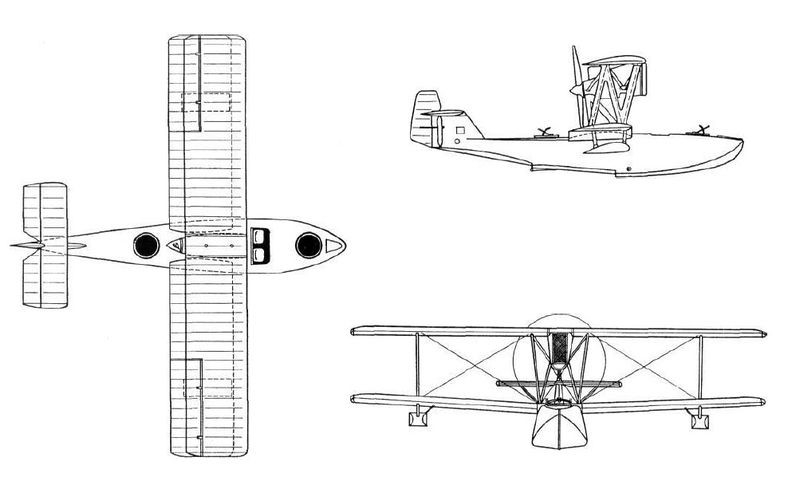
The MRL was designed as a four-seater biplane flying boat with a 400 hp Liberty engine driving a pusher propeller. The model had clean lines but it was very heavy.
The wings, with a Gottingen 436 profile, were rectangular in plan, with ailerons on the trailing edge of both wings. The upper wing was completely straight in its frontal view, but the lower plane had a certain positive dihedral and some small fixed stabilization floats were fitted. The interplane uprights were N-shaped with aerodynamic wood cladding and the necessary tension was achieved by means of cables.
The double-reinforced hull was very heavy and labor-intensive and expensive to build. With a total length of 9.8 meters and 4 meters to the first step, the width reached 1.5 meters and the maximum height 1.3 meters. The entire plywood hull was covered using 4 x 80 mm strips made from different types of wood and fixed using copper rivets with aluminum washers. The deck and the upper part of the rails were covered with pine wood boards, a little further down the rails were made of ash and walnut and from the waterline to the bottom of mahogany, which in this last area was installed with double layer. Between the plywood and the board covering, a layer of fabric coated with a waterproof lacquer was installed.
The tail was of the monoplane type with the stabilizers installed on a short keel and braced by simple struts. The keel ended in a small rudder. The rectangular stabilizer could change its angle of incidence in flight.
The engine was installed on mounts in the center of the biplane wingbox and featured a cooling radiator located at the front.
The MRL-1 was designed for three crew members. Pilot and co-pilot sat side by side in an open cockpit, protected by a windshield. At the bow was a facility for a gunner operating a machine gun located on a ring mount. A second defensive post was located behind the power plant and was intended to defend the rear hemisphere.
The construction of the MRL-1 was completed at GAZ No.3 in Leningrad in May 1925. On June 6, the model was transferred to the naval base where it was assembled, adjusted and the first operations of entering the water were carried out.
From the first stage of the tests it was possible to verify that the front radiator was very small, so the necessary cooling of the engine was not achieved. The propeller was calculated for 1,700 revolutions/minute, but the engine at full capacity only guaranteed 1,550.
The first flight was made on June 2, 1925. After carrying out some test flights, it was concluded that in operations on water the model presented poor longitudinal stability and the take-off run was too long.
In the air the model behaved normally and was easily controllable. The maximum speed reached during the tests was 180 – 185 km/h at an altitude of 1000 meters.
During one of the last test flights, the oil tank burst and the aircraft was forced to make an emergency landing with the engine stopped. The cause of the explosion was the absence of an exhaust valve in the tank, which caused the oil to heat up and the pressure of the air accumulated there to increase, causing it to burst through the seam of the welds.
The tests included only 9 flights and were generally considered positive, since the model met the requested specifications, but the long take-off run and the problems when separating from the water were considered intolerable, so it was recommended to modify the design of the contours of the hull.
The ascent rate and the ceiling reached of only 3,050 meters were also noted as unsatisfactory.
Although the decision had been made to mass-produce the model, the request was eventually withdrawn. The only example built was delivered to the White Sea for exploitation, being used in the Solovietski Special Operations Camp (SLON) as a link with the mainland.
MRL-1
Powerplant: 1 x 400 hp Liberty
Wingspan: 13.2m
Wing area: 50.0 m²
Length: 10.6m
Empty weight: 1660 kg
Maximum takeoff weight: 2600 kg
Fuel weight: 520kg
Full load capacity: 940kg
Wing loading: 52.0 kg/m²
Power load: 6.5kg/hp
Maximum speed at sea level: 185 km/h
Landing speed: 95km/h
Practical ceiling: 3050 m
Endurance: 5 hours
Range: 950km
Turn Time: 65s
Climb to 1000m: 11min
Climb to 2000m: 26min
Climb to 3000m: 55min
Take off time: 40s
Landing time: 15s
Accommodation: 4
 All Aero