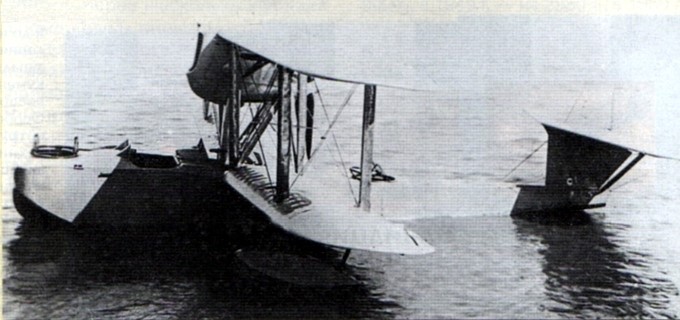
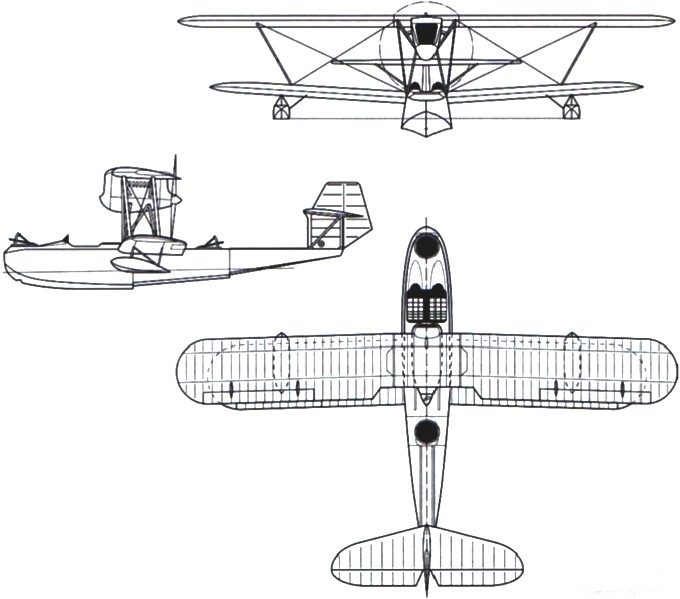
The Grigorovich MR-5 (Russian: Григорович МР-5) flying boat was a development of the earlier DP Grigorovich MR-2 model with a new metal hull. Both the armament and the distribution were similar to the previous model but the power plant was modified to install a 500/680 hp BMW-VI engine.
The project was ready by 1927 and construction began the following year. The new seaplane was developed keeping the same scheme of the previous models. It was a flying boat with a liquid-cooled engine and propeller propeller. The descriptive memory that accompanied the model during the tests defined the MR-5 as “totally made of aluminum except for the wings and side floats” .
The hull was made up of seven watertight departments. In the bow section, a waterproof bottom was installed in an auxiliary way. Round hatches with hermetic hatches were installed to allow passage inside the hull, and a similar hatch was installed in the upper part of the fuselage to allow access to the entrance of the fuel tanks.
The fuel system consisted of two main tanks with a total capacity of 608 liters. There was a third tank of 64 liters. The oil tank was located below the engine cooling radiator, which gave the powertrain an almost triangular cross-section. The BMW-VI engine was fitted with a two-blade wooden propeller 3.18 meters in diameter.
The armament of the flying boat was located in two turrets located in the bow section and in the back (TUR-5 and TUR-6 respectively). Under the wings, on each side, a pair of DER-6 mounts was located, capable of fixing aircraft bombs in two combinations: 4 x 82 kg and 8 x 48 kg.
The MR-5 was completed at Factory No.22 in Fili by the summer of 1929. First flying in July 1929, the tests were carried out between July and August of that year in Taganrog by test pilot ST Rybalchuk. This pilot moved the model to Sebastopol in September, in order to carry out the acceptance tests there.
The tests showed that the flying boat had excellent behaviour in the air. Gone were the stability problems that characterized the earlier MR-2 and MRL-1 models.
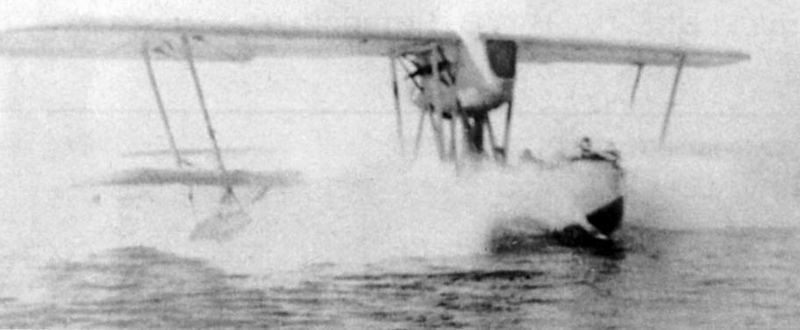
The behaviour on the water did not have the same results. It was determined that during takeoff and landing operations, the flying boat raised large curtains of water to the sides due to poor design of the bow. The takeoff and landing runs were also extremely long. The tests of behaviour in the sea with waves were not carried out. The pilots also determined that the aircraft had poor manoeuvrability at a combat altitude of 3,000 meters.
The MR-5 flew at the time of the transfer of the OMOS from Leningrad to Moscow, that is why the plane concentrated all the problems of the moment in its history. Later in OPO-3 it would be confirmed that the work on the creation of the MR-5 was not carried out following the approved scheme: the conceptual project was never approved, the established tests for wind tunnels were not carried out, and in spite of all this the construction was approved in the OMOS and the construction began.
At the time of Grigorovich ‘s arrest, the MR-5 was in the process of being assembled. Builder DP Samsonov was given the task to continue the assembly and carry out the necessary modifications.
The commission to define the fate of the MR-5 was convened for December 1, 1929. The representative of the Technical Scientific Council of the Directorate of the VVS R. L. Bartini participated in this commission. The commission concluded that the flying boat had design problems in the bow section. It was decided not to recommend the MR-5 for entry into service with the RKKA VVS and it was decided that the model would be accepted only when the design of the bow rails was modified and it was submitted again to state tests.
To carry out the proposed modifications, the model was delivered to the OPO-4 directed by Frenchman Paul Aimé Richard, but by that time the benefits obtained had ceased to interest the VVS and despite the fact that two new hulls were built, the aircraft was not finished.
A short time later and in view of the growing need for reconnaissance naval models, the development was handed over to the TsKB at the Menzhinski Factory. There the subject remained without progress until 1931, when the task was assigned to the head of the naval department Chetverikov, who developed the model MR-5bis or TsKB-10.
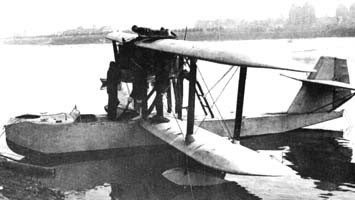
Variation: Chetverikov MR-5bis
Several well-known Soviet aviation historians in their works refer to this Grigorovich model as the MR-3. This assertion has been later spread by numerous articles, publications and internet sites, which have used these authors as a reference. On the other hand, evidence has been introduced about the MR-5, also by Grigorovich and with such a similar story, that it suggests that it was the same plane. To increase the confusion, researchers, who realized the problem, present the model as MR-3 (MR-5), without clarifying the relationship between the two.
Stranger still it seems that the builder Grigorovich named his reconnaissance model for open sea ROM-1 MR-3 and its derivative ROM-2 MR-3bis. Taking into account that both models (ROM-1 and MR-3) coincide in time, it is very unlikely that the manufacturer used the same name in very different models with the sole purpose of creating confusion in future history.
The renowned aviation researcher and writer Mijail Maslov in the series of articles “Airplanes of Dmitri Grigorovich”, published in the specialized magazine Aviation and Cosmonautics between 2012 and 2013, expresses that from his study of the primary documents of the time in none appear references to this model as MR-3 and yes as MR-5.
In this way we will use the names MR-3 and MR-3bis to refer to the ROM-1 and ROM-2 reconnaissance flying boats and the MR-5 and MR-5bis designations to refer to the single-engine reconnaissance flying boat created as a development with the metal hull of the MR-2 and the improved version made by Chetverikov in 1931.
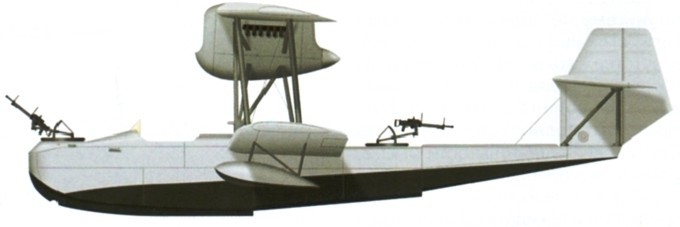
MR-5
Powerplant: 1 x 500/680 hp BMW-VI
Wingspan of upper plane: 15.6 m
Wingspan of the lower plane: 13.65 m
Length: 11.47m
Wing area: 53.0 m²
Empty weight: 2227 kg
Takeoff Weight: 3282 kg
Fuel weight: 440kg
Oil weight: 30kg
Total load capacity: 1055kg
Wing loading: 58.2 kg/m²
Power load: 6.2kg/hp
Maximum speed at sea level: 194 km/h
Cruising speed: 165km/h
Landing speed: 85km/h
Time to 1000m: 7.0min
Time to 2000m: 15min
Time to 3000m: 37min
Practical ceiling: 4000 m
Endurance: 4 hours
Range: 750km
Turning time: 29 sec
Accommodation: 2
Armament: Two 7.62mm machine gun
Bomb load: 4 x 82 kg or 8 x 48 kg
 All Aero