In November 1925, the leadership of the VVS highlighted the difficult situation of naval aviation, considering it incapable of fulfilling the tasks set due to the lack of modern seaplanes. In the speech of November 10 and in relation to Grigorovich it was written:
“Of the national builders, only the engineer Grigorovich has the experience in the construction of seaplanes, however two of his last hydro-apparatuses have been unsatisfactory, because without laboratory research at the present time it is impossible to obtain good results.”
By November 1925 and on Grigorovich’s own initiative in the GAZ No.3 in Leningrad, work began on a second example of the MRL reconnaissance flying boat. The Aviatrust management protested against the constructor’s decision, which proposed not being able to fulfil the state order and nevertheless assumed a new design of its own, but finally ended up accepting to include it in the industry plan for 1925 / 1926 under the name MRL-2 (Russian: Григорович МРЛ-2 (МР-2)).
Initially the new model was also designed using a Liberty engine but later it was decided to use a Lorraine-Dietrich engine. For this reason the name used later was MR-2 according to the acronym Morskoi Razvietchik or Naval Explorer.
About this flying boat VB Shavrov wrote:
“Externally it was more beautiful than the MRL-1. The same hull coating, but with a larger area using pine and less mahogany, which at the bottom had a single layer. The rails of the forward section were modified and the upper wing received an increase in its span. The wing bracing cables were made with 5 mm steel cables with rounded ends. The main braces had three and the rest had two cables. The overall dimensions were slightly increased in relation to the MRL-1.”
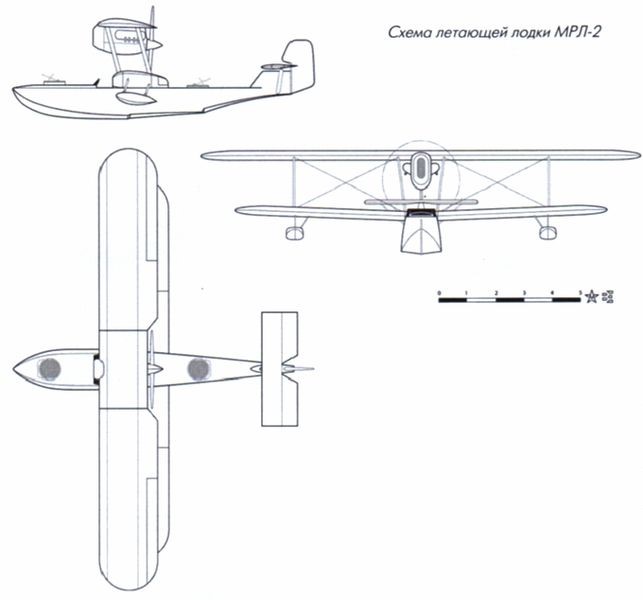
The new model was developed as a flying boat with a liquid-cooled engine and propeller propeller.
The double reed hull was made of wood and had been lightened in relation to the predecessor MRL-1, maintaining a similar structure.
The wing had a sesquiplana configuration with the lower plane slightly smaller in span and with a certain positive dihedral. The planes were secured by uprights in pairs made of steel tubes with tension cables and had a marked offset. Small stabilization floats were located on the outer sections of the lower plane wing gondolas.
The tail was of the monoplane type with the stabilizers installed on a short keel and braced by simple struts. The keel ended in a small rudder.
The 450 hp Lorraine-Dietrich engine was attached to the upper midplane structure. The fuel system consisted of two main tanks located in the hull, with a third 64-liter tank installed in the midplane.
The armament of the seaplane was located in two turrets located in the bow section and in the rear part. Under the wings, on each side, the fixing of a certain number of bombs was foreseen.
On June 18, 1926 the prototype was finished in the GAZ No.3 workshops. In September it was submitted for testing. Among its main characteristics, the cheapening and simplification of construction stood out, which should be reflected positively in the characteristics of the seaplane and in the production process.
The MRL-2 flying boat was analyzed by a commission composed of II Mashkievich and Ye. K. Stoman of the Directorate of the VVS, and DP Grigorovich and VL Korvin for Factory No.3.
This commission noted that the new model differed from the MRL-1 in the shape of its wings, the improvements made to the hull, its engine covered by a well-designed hood, and the backward displacement of the firing point.
The first flight of the MR-2 took place on September 22, 1926 and lasted 15-17 minutes. The forward position was occupied by DP Grigorovich himself, while pilot AS Melnitsky sat next to VL Korvin at the controls. That same day a second flight was made in which, together with Melnitski, the motorcyclist Funtikov and the engineer Vigand flew. The third flight was made by NOA members with pilot VN Filippov at the controls. This pilot highlighted the long run on takeoff and landing, lack of stability in horizontal flight and during glide. Melnitski had pointed out that the control and transverse stability of the MR-2 were superior to those of the MRL-1 and only the longitudinal was somewhat worse.
It was precisely the longitudinal stability that caused the accident of the pilot FS Rastyagayev that occurred on October 19, 1926. Rastyagayev was not a naval pilot and had no flying boat experience, yet he was the person commanded from Moscow to conduct the first stage of the state tests. On October 18, he made a familiarization flight together with factory pilot Zhukov in a MUR flying boat (M-5 training flying boat with a 120 hp Le Rhône engine) and later he made a solo flight. In his opinion there was nothing special about naval aircraft:
“ – No problems. No difference.”
The next day Rastyagayev took off, circled over the bay, and then glided too steeply. Subsequently, the MR-2 dived, inverted and fell onto a sandbank covered only by a meter and a half of water. The pilot was pulled from the wreckage with a number of injuries and that night he died.
The commission investigating the event, chaired by NM Tulupov, originally concluded that the accident occurred due to the pilot’s lack of familiarity with naval models. In the official minutes of the commission presented on November 27, 1926 , it was written:
“The MR-2 is unstable in the longitudinal axis. At small angles of flight it does not reach the work of the rudders. When the pilot Rastyagayev went into glide he performed a ground pilot maneuver pulling the stick sharply towards himself which caused the plane to dive. On a second attempt the rudders did not respond, going into an inverted dive.”
A more detailed study of the catastrophe was later carried out. A scale model was urgently made and tests were carried out in the wind tunnel of the TsAGI . These tests showed that the cause of the accident was the lack of longitudinal stability of the MR-2 when flying with 48% cog and having the stabilizers set at a positive angle.
The commission established that if the aerodynamic tests had been carried out earlier, this accident could have been avoided.
It is noteworthy that the history of the MR-2 is coincident with that of Polikarpov ‘s Il-400 fighter, which was also destroyed during its first flight due to poor center of gravity selection. The cause of these accidents cannot be seen only in the inability of theoretical calculations. To a large extent, the self-sufficiency of its creators, Polikarpov and Grigorovich, who underestimated the scientific possibilities of institutions such as the TsAGI, played a role, considering that his experience was more than enough to achieve successful designs. This was not an isolated case. Many Soviet constructors presented important problems in the way of carrying out their constructions without the support of aeronautical science.
In any case, after the MR-2 accident, the aerodynamic centering of models was defined as one of the main aspects in aeronautical construction and wind tunnel testing was established as an obligation in the approval process of an aeronautical project.
MR-2
Engine: 1 × Lorraine-Dietrich 12E, 340 kW (450 hp)
Wingspan: 15.6 m (51 ft 2 in)
Wing area: 56.7 m2 (610 sq ft)
Length: 13.6 m (44 ft 7 in)
Empty weight: 1,770 kg (3,902 lb)
Gross weight: 2,770 kg (6,107 lb)
Fuel weight: 560kg
Total load capacity: 1000kg
Wing loading: 49.0 kg/m2 (10.0 lb/sq ft)
Power Load: 6.2kg/hp
Maximum speed: 179 km/h (111 mph, 97 kn)
Landing speed: 82km/h
Range: 900km
Endurance: 5 hours
Service ceiling: 4,200 m (13,800 ft)
Time to 1000m: 7min
Time to 2000m: 17min
Time to 3000m: 34min
Armament: 1-2 x machine guns
Crew: 2
 All Aero