As early as 1915, a group of naval pilots had asked the Fleet for a long-range aircraft capable of carrying out long patrols, covering the entire Baltic Sea area. The start of the war increased the requests and increased when the conflicts with Turkey began.
On August 12, 1915, a meeting of the Aviation Committee of the Baltic Sea Liaison Service took place, in which once again the issue of the need for the provision of large seaplanes with a 6-hour patrol capacity was discussed. Based on these requirements, the builder DP Grigorovich proposed to build such a device.
The Marine Cruiser (Mosrkoi Kreiser or MK (Russian: Григорович МК-1 “Морской крейсер”)) was designed in 1916 to meet the requirements of the Naval General Staff (MGSh) and was conceived to serve with the Baltic and Black Sea fleets in long-range reconnaissance and bomber functions.
The MK-1 was the largest Russian seaplane ever designed and it only yielded to the Ilya Muromets bomber with floats.
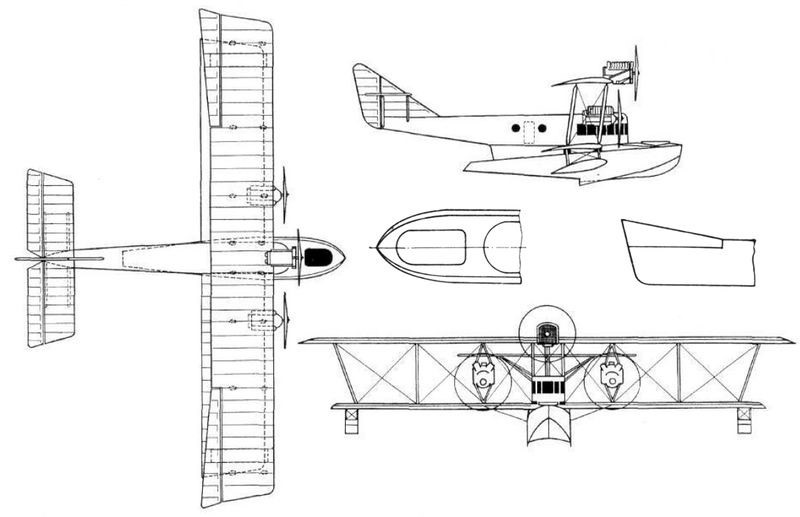
The MK-1 featured a center float, biplane configuration, three engines, and a four-crew capacity. From the technological and constructive point of view, the model maintained the characteristics of the designs developed in the Schetinin Factory.
A feature was that the float and fuselage were merged into a single structure, resulting in a general outline of combined features. This float had such dimensions that it could generally be considered a hull. In its lower region it presented a redentient with concave and lateral sides similar to those used in Grigorovich’s M flying boats. The construction of the internal structure of the float was made of ash with plywood covering.
In the forward region of the fuselage the closed cockpit was located, built with plywood and with good frontal glazing. At the rear, the fuselage appeared as a wooden frame braced by cables and covered with fabric.
The wing box was of the conventional type with three pairs of struts in each half plane and a certain offset. The upper plane was slightly larger than the lower plane and had trapezoidal-shaped ailerons. The wing structure was conventional, with two wooden spars and a rather slim profile. It should be noted that this wing box was fixed to the upper part of the float body by means of rubber shock absorbers with a travel of 180 mm.
In the tail section there was a wide triangular keel on which the horizontal planes were fixed, braced by uprights and the large-area rudder.
Originally it was thought to equip the MK-1 with only two 220 hp Renault engines located between the planes. Later, when construction began, the designers realized that the weight of the model exceeded that calculated and the center of gravity was located a little behind, so it was decided to locate on the upper plane and on the line of the longitudinal axis a third engine. A 150 hp Sunbeam motor was first tested, but was later replaced by a 140 hp Hispano-Suiza V-cylinder motor, which was found at the factory. In this way the MK-1 became the world’s first three-engined seaplane.
The cockpit of the pilots in the MK-1 was characterized by being very spacious and located high above the hull. In the bow section a gunner was located operating a 76 mm gun.
The MK-1 was completed in the middle of 1917 and only late in the fall was it ready for testing. In November the pilot Ya. I. Siedov-Sierov attempted to make the first flight in Petrograd Bay, taking several people on board. The weather was not the most propitious, the cold wind had created waves. At the beginning of the take-off and giving full throttle to the upper engine, the nose sank and the water swept over the bow, filling a large part of the first watertight compartment of the hull. The “Cruise” was stuck on its nose and ended up sinking. All the crew members were able to be evacuated.
The flying boat was pulled out of the water with significant damage. The cause of the problem was considered to lie in design problems of the bow section of the float, which needed to be lengthened. The need was also seen to eliminate the upper engine and increase the power of the two located between the wing planes. This meant a major job that was decided not to undertake, especially considering that the GASN torpedo bomber was already being built, which seemed much more perspective. Thus ended the development.
Grigorovich/Schetinin MK-1 Sea Cruiser
Power plant: 2 x 220-hp Renault & 1 x 140-hp Hispano-Suiza
Upper plane span: 30 m
Length: 16.50 m
Height: 4.50 m
Accommodation: 4
 All Aero