
Despite the poor results obtained with the M-1 flying boat, the Russian fleet command was predisposed towards an effective national flying boat model. On June 28, 1914 , the Naval General Staff (MGSh) wrote:
“The General Staff… to get out of the position, considers it very advisable to start the indigenous construction of hydroplanes and establishes the following conclusions:
1 – Because the hydroplane designed and built at the SS Schetinin and K Society is available, allowing the factory to carry out the tests at the Puerto del Emperador Alexander III aviation station, but on the condition that the pilot be from the factory. In case of success of the tests the flying boat will be acquired for the needs of the Baltic Sea aviation.
‘ In the event that the hydroplane shows good results, the Naval General Staff considers requesting several of these boats after the problems presented have been solved.”
On the other hand, with the war approaching, the Navy leadership, the 2nd rank captain BP Dudorov requested the MGSh without delay to buy from the PRTV and the RBVZ (Russian Baltic Wagon Factory) all the hydrofoils, finished or not, that could be ready in a short period of time.
These factors encouraged Schetinin to redirect the fundamental activity of PRTV towards the development of navalized models. DP Grigorovich was working on a development of the M-1 model, so on July 29, 1914 a contract would be signed for the production of four new improved examples.
The changes introduced were so significant that the resulting aircraft earned the right to be defined as a new model, which came to light as the M-2 (Morskoi (Naval) – 2), Russian: Григорович М-2.
The contract established the delivery of the first copy for the 7th, the second for the 12th, the third for the 17th and the last for August 23, 1914. Each flying boat was valued at 8,000 rubles and instructions were given to collect four Gnôme engines between 80 and 100 hp in Moscow.
The acceptance conditions established the reach of a height of 500 meters in 12 minutes with the 100 hp engine and 15 minutes with the 80 hp, carrying a load of 75 kg above the weight of the crew and the necessary fuel for three flight hours.
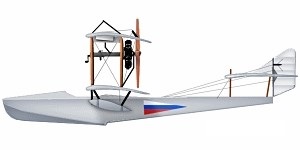
The M-2 was a propeller-driven biplane flying boat, generally similar to that of the M-1 and originally the same engine, but its overall dimensions were increased. The hull grew in width in order to accommodate both crew members side by side. The bow also changed its shape from flat to tapered with a concave bottom in the front, while a new three-sided tail section featured new, much higher mounts, to which the considerably larger area stabilizer was attached.
The wingspan of the upper wing was considerably greater than that of the lower wing, but unlike the M-1 the diagonal supports at the wingtips were not used. The biplane box maintained its location on supports above the fuselage and had only large-area ailerons on the upper plane. The lower wings were installed 1m above the hull on the engine support frame.
The triangular section rear fuselage was raised from the water, tail was equipped with a skid, often referred to as the “shovel”.
According to Shavrov the M-2 to M-4 were used to test some novelties such as the variable incidence stabilizers in flight (for this purpose they had an elevator in the lower part of the leading edge) and in the M-4 a ski – paddle with rubber buffer hinged under the tail to improve launch.
The types of wood used were generally similar to those used during the construction of the M-1.
The construction of the model in the Schetinin factory introduced a constructive novelty: for the first time in Russia, the hull was formed inverted, with the keel up. The first M-2 was delivered to the naval experimental station located in the Grebni port of Petrograd only on August 18, 1914, because before that date the hangar was not found ready for its conservation.
The tests of the prototype with the 80 hp Gnôme engine plant began in August 1914. Unfortunately, the prototype was destroyed on the 31st of that month causing the death of its pilot PV Evsyukov. It is noteworthy that VB Shavrov defines this engine as an 80 hp Clerget, which makes this statement appear in multiple articles and sites that reference this source.
The construction of the other examples was stopped until the investigations were completed. The causes of the accident were never established, but no problems related to structural weaknesses or linked to the construction of the model were found, so it was agreed to continue production.
On October 8 at the Schetinin factory, 4 Gnôme Monosoupape engines of 100 hp were received (The engine of the damaged unit was delivered to the RBVZ) and on November 28, 1914 the first of the new units with this power plant and modifications in the selection of the airfoil was received at the Third Naval Station in Revel (Tallinn). Only 12 days later a second copy would arrive. The test flights were developed until December 22 by the pilot of the factory Ya. I. Siedov-Sierov and the fleet pilot Lieutenant II Kulniev, resulting in numerous remarks and proposals for improvements.
On December 20 three FBA (Franco-British-Aviation) flying boats of the six contracted to France on September 12, 1914 arrived at the Third Station. Both because of their construction and because of their performance, they were quite superior to the M-2, which is why the representatives of the Navy took a negative position towards the Schetinin – Grigorovich model. By the end of the year none of them had been able to present themselves to the acceptance tests.
During the winter the company’s mechanic and pilot made the changes so that by the spring of 1915 flights could be resumed. At that time, a series of improved components arrived from the factory and were installed in the second prototype. General tests continued until April 1915, resulting in a climb time of 15 minutes to a height of 1,300 meters.

In general, they received a positive assessment, so on April 25, 1915 they entered service with the Baltic Fleet aviation with the registrations Sch-2 and Sch-3. These served in the Third Revel Station, basically in training missions, until they were discharged in the winter of 1915-1916 (in the month of November according to Maslov). After that date the engines were removed and for some time were kept in Revel. Due to the fact that these examples underwent changes in the wing profile and hull lines during the tests, their name was changed to M-3 (according to Maslov the name M-3 only corresponded to the second of these, since the first kept as M-2 (Sch-2)).
In the summer of 1914 in the Black Sea the situation was calm and by the month of September the Naval Aviation only had six military planes. The situation would change radically in October, when Turkey declared war on Russia. The new situation made it necessary to take urgent measures.
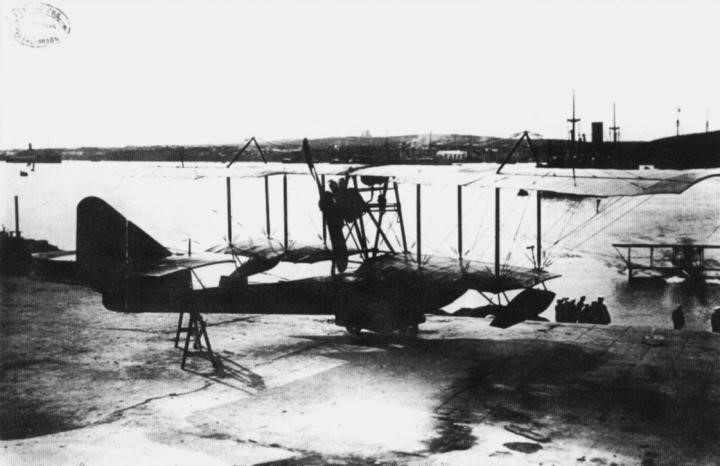
From a request of the Black Sea pilots and after several talks held by the head of the Russian aviation, Grand Prince Alexander Mikhailovich Romanov, the commander of the Baltic Fleet NO von Essen; the head of the MGSh AI Rusini and the head of the Aeronautical Department of the MGSh AA Tuchkov, the remaining two copies of the contract of four were sent to Sevastopol on March 10, 1915. This measure was aimed at strengthening the capacity of the air forces for the operations to be carried out in the Bosphorus area.
Ten days after the arrival, a PRTV brigade would arrive under engineer AN Sidielnikov and also made up of pilot Ya. I. Siedov-Sierov, two mechanics and two assemblers. On March 24 the flying boats were transferred to the assembly site and on the 31st the commission from the port of Sevastopol arrived to carry out the tests.
They had to make a flight of 25 minutes and another of 13 minutes in which they should reach the contracted height in 7.5 minutes. The planes received the numberings “29” and “30” and were to complement a varied group of seaplanes that made up the Black Sea Fleet aviation. These M-2s would later be referenced in documents as M-2/M-4 or simply M-4.

On April 8, 1915, military pilots began familiarization flights and after a series of acceptance tests, the two were accepted by the Fleet, eventually being used in military actions. On April 12, 1915, number 29, armed with a Maxim machine gun in an installation designed by Kryltsov, was lowered into the water from the cruiser “Emperor Nikolai I” in the Bosphorus region. Crewed by A. Ye. Zhukov and SN Korsakov the flying boat managed to carry out an attack on a Turkish gunboat of the type “Burak Reis”, dropping a bomb that exploded about 70 meters from the stern. This was considered the first military action of a flying boat in Russia and could have ended as a major catastrophe: a hose rupture forced the crew to make a landing a considerable distance from the base, but they managed to reach it by sailing.
Reports on the use of the Schetinin / Grigorovich flying boats in the Black Sea theater were promising, but the Aviation Committee had some doubts about the structural resistance of the model, especially since “30” began to present problems with the hull cladding slats, which came off even after normal landings. As a result, on May 15, a document was issued to the factory in which it recommended reducing the angle of attack of the stabilization floats, reinforcing their fixation and modifying the hull in order to add a rudder that would improve operation in the water. PRTV received the considerations but there was little that could be done because the production had culminated with the delivery of the four copies.
The flying boat “30” was decommissioned in October 1915. In the case of “29”, no evidence has been found to define its operating time.
The factory numbers of the delivered were 196 and 197 (the numbers of the others are unknown), The Baltic Sea Fleet of M-3s were Sch-2 and SCh-3. The Black Sea Fleet of M-4s were naval register ”29”, factory number 196, and naval register ”30”, factory number 197.
M-2 prototype
Powerplant: 1 x 80 hp Gnôme
Upper plane wingspan: 13.68 m
Wing area: 33.5 m²
Length: 8.0m
Normal takeoff weight: 870 kg
Wing loading: 26 kg/ m²
Power Load: 10.9kg/hp
Speed at sea level: 115km/h
Cruising speed: 76km/h
Ascent time to 1000 m: 7 min
Ceiling: 4000m
Practical range: 320 km
Endurance: 3.5 hours
Accommodation: 2 side by side
1913 M-3
Span: 44’10”
Length: 26’3″
Loaded Weight: 1918 lb
M-4
Powerplant: 1 x 100 hp Gnome Monosoupape
Wingspan: 13.62m
Wing area: 37.90 m²
Length: 8.00m
Normal takeoff weight: 870 kg
Wing loading: 26 kg/m²
Power load: 8.7kg/hp
Top speed: 100km/h
Cruising speed: 76km/h
Practical range: 320 km
Accommodation: 2 side by side
 All Aero