With the beginning of the First World War in Russia, the Army and the Fleet were forced to develop their own research and development units where the prototypes were designed, the production documentation was developed and the experimental units were manufactured, which would later be presented to the national industry in search of a candidate for production. With this objective, it was proposed to create in 1918 the Kherson centers for the Army and the Grebni port center for the Navy. Both institutions would be developed from state funds and rapid results were expected from them.
DP Grigorovich soon understood the situation and decided to offer his services to the Navy, proposing the creation of a specialized construction bureau and an experimental factory for the development of flying boats. The request for support from an experienced engineer was welcomed by the military and soon Grigorovich, who was already 33 years old at the time, was able to count on the necessary material resources to become independent and be able to carry out his ideas independently. SS Schetinin for his part, freed himself from the development. The Navy also gained from the real possibility of presenting real results in the short term and somehow demonstrating to the authorities that the decision to provide it with its own engineering facilities had not been simply another waste of money.
On June 1, 1917 Grigorovich ended his working relationship with SS Schetinin. Grigorovich received bank loans with low interest rates that allowed him to lease some facilities to organize an experimental factory and an empty building belonging to the Ismailovski regiment, at 12 Rota, Building 26. As an aid to be able to make the loan payment, the new facility received an order for the construction of 40 M-5 flying boats (later M-20), which was signed on July 28, 1917 with deliveries scheduled for the period between September 1, 1917 and January 1, 1918. The price of each unit was set at 16,000 rubles. In parallel Grigorovich received requests for the development of several experimental models.
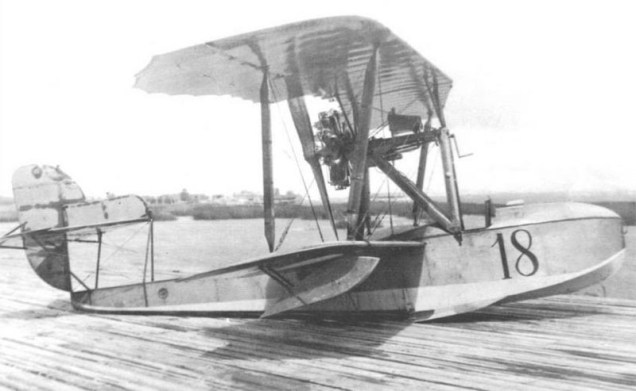
Dmitri Pavlovich designed the flying boat that received the 17th consecutive in the series of naval models (Russian: Григорович М-17), obtained as a development of the M-11 fighter with a 130 hp Clerget engine. The second prototype, slightly modified, would receive the designation M-17bis.
For different objective reasons, the two M-17 copies would only be finished in 1918. The tests of the model began on September 26, 1918 and showed the same problems of the basic model M-11 among which the negative influence of the rotary engine and poor seaworthiness stood out. Despite not successfully testing as a fighter, both the M-17 and M-17bis entered service with the Baltic Sea Fleet, where they remained for some time.
According to VB Shavrov, the M-17 was equipped with the 150 hp Hispano-Suiza engine and several copies were built that served with the Baltic Fleet and between 1921 and 1922 even in the Black Sea. In November 1917 the M-17bis with a 130 hp Clerget engine would appear.
M-17
Power plant: Clerget, 130 hp
Wingspan: 8.80m
Length: 7.60m
Empty weight: 680kg
Normal takeoff weight: 940 kg
Top speed: 155km/h
Cruising speed: 135km/h
Accommodation: 1

 All Aero