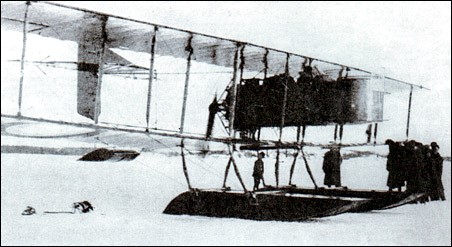
Pilot Nagurski’s flights in a Maurice Farman MF.11 model to the Arctic in 1914 showed that floats could serve not only to land on water, but also on ice and snow. With the M-11 Grigorovich had shown the possibility of installing skis on flying boats, but the performance was affected in such a way that the need soon arose to create a model capable of operating during the time when the waters froze in the north ocean seas.
Dmitri Grigorovich began work on the M-16 model between August and September 1916 (it could be a little earlier). Naval pilots needed a “winter” model, capable of operating on the frozen and snow-covered surfaces of the Baltic Sea.
With the war, the Navy was involved in multiple tasks, generally operational, so they could pay very little attention to channelling the interests. The Department of Aeronautics of the Naval General Staff (MGSh) could do little burdened with bureaucratic tasks. Under these conditions, the builders of the aeronautical factories began to define what type of naval aircraft to project, assuming that they would cover the needs of the military. The owners of these factories, on multiple occasions, worked on account and at risk. Military experience and engineering thought were divorced, but this procedure would constitute the seed for the development of an experimental aviation program.
On September 20, 1916 at a meeting attended by representatives of naval aviation, the aeronautical departments of the MGSh and GUK and representatives of factories (BP Dudorov, AA Tuchkov, IN Dmitriev, DP Grigorovich, Yu. A. Brezhniev and AN Tupolev) future requests for naval models were discussed. Those present defined the technical task for the projection of the winter model. This airplane had to have the ability to land on water, ice and snow with a landing speed of no more than 75 km/h. The maximum speed was to exceed 100 km/h.
Schetinin promised to have such a plane ready by mid-October. This model was the Grigorovich M-16 (Russian: Григорович М-16), although it is also known as Sch M-16 or Schetinin M-16, being one of the last works of Grigorovich before becoming independent to his own factory.
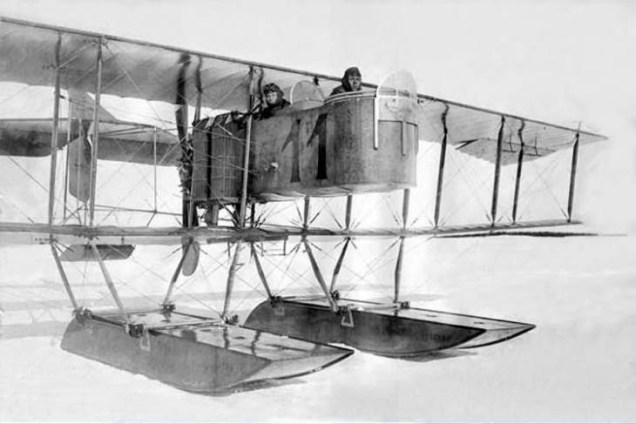
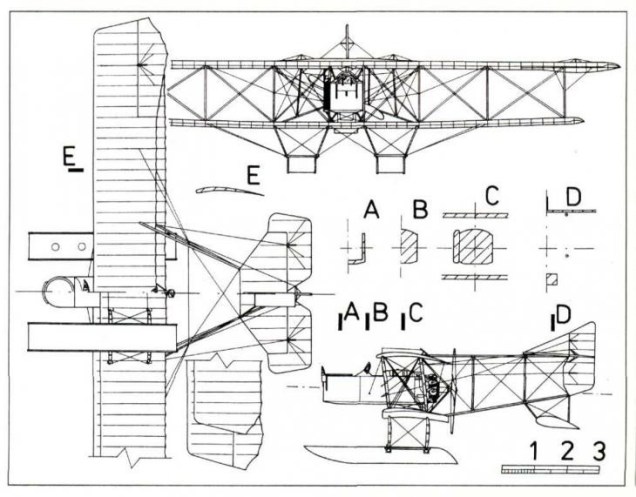
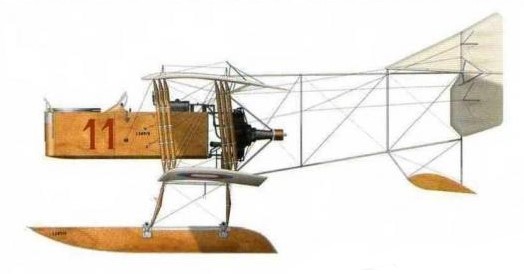
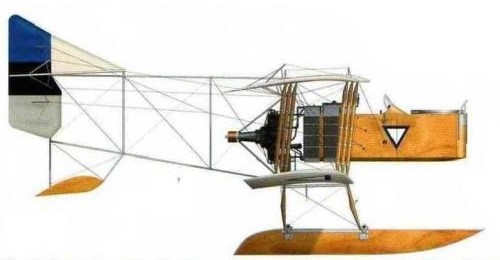
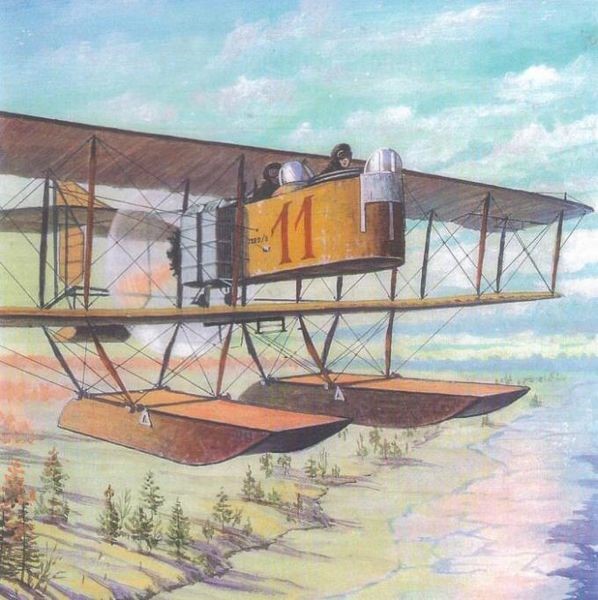
The M-16 was a single-engine biplane with a short crew gondola supported between the planes by a system of struts.
The wing, similar in construction to that of the M-9 model, was characterized by having a large area. The wing featured an unequal span and three sections supported and braced by tension cables.
Two flat-bottomed floats without grooves with a large support surface, necessary to operate on snow, were attached to the lower plane. Each float weighed about 77 kg, to which must be added a third very wide unit located under the tail region and weighing 8 kg.
The tail unit featured a single yoke and rudder assembly; Although similar in general configuration to that of the M-15 flying boat, the new aircraft’s rudder extended behind the horizontal planes, and the stabilizers were supported by four spars from the wings.
The central gondola, Farman type, accommodated the crew located in tandem, the instrumentation, the machine gun and the fuel. Aft of the gondola was a 150 hp Salmson liquid-cooled radial engine driving a two-blade propeller, with radiators located on the sides of the gondola.
Defensive armament consisted of a Lewis, Maxim, or Vickers machine gun located forward on a movable mount and operated by the spotter. The M-16 could carry up to 100 kg of small bombs.
On November 6, a naval commission participated in the factory tests of the M-15 and M-16 prototypes (with factory number 1080). The M-16 with a payload of 350 kg was capable of reaching 500 meters in 6.5 minutes, which was considered enough for a firm request for the construction of 40 examples to be made a couple of weeks later.
At the beginning of December, the first M-16 (it could be the prototype) was delivered to the Third Naval Station in Revel and received the registration ZS-1. On the 13th, piloted by Prokofiev-Severski, he managed to survive an accident about which the captain of the first rank BP Dudorov has left us evidence in a communication issued to the MGSh:
“Today during a race on the water after ditching, the M-16 winter aircraft broke the gondola stringers at the engine mounting site, which ended up falling off. Fortunately, everything ended without consequences. I request to stop all construction work on the “winter” apparatus and urgently send engineer Grigorovich to Revel to investigate the causes of this accident.”
Only two days later, Dudorov would recall his request again, since the situation had become extremely complicated due to the impossibility of flying the flying boats due to the winter frost.
On December 16 and with the presence of Grigorovich, the commission of naval aviators reviewed the plane and came to the conclusion that it would be necessary to raise the engine installation by lengthening the float supports and reinforcing the rear amortization system. of both units. It was also proposed to reinforce the entire engine installation system. For this, the rear supports had to be reinforced, adding new steel parts.
Everything seems to indicate that these recommendations were heeded and brought positive results, since in subsequent tests there were no problems with fixing the motors.
Another interesting detail is that on December 30 Military pilot Captain Grigorov, who at that time was studying at the Nikolayevsk Military-Aeronautical Academy, proposed to the Navy to test a self-designed fuel tank protection system on the M-16. Shortly before the war this officer had designed a protection system by coating the tanks with a layer of rubber that was considered cheap and effective and the M-16 greatly needed this system because the fuel tank was located in the nacelle, in front of the engine, so that in the event of a small fuel leak, the proximity to the hot engine could turn into a fire. It is not clear if this system was actually used on the plane, but there is evidence that protections of this type were prepared in the Russian-American Society “Triugolnik” based in Petrograd.
Based on the results of the first month of operation of the M-16, in January 1917 a list of requests for improvements in the construction of the model was delivered to the factory. In addition to the increase in the rear of the floats, the military requested to locate a transparent hatch in the floor of the gondola and the installation of steps that would allow the crew to occupy their positions, to locate a windshield in front of the pilot and to install on the left side a bombardment collimator designed by Senior Lieutenant SA Lishin. It was also requested to move the compass position and install an artificial horizon, as well as the installation of removable supports for bombs to be placed under the gondola and the wings.
The pilots highlighted a strange behaviour of the model from the elevators. When pulling the stick rearward, the plane initially did not react, but when the stick reached a certain position the plane “jumped” upwards. The same thing happened during the descent. It was pointed out that with a full tank and without a passenger, the model behaved quite well, but when the tank emptied a little or was carrying the weight of another person, there was a tendency for the plane to lower its nose, forcing the pilot to maintain constant pressure on the nose.
The initial production contract included a request for 40 complete examples, 10 without motors to be used as spare parts and an unspecified number of float sets. Production started from the end of 1916. In general, the Schetinin factory produced 36-40 examples.
Contract date: November 24, 1916
Number of copies: 40+10 spare without motor
Serial numbers: 1201-1232, 1242-1245
18,000 rubles per unit with a 150-hp Salmson engine and 17,700 for spare ones. 3150 rubles for each additional set of floats. Expected deliveries from December 10, 1916 to February 1, 1917.
Contract date: January 30, 1917
Number of copies: 1
Serial numbers: 1080
Contract for the purchase of the prototype
Between November 6, 1916 and July 1917 the Baltic Sea Fleet received at least 36 examples of the M-16. These planes were used primarily as scouts and patrol planes. The model became known to the military as ZS (Zimni s Salmsonom or Invernal con Salmson) and military registrations featured these letters and a consecutive number (ZS-1, ZS-2, etc).
At least one example was severely damaged during a fire on the night of January 6-7, 1917, and another was totally destroyed. The numbers of these were 1205 and 1206. By mid-1917, according to reports in the Baltic Sea Fleet, 15 were registered.
The Black Sea aviation did not need the “winter” models due to the climatic conditions in the area of operations.
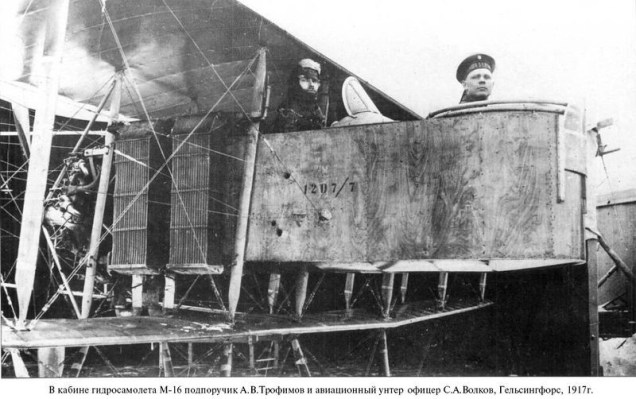
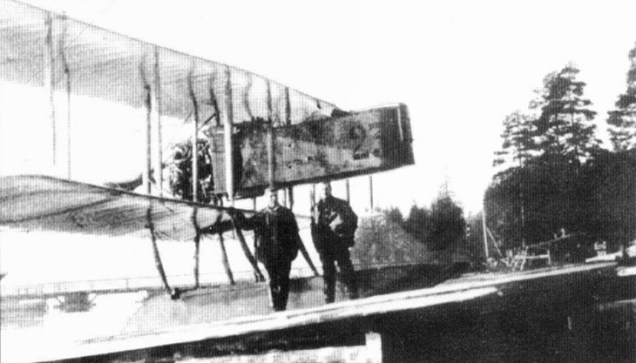
Six M-16s fell into Finnish hands during the Russian Civil War. After the abandonment of Revel by the Russian troops, six M-16 in perfect condition went to Finland, where they were exploited for several years until being decommissioned around 1923.
The first Finnish parachute jump was done on June 17, 1922 from a M-16 by a parachuter named E. Erho. The aircraft were flown until 1923.
By May the Baltic winter campaign was over. The mechanics replaced the alcoholic coolant in the engines with a normal type and on the 22nd of that month, officer G. Ya, Erdeli received the order to prepare six M-16 units with wheels, but there is no evidence that this was done, nor does any evidence support VB Shavrov ‘s assertion that during winter operations some M-16s replaced their floats with skis.

In the summer of 1917 the head of the 6th Baltic Sea Air Division, Lieutenant AI Makarevich, modified one of the M-16s in order to improve its performance. The changes were made at the base of the division’s 2nd Brigade based at Abo and as a result the officer hoped to achieve a normal wheelset. Unfortunately this officer would never get to see his finished design. The winds of revolution reached Abo, discipline cracked and Makarevich’s authority degraded to such an extent that the Naval Aviation Command decided to reform the unit. The order came on July 18, but its execution was delayed and by the 30th the sailors, gathered between the hangars, assassinated Makarevich.
By mid-November, however, it was finished in the local workshops and prepared for testing. Apparently, the results were positive, since by the beginning of December at least three M-16 copies had been modified. Foreign intervention and the Civil War that followed erased practically all the evidence and for this reason no data on this project was preserved. Presumably without the heavy floats and their bracing structure the modified M-16 performed better.
With the arrival of the winter of 1917-1918 military activity in the Baltic area practically disappeared, the M-16 was used mainly in reconnaissance and liaison missions. For the summer campaign the model was totally obsolete, being able to be used only as a bomber.
Operators:
Estonian Air Force
Finnish Air Force
Imperial Russian Navy
Soviet Naval Aviation
Specifications:
M-16
Engine: 1 × Salmson, 150 hp
Wingspan: 18.0 m
Wing area: 61.8 sq.m
Length: 8.60 m
Empty weight: 1,100 kg
Max. takeoff weight: 1,450 kg
Full load capacity: 350kg
Fuel and oil capacity: 185 kg
Wing loading: 23.5 kg/ m²
Power Load: 9.7kg/hp
Maximum speed: 130 km/h
Speed at sea level: 110km/h
Cruising speed: 92km/h
Service ceiling: 3,500 m
Time to1000m: 15min
Time to2000m: 40min
Endurance: 4 hr
Crew: 2
Armament: 1x MG
Bombload: 100 kg
 All Aero