A proposal arose to use new-type cannons in airplanes, in which the recoil was compensated by the reactive force of the gases expelled during firing, for which they were known as dynamoreactive cannons (DRP). These guns were lighter than normal guns of a similar caliber.
Grigorovich IP-1 / DG-52 Article
The development theory of dynamoreactive guns was developed in the late 1920s by professor and later academician BS Stiechkin. The engineer LV Kurchevski was in charge of materializing these ideas. The guns designed by him were named APK after Avtomaticheskaya Puchka Kurchevskovo or Kurchevski Automated Guns and would be used for the first time in the IZ fighter developed by Grigorovich.
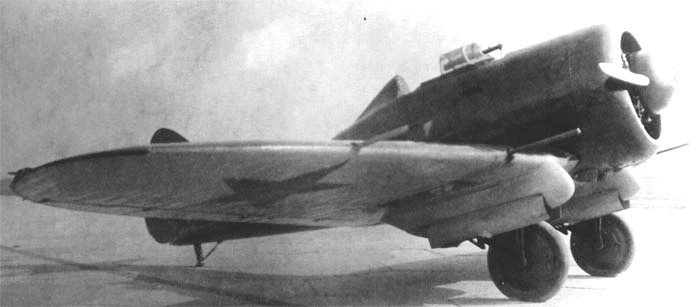
In 1934 D. P. Grigorovich prepared a new fighter armed with APK cannons, which received the factory name DG-52 and was known by the military as IP-1 (acronym for Istrebitiel Puchechni – Gunfighter) (Russian: Григорович ИП-1 (ДГ-52)).
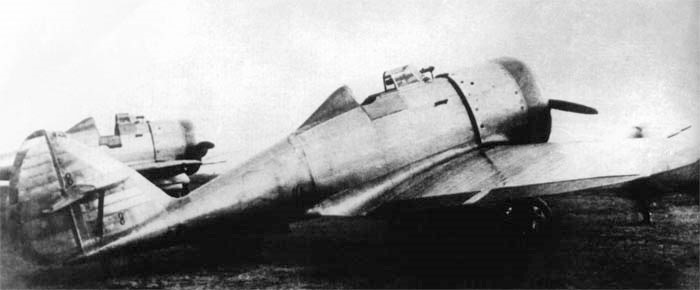
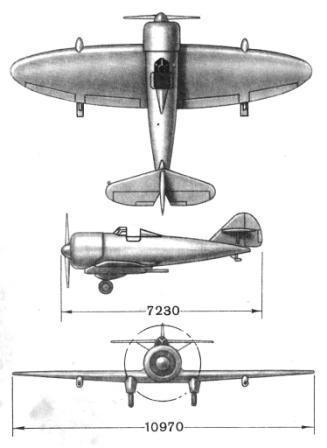
Structurally, the IP-1 was designed as a low-wing cantilever monoplane with all-metal construction. The fuselage terminated in a large-area empennage with the planes set high and braced by struts. The fuselage skin was made with sheets of 1.0 – 1.5 mm. The central wing occupied 55% of the entire span to locate the cannons outside the propeller arc.
The elliptical-shaped wing was designed to achieve the lowest inductive resistance. The wing construction was made up of tubular chrome-molybdenum steel stringers with skeletal ribs made up of rolled profiles with stringers supporting the coating. This wing would later be known as the “Grigorovich Stringless Wing”. The wing covering, with sheets of 0.6 – 0.8 mm, was fixed to the edges of the stringers by means of additional profiles and to the edges of the ribs. The ailerons and landing flaps were designed as shutter type.
The tail was totally metal, but in the production copies the rudders were covered with fabric.

Originally a retractable type landing gear was selected with the ability to carry wheels in the summer and skis for the winter. The undercarriage retracted backwards, leaving the skis inserted in fairings in the wing. This solution, used for the first time in the USSR, reduced aerodynamic resistance to such an extent that the model could maintain performance throughout the year. The landing gear had oleo-pneumatic suspendion and the retraction system had a hydraulic drive. The prototype’s tail skid lacked retraction, but on production examples it would be replaced by a fixed wheel.
The power plant selected was the 640 hp Wright Cyclone SGR-1820 F-3 covered by a long NACA hood. The propeller had metal construction and ground adjustable pitch.
The pilot was accommodated in an open cockpit with a faired headrest in the fuselage.
The armament was similar to that of the IZ fighter, with two APK-4 dynamoreactive recoilless cannons under the wings capable of firing 5 rounds, but instead of the PV-1 machine gun a more effective ShKAS were installed. These machine guns were to serve as aiming rifles for the main recoilless guns.

The state tests of the IP-1 fighter were developed between January and March 1935. The fighter was characterized by high speed and good manoeuvrability, with a turn time of 14-15 seconds. The climb was poor due to the great weight of the cannons.
The military gave an excellent evaluation of the model, highlighting the high speed, the good manoeuvrability and stability in flight, the simplicity of piloting, and the good visibility from the cabin. The great stability of the dive was also highlighted.
The tests showed that the fighter had reservations and problems appeared. Among them, the weakness of the engine hood, the overheating of the oil, difficulties with the control of the plane at the time of departure or retraction of the landing gear, the inconvenience of using the machine gun and the lack of rigidity in the fixing of the APK cannons, among others.
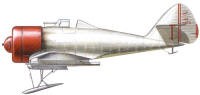
After the tests carried out between August and September 1935, other defects appeared, such as weakness in the fuselage coating and low effectiveness of the ailerons. It is noteworthy that none of these problems was serious and all could be solved with a certain amount of work, so they did not overshadow the potential of the model. The design collective kept improving the IP-1 until 1936.
The head of the VVS Ya. I. Alksnis demanded that the RKKA VVS Directorate submit its requests to increase the request for IP-1 fighters at the cost of reducing the requests for other fighters.
The IP-1 went into production at Kharkiv Aviation Factory No. 135, where a metal aircraft was being built for the first time. In parallel, modifications and improvements began, which were introduced directly into the production process. Early examples were armed with two APK-4s and two ShKAS machine guns.
At that time the VVS’s perception of dynamoreactive guns had changed. The results of Kurchevski ‘s APK guns were not what was expected and, on the other hand, conventional guns had already appeared, of smaller caliber, but with greater speed. The Directorate of Special Works (USR), led by LV Kurchevski, was dissolved in February 1936 and this builder would soon be a victim of the repressive wave of those years.
Already in the summer of 1935 Grigorovich had received a request to develop a modification of the IP-1 with 20-mm cannon and machine guns. In January 1937 the first example with this configuration, with factory number 034, was ready and successfully passed the factory tests. Production examples were fitted with two 20mm ShVAK cannons installed in the midplane and the machine gun armament was increased to six 7.62mm ShKAS machine guns (two under each wing console and one in the midplane). The Shvetsov M-25, a license-produced version of the Wright Cyclone F-3, was selected as the powerplant.
Between 1936 and 1937, up to the time production closed at Factory No.135, some 90 IP-1s were built.
These changes brought about a backward movement of the centre of gravity. During the spin tests, carried out at the NII VVS by PM Stefanovski, it was found that the model had problems.
Already at the stage of state tests in 1935, on one of the flights, the plane entered a flat spin from which it was difficult to get out, losing about 800 meters in height in the attempt. At that time it was considered a casual situation, but now, with the changes, the defect was showing up again.
Flight tests were planned to study the phenomenon. During the flight the test pilot AI Nikashin tried all possible manoeuvres, but it was impossible for him to get the IP-1 out of the flat spin and at the last moment he abandoned it by parachuting.
It was decided to begin a research process to improve the aircraft’s behavior in a spin. TsAGI participated in this process. The specialists of this institution came to propose a special parachute located in the tail section to facilitate the exit of the spin, but this solution was finally discarded. Professor AN Zhuravchenko proposed to install a long fin from the headrest to the vertical keel, which should improve directional stability. With these changes the plane was able to get out of any type of spin without difficulty.

A large part of the 90 examples produced ended up being delivered to the 43rd Aviation Brigade. RKKA VVSs used the IP-1 until 1939, when it began to be replaced by the Polikarpov I-16. From there the traces of the IP-1 disappear. The final destination of the withdrawn examples is unknown.
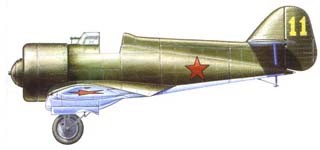
In November 1939 at the NII VVS the flight tests of the IP-1Sh model with a Shvetsov M-25 engine and modified by the institute’s specialists as an armoured attack aircraft were carried out. The modifications were made on a serial IP-1 model produced by the Kharkiv Factory No.135 in 1935.
The model featured armament similar to that of later versions of the fighter, consisting of two 20mm ShVAK cannons located in the midplane and six 7.62mm ShKAS machine guns. The “P” type armor consisted of 6 – 6.5 mm cement plates capable of withstanding impacts from 7.62 mm bullets from distances of 125 m and at angles of up to 35 degrees. This armour covered the vital points of the construction. The fuel tanks were protected by two armour plates weighing 72.8 kg.
The pilot was defended from shots from behind by an 18.5 kg armour plate and on the sides by two 12.6 kg vertical side plates. Frontal impacts were to be covered by the engine. In total all the armour added a weight of 125 kg.
The takeoff weight of this version reached 1,940 kg, so the maximum speed decreased to only 320 km/h at sea level and 343 km/h at 2,000 meters.
In the report of the conclusions of the tests, it was reflected that due to the poor flight performance, the construction difficulties and the appearance of associated difficulties (vibrations in flight and new problems with spin entry), the model lacked prospects for growth.
In order to study the effectiveness of this armour, it was decided to transfer the model to the NII-48 to study the resistance to the impact of different types of weapons.
The tactical specialists of the VVS planned to use the IP-1Sh fighters in chains or brigades, attacking the enemy in dive encounter contacts from distances of 1000 – 1500 from the target.
It was considered that the fighter would be basically intended for attacking ground targets located in a radius of action of 200-350 km or as part of Vaxmistrov ‘s Zvenó combined structures, in order to increase the range of actions.
The IP-1 was Grigorovich ‘s last aircraft to be mass-produced. In 1927 he became seriously ill and the following year died.
IP-1
Powerplant: 1 × 710 hp Shvietsov М-25
Wingspan: 10.97m
Wing area: 19.98 m²
Length: 7.23m
Empty weight: 1200kg
Normal takeoff weight: 1880 kg
Maximum speed at sea level: 343 km/h
Maximum speed at 3000 m: 410 km/h
Cruising speed: 298km/h
Practical range: 1000 km
Maximum ascent speed: 574 m/min
Practical ceiling: 7700 m
Climb to 1000 m: 1 min 19 s
Armament: Two dynamoreactive 76.2 mm Kurchevski APK-4 cannon – 10-14 shells / one 7.62 mm ShKAS machine gun.
Accommodation: 1
 All Aero