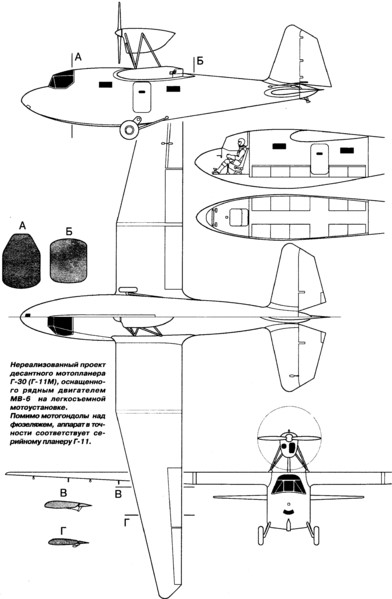
In 1942 Gribovski began development of a motorized version of the G-29 glider with a 100 hp M-11 engine. Two possible variants of the powerplant installation were analyzed: on the nose of the glider or on a pylon on the centroplane. After analyzing the advantages and disadvantages, the second option was finally decided, considering that it could be executed with minimal changes in the production chain.
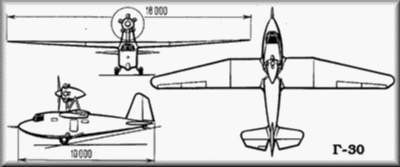
The moto-glider was named G-11M (G-30 in consecutive Gribovski models) Russian: Грибовский Г-11M (Г-30).
One example was modified in the summer of 1942 at Factory No.471, but it is not clear whether it was ever tested. Maslov states that it was successfully tested in 1942, but other sources such as Shavrov state that it was never tested without explaining reasons. In any case, the need to increase motive power was valued, so the wing installation of two M-11 or MV-6 engines was recommended. In this way the G-30 became a transport airplane.
The decision to produce the model was affected by the cancellation of serial production of the G-11 glider in 1942 itself. On the other hand, the need for a small twin-engine transport aircraft had already been covered by the Scherbakov Sche-2. The VVS did not approve production, so development was abandoned. Other competitors such as the Polikarpov MP or the Moscaliov SAM-22 would have the same fate.
G-30 (G-11M)
Engine: M-11 100 hp
Wingspan: 18.0 m
Wing area: 30.0 m²
Length: 9.71 m
Empty weight: 1500 kg
Loaded weight: 2400 kg
Fuel + oil load: 70 kg
Payload: 830 kg
Wing loading: 80 kg / m²
Power load: 24kg / hp
Surface of the horizontal planes: 5.64 m²
Vertical plane surface: 2.7 m²
Spoiler area: 3.1 m²
 All Aero