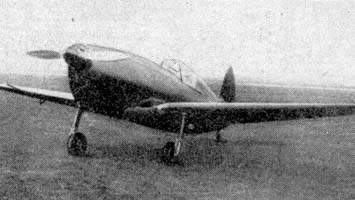
Initially, in December 1939, a new Construction Bureau was created as a subsidiary of Factory No.301. This new organization was based on a garage under construction belonging to the “Mosvoyentorg” located in the Pavshino village, belonging to the Moscow suburbs.
In this period under the direction of Gribovski, several conceptual projects of training aircraft would be developed, among which a fighter trainer called G-28 and nicknamed “Krechet” (Gyrfalcon) (Russian: Грибовский Г-27 Кречет) stood out.
In order to ensure its development, the order was issued on March 10, 1940 to create the Experimental Construction Bureau No.28 (OKB-28), subordinate to the NKAP structure and under the leadership of VK Gribovski. At the VVS controls the plane would be registered as TI-28, an acronym for Trenerovochni Istrebitiel or Fighter Trainer.
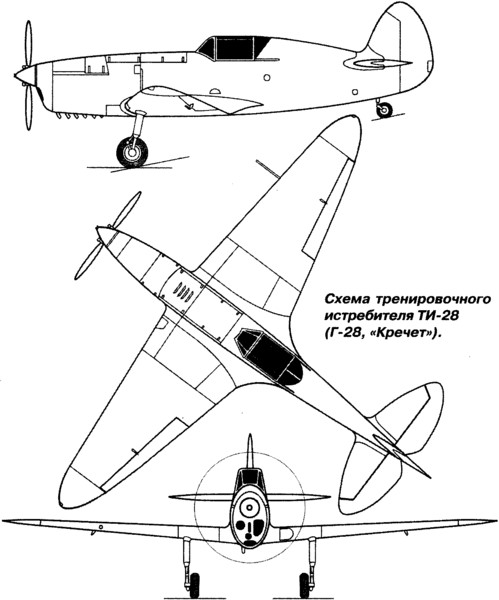
The G-28 was designed as a low-wing cantilever aircraft with a trapezoidal shape in the plane and rounded ends. The construction was developed mostly with wood. The entire structure of the wings and the fuselage was built with this material. Only the stabilizers and flight control surfaces featured a fabric-covered duralumin frame.
The wings featured a double-spar structure with an RAF-34 airfoil. Aerodynamically balanced spoilers were located on the trailing edge.
The fuselage featured a semi-monocoque structure with plywood skins and ended in a conventional-type tail unit. The empennage was built as an integral part of the structure of the fuselage tail section. The elevators and rudders had weight balance and aerodynamic compensation.
In order to simplify the construction of the model it was decided to use a fixed landing gear of conventional type. The main landing gear was attached directly to the forward wing spar and the tailwheel was located at the rear of the fuselage.
In the nose there was an inverted six-cylinder in-line MV-6 engine (a copy of the French Renault Bengali 6 engine manufactured in the USSR under license) of 220 hp. The propeller had two blades and constant pitch. The tunnel-type radiator was located at the bottom of the engine.
The pilot’s cabin was enclosed and rearward in the fuselage. The transparent top cover featured rear opening. As a fighter trainer, the TI-28’s instrument panel featured a fairly complete set of equipment, allowing it to perform day and night flights.
For training in the use of weapons, the TI-28 received a 7.62 mm ShKAS synchronized machine gun with 400 rounds, a photo machine gun and a PAK-1 type collimator. Under the wings were located some supports capable of carrying bombs of 10, 25 and 40 kg.
The TI-28 trainer was built in the spring of 1940. The first flight took place on May 22 of that year with the pilot of LII V. Gravrílov.
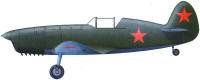
In less than a month the TI-28 passed the entire test flight program. In addition to Gavrilov, the TI-28 was air-tested by well-known Soviet NII VVS test pilots such as MM Gromov, AB Yumashiev, and PM Stefanovski, who gave the aircraft an excellent rating. Unfortunately, the beginning of the Great Patriotic War prevented the completion of the tests in Moscow, so in 1941, when the NII VVS was evacuated, the TI-28 prototype flew to Sverdlovsk. Its fate thereafter is unknown.
In order to improve the aircraft’s characteristics, the military recommended replacing the power plant with the improved 240 hp MV-6A and repeating the tests. It was felt that the landing run of 280 meters could be shortened and by installing a slightly more powerful engine some gain in speed could be obtained.
The construction of a second example had begun. During the evacuation, Gribovski decided to keep it, with the aim of continuing its development when the situation allowed. These ideas also did not happen. With the beginning of the war the needs for fighter training aircraft would be covered from the conversion to two-seaters of single-seater models in production.
Г-28
Powerplant: 1 x 220 hp MV-6
Wingspan: 9.00m
Wing area: 11.60 m²
Length: 7.66m
Height: 2.80m
Empty weight: 897 kg
Normal takeoff weight: 1157 kg
Wing loading: 100kg/m²
Power load: 4.8kg/hp
Fuel + oil capacity: 122+15kg
Maximum speed at sea level: 275 km/h
Top speed at 1600m: 303km/h
Cruising speed: 226km/h
Landing speed: 90.5km/h
Practical range: 500 km
Practical ceiling: 6600 m
Take-off run: 280m
Armament: One 7.62mm ShKAS synchronized machine gun, one photo-machine gun
Bombload: 40kg
Accommodation: 1
 All Aero