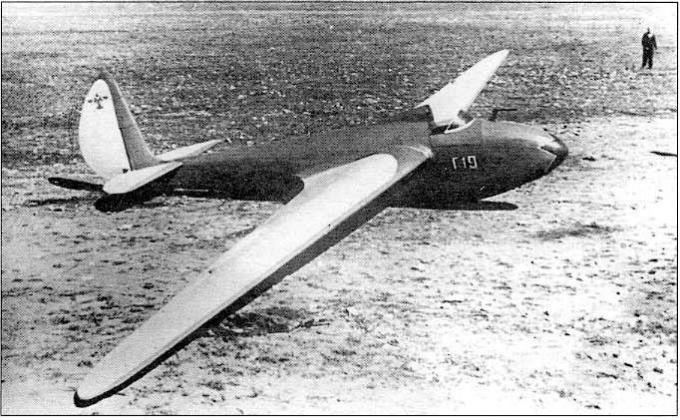
The G-19 (Russian: Грибовский Г-19) glider was designed as a development of the record – breaking G-17 single – seater and was generally similar to it. It would be the last glider designed by Gribovski, who would from there on design and construct light aircraft.
The Gribovski G-19 was designed as a single-seat cantilever mid-wing glider, specially prepared for aero-tow.
The double spar wing, presented in the front part of the wing was covered with 1 mm plywood sheets, up to the position of the second spar. The rest of the wing and ailerons were covered with fabric. The wing design used the TsAGI R-II profile proposed by the engineer PP Krasilschikov. Unlike the previous G-17, in addition to the louvered ailerons, it featured flaps to improve operations during landing. As with the G-18, great attention was paid to improving the attachment of the wings to the fuselage.
The trimmed tail unit featured cantilever planes and monoplane configuration. The leading edge of the empennage and horizontal planes also featured plywood overlay. The rudders were covered in fabric.
The fuselage featured a monocoque structure with a plywood coating. At its bottom there was a landing gear in the form of a ski with suspension.
The pilot was located in an open cockpit located in front of the wing leading edge, protected by a windshield. At the rear of the cockpit, the fuselage deepened to form a headrest.
The G-19 glider was designed and built by the Moscow Building Bureau (MKB) of OSOVIAJIM in 1935. This glider entered the XI National Gliding Competitions.
G-19
Wingspan: 16.00 m
Wing area: 14.40 m²
Length: 6.15 m
Height: 1.70 m
Empty weight: 142 kg
Wing loading: 15.4 kg / m²
Surface of the horizontal planes: 1.60 m²
Empennage surface: 0.85 m²
Ailerons surface: 1.50 m²
Glide ratio: 24.3
Accommodation: 1
 All Aero