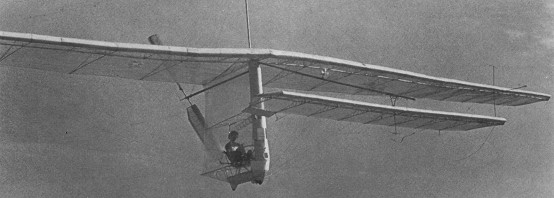
After the Condor, a new design went together at Shafter, a new base in Central Valley. It was called number two because it represented a major change in some ways. Paul MacCready kept the basic wire-braced tube-structure concept, but aspect ratio was increased from 8.3 to 12.8 and the wing loading raised from 0.22 to 0.26 lbs/sq.ft. A thick, double-surface airfoil was computer-designed and only a single tube along the centre of pressure was used for the spar. By eliminating the rear spar, enough weight was saved to permit use of more closely-spaced ribs and a cardboard leading edge. The pilot’s seat and chain-wheels were enclosed by a streamlined plastic envelope.
The result was that Greg Miller and Tyler MacCready almost immediately doubled their duration times. But making a turn and control of the new machine in bank had yet to be accomplished. Beyond a quarter turn the drag was too high creating reversal at low speeds.
Opposite-action wing warp was one of the final keys to success. The drag of the inner wing (due to its increased angle of attack) swings that wing back, but also adds just enough lift to keep it from dropping. The result – a perfect turn. The pilot just clicks a lever into the notch and the wings are held in a twist for a turn with no other action necessary until the ship is straightened. Then he lifts the lever into neutral and goes his way. The Condor can turn about in only 180 feet. The wings were slightly swept back to aid stability, and the foreplane could be banked and its angle of incidence in¬creased to start a turn, with the innermost wing warped to provide additional lift and thus balance the turn and prevent that damaging slip into the ground which had wrecked previous man powered aircraft.
By the summer of 1977 the Gossamer Condor had made more than 430 flights and had accumulated more time in the air than all previous man powered aircraft com¬bined.
On 23rd August 1977, for the 223rd flight, in ideal conditions with a windspeed of less than 2 knots, Bryan Allen made a 30ft take-off run toward the north pylon on Shafter Airport runway. After a 500ft cruise Bryan cleared the Tee bar on the start line and observer Bill Richardson clicked his stopwatch. Bryan was soon into the first, right turn after 250 more feet and he made a 425ft diameter 180 degree sweep around the marker to head for the south pylon, 2,640ft away. It was a smooth cruise of almost three minutes, then another sweeping left turn to re-trace his course back northwards. As he neared the original take-off point, eager followers yelled encouragement and with one last effort Bryan took the Condor over the Tee bar to finish at precisely 6:22.5. He had traced an almost perfect figure eight, the flightpaths 9ft 7in. apart on the start/finish line and met all the conditions of the famous contest.
On 31st December 1977, Gossamer Condor was aired for the last time before moving across the USA to be hung in the Smithsonian Institute at Washington DC. Rough weather over Christmas almost prevented this ‘last fling’ but fate decreed a dead calm end to the momentous year.
Less than a month after the Gossamer Condor’s record-setting flight, the manpowered airplane was flown by Maude Oldershaw whose husband was the Condor’s mechanic.
The Gossamer Condor, winner of the Kremer Prize for man-powered flight, in 1978 was being moved to the National Air and Space Museum, in Washington, D.C.
Aspect ratio 12.8.
Height 18 ft.
Length 30 ft.
Span: 96 ft.
Wing area: 760 sq.ft.
Canard area: 93 sq.ft.
 All Aero