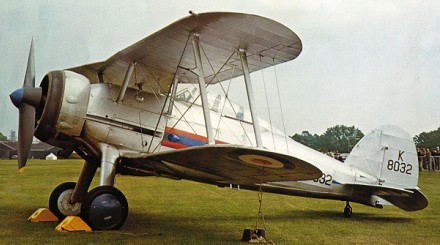
An improved version of the high-performance Gauntlet, in the Gloster SS.37Gladiator H. P. Folland endeavoured to satisfy the requirement of the Air Ministry’s F.7/30 specification which the Gauntlet had failed to meet. However the Gauntlet’s maximum speed was some 32km/h below the F.7/30 requirement, which also called for an offensive armament of four machine-guns.
The Gauntlet represented a close approach to the requirement and Folland decided that aerodynamic improvements of the basic Gauntlet fuselage (together with installation of a more powerful engine) should prove adequate for the Gloster design to be ordered into production. It had been intimated by the Air Ministry that submissions for the F.7/30 requirement which were powered by the new Rolls-Royce Goshawk evaporative-cooled engine would receive favourable consideration. This meant that of the seven other contenders for this contract, five were designed to utilise the Goshawk. When this engine failed, it eliminated most of Gloster’s competitors. Folland pinned his hopes on the Bristol Mercury ME.30 radial which was then promising a power output of some 521.6kW. But it was not available when the prototype SS.37 was nearing completion and the first flight, on 12 September 1934, was made with an 840 hp / 395kW Mercury IV. The prototype Gladiator had an open cockpit, no gyro instruments and only 645 hp; the production airplane had a greenhouse that you closed by winding it forward by means of a bicycle chain and sprocket arrangement.
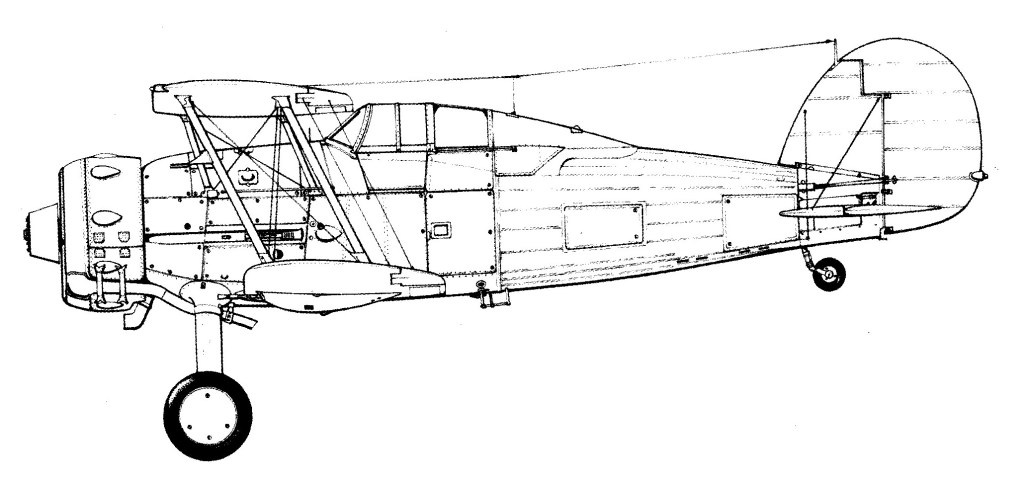
Features included each of the four planes having small hydraulically depressed drag flaps and cantilever landing gear with Dowty internally sprung wheels. Most early production had the Watts wooden propeller, though performance was better with the three-blade metal Fairey-Reed type.
On 1 July 1935 the Air Ministry ordered 23 aircraft in July 1935, as Gladiators, one going to Greece. These were powered by the 618.5kW Bristol Mercury IX. Other improvements included an enclosed cockpit with a sliding canopy and a redesigned tail unit.
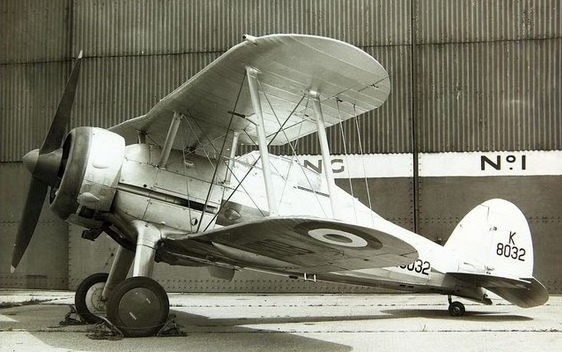
It introduced refinements such as wing flaps and cantilever undercarriage which enabled it to combine a top speed of 253 mph but the maximum speed, between 174 and 217 knots, was slower than those of the newest bombers. The armament was four .303 Browning machine guns (two, engine synchro¬nized, in cutaways in the fuselage sides, and two in blisters under the lower wings) was inadequate. Metal structure, fab¬ric covered, no armor plate, no self-¬seal around the fuel tanks and no proper fire wall behind the engine.
It first entered service with Nos. 3 and 72 Squadrons in January 1937 as a replacement for the Bulldog.
The early Gladiator I were followed by an improved Gladiator II in 1938 powered by the Bristol Mercury VIIIA engine. Other improvements comprised the addition of a battery and electric starter and the inclusion of a full blind-flying instrument panel.
Production also included 60 Sea Gladiators for the FAA. Generally similar to the Gladiator II, they differed by being equipped for catapult launch and deck landing – although not intended for operational use from carriers – and carried an inflatable dinghy in a fairing beneath the lower wing centre-section.
When World War II began, in 1939, the RAF still had 13 Gladiator squad¬rons; one home squadron was still fly¬ing them when the Battle of Britain started in 1940. Production of the type finished that year, but two squadrons went to France with the Advanced Air Striking Force in 1939.
In just ten days of hard fighting, following the opening of the German assault on 10 May 1940, all the aircraft had been lost. In a desperate attempt to provide fighter cover for the ‘little ships’ involved in the Dunkirk evacuation a detachment of home based aircraft, known as ‘G’ Flight, was formed at RAF Manston in late May.
One squadron (No. 247) served during the Battle of Britain. In Norway during April, May and June the Gladiator, flown by Pilots of No. 263 Squadron from a frozen lake, offered opposition to the Luftwaffe forces supporting the German invasion of that country, fighting on until all its aircraft had been destroyed in the air or on the ground.
Only two home based units used the Gladiator operationally during the Battle of Britain; No.247 Squadron at RAF Exeter and RAF Roborough and No.804 Squadron, Fleet Air Arm at stations in Scotland.
A flight of four Sea Gladiators, flown by RAF pilots, defended Malta with such success that the Maltese named three of them Faith, Hope and Charity and, after the war, preserved one as a reminder.
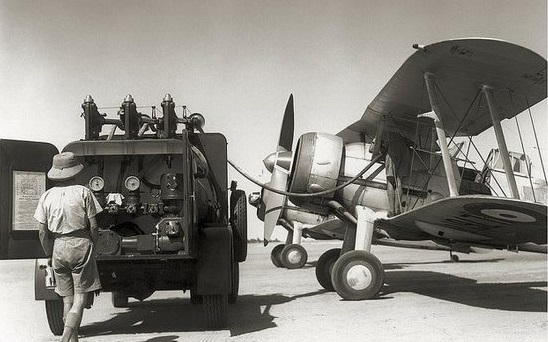
The last biplane fighter to serve with the RAF and Royal Navy, of the total 747 Gladiators which were built, almost 30% were exported, serving with the armed forces of Belgium, China, Finland, Greece, Iraq, Irish Republic, Latvia, Lithuania, Portugal, Norway and Sweden. In addition some aircraft transferred from the RAF operated with Egyptian and South African forces.
After the Russian invasion of Finland in 1940, slowly reinforcements began to arrive for the Finnish air force. The first to come were 5 Gloster Gladiators, 12 Hurricanes, 17 Lysanders and 24 Blenheims, all from Britain. After that, 76 Morane-Saulnier and Koolhoven F.K. fighters arrived from France. Italy sent 17 Fiat fighters, Sweden 12 Gloster Gladiators, and the USA 44 Brewster Buffalo, of which however only 5 reached Finland in time. Even the Union of South Africa sent 25 Gloster Gladiators. Pilots and ground personnel from a number of countries also volunteered to assist them.
At the peak of its deployment the Gladiator was flown by 29 home and 11 overseas squadrons and many remained in RAF service until early 1945.
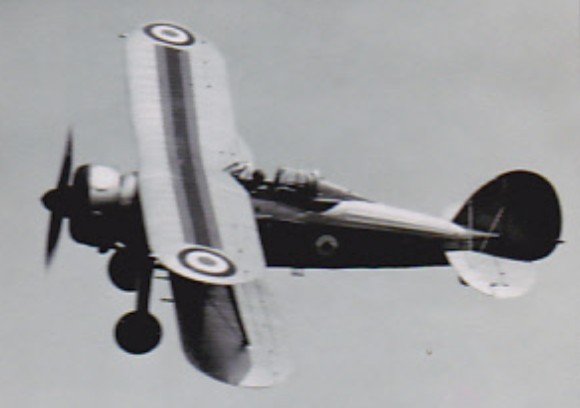
Total production amounted to at least 767, including 480 for the RAF, 60 Sea Gladiators and 216 exported to 12 countries. The last delivered in May 1940.
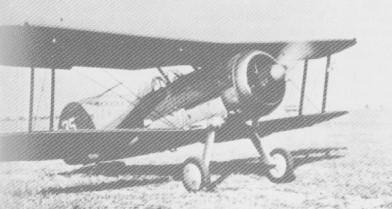
Users were Belgium, China, Egypt, Finland, Greece, Iraq, Ireland, Latvia, Lithuania, Norway, Portugal, South Africa, Sweden, and the RAF and RN.
Gladiator I
Engine: Bristol Mercury IX or IXS
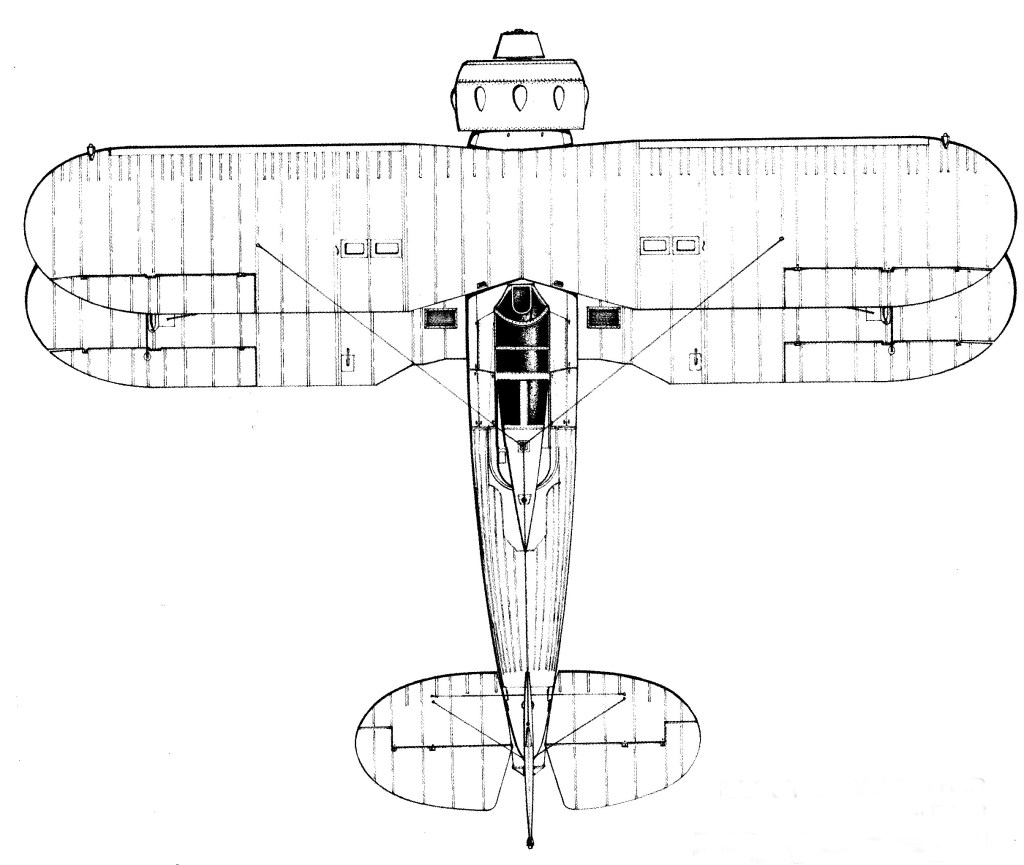
Wingspan: 32 ft 3 in / 9.85 m
Length: 27 ft 5 in / 8.38 m
Height: 10 ft 4 in / 3.17 m
Empty weight: 3450 lb / 1565 kg
Loaded weight: 4750 lb / 2155 kg
Max speed: 253 mph / 407 kph
ROC: 2300 fpm / 700 m/min
Service ceiling: 33,999 ft / 10,060 ft
Range: 440 mi / 708 km
Armament: first 71 aircraft 2 x 0.303in Vickers in fuselage, 2 x 0.303in Lewis lower wings, subsequent 4 x 0.303in Browning in same locations. 600 rounds each in fuselage, 400 in wings
Sea Gladiator
Empty weight: 3475 lb
Loaded weight: 5420 lb
Max speed: 245 mph
Range: 425 mi
Gloster SS 37 Gladiator Mk. II
Engine: Bristol Mercury IX, 840 hp / 620kW
Prop: 10ft 9in dia Watts two blade fixed pitch wooden
MAUW: 4,750 lb.
Empty weight: 3,450 lb. (1,565 kg).
Wingspan: 9.8 m / 32 ft 2 in
Length: 8.4 m / 27 ft 7 in
Height: 3.2 m / 10 ft 6 in
Wing area: 30.0 sq.m / 322.92 sq ft
Max speed: 213 kts/253 mph at 15,000 ft.
Ceiling: 7500 m / 24600 ft
ROC: 2,450 fpm.
Endurance: 2hr at 210 mph.
Fuel cap: 100 (U.S.) gallons.
Range: 400 miles.
Crew: 1
Armament: 4x .303 MG (7,7mm)


 All Aero