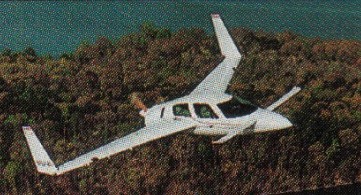
Initially referred to as the Speed Queen SQ2000, the SQ2000 was a new design following the lines of the Velocity etc., but with more rounded fuselage lines. The SQ2000 was designed by Stan Montgomery, and the prototype (which had the undercarriage of an Infinity) made its first flight in 1997 under the power of one 200hp Lycoming IO-360-C1A engine.
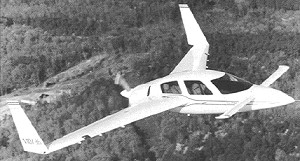
The basic SQ2000 could be completed as a 2-seater with as very large baggage compartment or as a 4-seater.

The SQ2000 features a cantilever mid-wing with tip rudders and a canard, a four-seat enclosed cabin accessed via doors, fixed or optionally retractable tricycle landing gear and a single engine in pusher configuration.
The aircraft is made from composites. Its 26.58 ft (8.1 m) span wing has a wing area of 104.0 sq ft (9.66 m2). The cabin width is 48 in (120 cm). The acceptable power range is 160 to 260 hp (119 to 194 kW) and the standard engine used is the 200 hp (149 kW) Lycoming IO-360 powerplant.
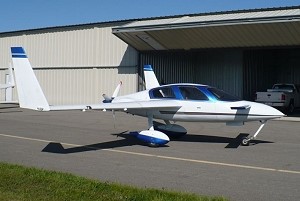
Like many canard designs, the SQ2000 has lengthy runway requirements. The standard day, sea level take-off run is 1,600 ft (488 m), while the landing roll is 1,500 ft (457 m).
The SQ2000 lacks flaps and has a high landing speed. The overall cabin height of the SQ2000 has more headroom since the seats are mounted lower. The kit is more complete as it uses molded wings and canards.
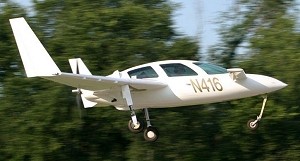
Several examples had been completed and flown by 2005, including one by Mr. Paul Lee with one 200 hp Franklin 6A-350-C2 engine and one by Mr. David Kanson with one 200 hp Lycoming IO-360 engine.
SQ2000 aircraft were observed with Velocity style undercarriage (retracting into the fuselage) and with a KLS-developed undercarriage, which had straight undercarriage members retracting inwards into the wings.
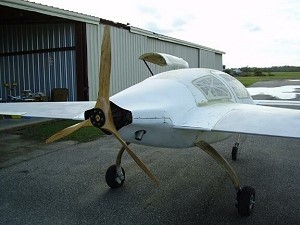
One particular SQ2000 was christened the Rotor-EZ by its builder, Paul Conner, who fitted one Mazda 13B rotary engine instead of the typical Lycoming, and a one-piece wooden propeller.

The aircraft made its first flight on 11 December 2004, but was lost in a fatal accident in May of the following year.
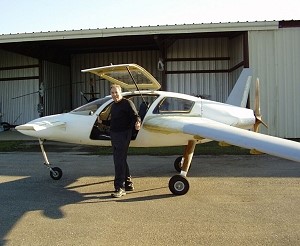
Several models were planned for amateur construction and available from Glassic Composites, LLC, which planned various models: the SQ2000 XP, similar to the SQ2000, but with lower empty weight and suited for 150-200hp engines such as one Lycoming O-320 or Lycoming O-360 series (one example seems to have been built but probably not completed); the SQ2001, a three-seater with a passenger in the rear of the cabin; and the SQ2002, a so called 2+2 version with children’s seats. Yet none of these variants was built, and when
The SQ2000 was available with fixed or retractable undercarriage. The basic structures are moulded with spars.
The SQ2000 first flew in 1993. The kit price in 1997 was US$22,000 for the SQ2000, and US$34,900 for the SQ2000 XP.
Less than a dozen aircraft were either completed or in construction in 12 years, and only eight on the US civil register. One reason probably lies in Glassic’s lack of credentials and the subsequent takeovers of the company’s assets.
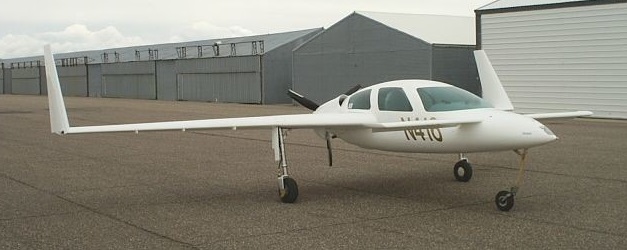
Known completions are; SQ2000 N10736 (prototype), N416, N330DW, N2396M, N2366R, N206SQ, and N440DH. SQ2000 XP N971CL and the Rotor-EZ N2992P.
Glassic Composites ceased its activities and as of 1999, and was taken over by KLS Composites, a company formed by SQ2000 builders Messrs. Keith Register and Stan Montgomery.
Wing area: 104.2 sq.ft
MTOW: 2250 lb
Empty wt: 1100-1250 lb
Useful load: 1000 lb
Payload w/full fuel: 748 lb
Max wing load: 21.0 lb/sq.ft
Pwr load: 11.0 lb/hp
Cabin length: 83 in
Cabin width front: 47 in
Cabin width rear: 42 in
Cabin head room: 41 in
Prototype
Engine: 1 x 200 hp Lycoming IO-360-C1A
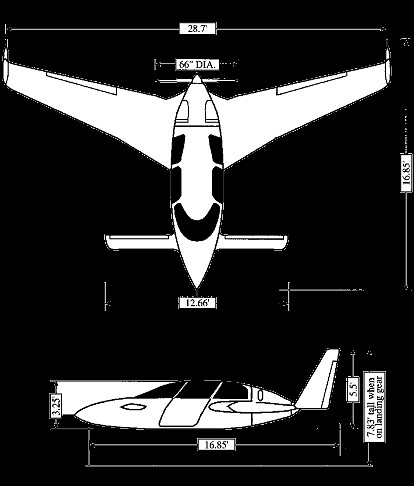
Wingspan:27.8 ft.
Length: 16.85 ft.
Height: 7.83 ft
Maximum speed: 258 mph
Cruise speed: 225 mph
ROC: 2,.200 ft./minute
Ceiling: 25,000 ft.
Range: 800 miles
SQ2000
Top speed: 250 mph
Cruise: 230 mph
Stall: 67 mph
Range: 900 sm
Rate of climb: 2200 fpm
Takeoff dist: 1700 ft
Landing dist: 1700 ft
Service ceiling: 25,000 ft
Engine: Lycoming IO-360, 200 hp
HP range: 150-250
Fuel capacity: 42 USG
Empty weight: 1200 lb
Gross weight: 2250 lb
Height: 7.8 ft
Length: 17.5 ft
Wing span: 28.7 ft
Wing area: 104 sq.ft
Seats: 4
Landing gear: retractable nose
SQ2000 XP
Top speed: 270 mph
Cruise: 235 mph
Range: 1035 sm
Rate of climb: 2200 fpm
Takeoff dist: 1500 ft
Landing dist: 1500 ft
Engine: Lycoming IO-360C-1C, 200 hp
HP range: 150-200
Fuel capacity: 52 USG
Empty weight: 1100 lb
Gross weight: 2100 lb
Height: 7.8 ft
Length: 17.4 ft
Wing span: 28.6 ft
Wing area: 104 sq.ft
Seats: 4
Landing gear: retractable nose or retractable tail
SQ2000 XP
Powerplant: 1 × Lycoming O-360, 200 hp (150 kW)
Wingspan: 26 ft 7 in (8.10 m)
Wing area: 104.00 sq ft (9.662 m2)
Length: 17 ft 6 in (5.33 m)
Empty weight: 1,200 lb (544 kg)
Gross weight: 2,250 lb (1,021 kg)
Fuel capacity: 42 U.S. gallons (160 L; 35 imp gal)
Maximum speed: 260 mph (420 km/h, 230 kn)
Cruise speed: 230 mph (370 km/h, 200 kn)
Range: 851 mi (1,370 km, 739 nmi)
Service ceiling: 25,000 ft (7,600 m)
Rate of climb: 2,200 ft/min (11 m/s)
Wing loading: 21.6 lb/sq ft (105 kg/m2)
Crew: one
Capacity: three passengers
Paul Lee’s N416
(The following are at 1850 lbs. & 117 CG)
Empty weight : 1410 lbs. (1394 lbs. without 9 qt. oil)
Engine : Franklin 6A-350-C2, 200 hp
Propeller : 66″ 3 blade, IVO magnum in-flight adjustable
Fuel Capacity : 35 gal. (includes 2.25 gal. in supplementary tank)
Landing gear: all-three wheels retractable
Climb: 2000 ft./min (105kts, 2000 dens alt.)
Ceiling: 18,000+ ft. (still doing 200+ ft./min)
Best glide ratio : @ 19:1 (105 kts., 3000 dens alt.)
Fuel efficiency : best about 5 gal. per hour near 120 kts.
Canard stall : 66 kts.
Takeoff distance : @ 1500 ft., rotate at 80 kts. (IVO electric adjustable prop.)
Landing rollout distance: approx 2000ft
Speed: 180 kias (3000 dens alt., 2800 rpm)
Crew/passengers: 2-4
 All Aero