During a general conversation, Harold E. “Hal” Lemont told Gazda of his work with Igor Sikorsky; Gazda asked if Lemont would like to design and build a helicopter for him. They
agreed that Lemont would lay out a design for a two-pJace helicopter, and thus the Gazda Model 100 was begun.
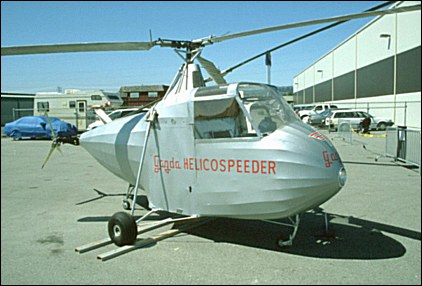
The Gazda Model 100 Helicospeeder NX69154 was designed and developed in 1943, 1944, and 1945 by Antoine Gazda of Wakefield, Rhode Island. It was a single motor and torque aircraft with unique concepts which had the following features:
A swing tail for forward flight was designed to permit flight as a gyrodyne (V. Isaoco, J. Bennett) at higher than manual helicopter speeds with the rotor axis vertical.
To control blade inplane motion to prevent ground resonance a rotor azimuthal blade positioning system was included.
A wheel/stick installation was used so that positioning of the aircraft was achieved by one appropriate motion of the pilot control.
An internal swash plate below the main rotor gearbox actuated push rods going up to the rotor head which controlled blade collective and cyclic pitch as a low drag solution.
Belt drives were used between its engine, the cooling fan, and the main rotor gearbox. A drive shaft from the gearbox to the swinging tail rotor was also included with a torseinal damper as part of this shaft.
An all-aluminum single-seat helicopter, it was powered by a Continental A-75 engine.
Two assistants for detail designs were hired from previously known engineers who had attended RISC – Mr. S. Fitzpatrick in 1944 who was later replaced by Mr. H. Sadler in 1945.
The Helicospeeder was manufactured by Helicopter Engineering & Construction Co. and designed in accordance with general practice at that time. The fuselage was welded steel aircraft tubing. Main rotor blades were steel tubular spars, wooden leading edge wire cable training edge and airplane fabric covering. Cast aluminum gear cases and industrial/automotive gears, bearings, belts, and pulleys were used. The wheels came from a Piper Cub. Considering the limited pool of knowledge and experience in helicopter design, and Mr. Lemont’s earlier background with the Sikorsky VS-300, it is natural that there would be considerable similarity between these two machines.
Its Cierva-type rotor hub, with hydraulic-interconnect links between blades, made ground resonance impossible.
Initially, attempts were made to use a jet of air from the tail to counter torque. However, due to difficulties, a tail rotor was used that could be turned 90 degrees by the pilot, and thus serve as a push propeller for added thrust.
The Model 100 was constructed in the Rhode Island area during World War II, incorporating some surplus aircraft items. Powered by a 75 hp (56 kW) Continental A-75 engine, it was specified to carry one person and publicity releases claimed an ultimate goal of a 300 mph (483 km/h) maximum airspeed. Flight testing was done by Mr. Gazda himself, whose limited experience at the controls of a rotorcraft may have been detrimental to success of these tests. The designer/constructor carried out test flights and a more modest actual speed of 100 mph (161 km/h) was reached.
Production examples were expected to sell for 5,000 U.S. dollars, but no firm sales were made. As Gazda came to understand the difficulty in learning to fly the aircraft, plus the cost of further development, he decided to discontinue further work on this aircraft, and only one example of the initial version was completed.
The Helicospeeder was sold at auction after Mr. Gazda passed away, and was purchased by HAl Past-Chairman Vincent Colicci, who eventually sold it to Dr. Voss. After some years at AgRotors in Pennsylvania, Stanley Hiller took it on loan for his aviation museum in San Carlos, California, and had it restored to its original condition (it would appear that the Model 100 was also placed on public display at some point in time in the Owls Head Transportation Museum at Knox County Regional Airport—located two miles south of Rockland, Maine.)
Helicospeeder
Engine: 1 x Gazda, 130hp
Rotor diameter: 7.62m
Length: 5.79m
Height: 2.54m
Gross weight: 544kg
Cruising speed: 224km/h
 All Aero