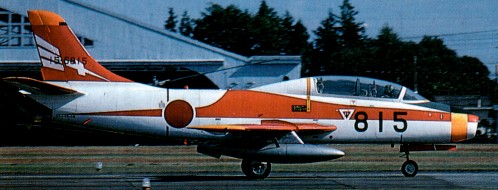
First post-war jet aircraft of Japanese design, the prototype T1F2 flew for the first time on January 19, 1958, powered by a 4,000 lb thrust Bristol Siddeley Orpheus 805 turbo-jet. Two production batches of 20 of this version were built as standard two-seat intermediate jet trainers for the Japanese Air Self-Defence Force, under the designation T1A.
They were followed by the all-Japanese T1F1 (JASDF designation TIB) with a 2,645 lb thrust J3 IHI 3 turbojet produced by Ishikawajima-Harima. The prototype of this version flew on May 17, 1960, and 20 production models were ordered by the JASDF for delivery between August 1962 and March 1963.

T1A / T1F2
Engine: 1 x 4,000 lbs.t. (1814 kgp) Bristol Siddeley Orpheus 80506.
Span: 34 ft 5.5 in (10.5 m)
Length: 39 ft 9.25 in (12.12 m)
Wing area: 239 sq.ft (22.22 sq.m)
Height: 13ft 3in
Empty weight: 5,335 lb (2 420 kg)
Loaded weight: 9,150 lb (4 238 kg)
Gross weight: 10,6701b
Max speed: 576 mph (921 kph) at 20,000ft (6100 m)
Cruise: 397 mph (640 kph)
Initial climb: 3,460 fpm (17.3 m/sec)
Ceiling: 52,490 ft (16000 m)
Range: 806 mls (1297 km).
Max rate of climb at SL: 6,100 ft/min
T1B / T1F1
Engine: 1 x 2,645 lbs.t. (1200 kgp) J3 IHI 3.
 All Aero