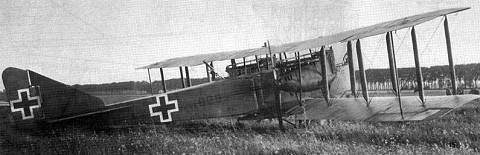
The G.III bomber was a twin 194kW Mercedes D.IVa engined scaled up version of the G.II which saw much operational service from early 1917. Its wings of increased span incorporated three bays outboard of the motors. The undercarriage comprised two pairs of wheels, with a fifth wheel immediately under the nose gunner’s cockpit the latter assisting any heavily loaded takeoff, but mainly preventing a nose over landing on the crude runways of the period. Construction of the G.III was a typical contemporary mixture of wood, plywood and steel tubing, and the three man crew consisted of a pilot and a ‘bombing officer’ in a side by side cockpit, with two cockpits mounting guns in the nose and mid fuselage connected by an internal passageway for the third crew member. Capable of lifting a 1500 kg (3310 lb) bombload, the main weight of bombs was carried externally below the main nacelle, but internal racks, each for five 10 kg (22 1b) bombs, were located either side of the communicating passage aft of the pilot’s cockpit.
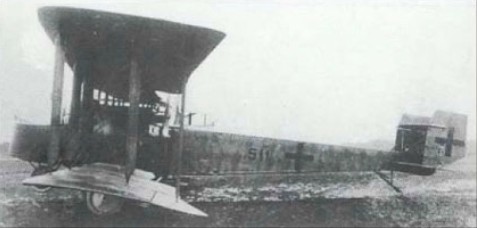
For the final 18 months of the First World War, Friedrichshafen G.IIIs, in company with the better known Gotha G.V bombers, formed the real strength of German heavy bomber units, particularly on the Western Front in France. Used mainly in long¬distance night raids, G.IIIs are known to have attacked such principal targets as Paris, and are believed to have participated in some of the well publicized attacks against Eng-land.
During 1917 Friedrichshafen concentrated on the production of the G.III and G.IIIa with many others being built under contract by Daimler and Hansa. An improved variant was the G.IIIa, built under licence by the Daimler works. This differed from the G.III only in minor structural changes to the tail unit and wing tip configuration.
It is not known how many G.IIIs and G.IIIas were built in total, but more than 330 were produced by the subcontractors.
Span: 23.7 m (77 ft 9 in).
Length: 12.8 m (42 ft).
Endurance: 5 hrs.
Powerplants: 2 x 260 hp Mercedes D IVa
Armament: Bombload up to 1496 kg (3300 lb); 1 Parabellum machine gun in nose; 1 Parabellum machine gun in rear
Maximum speed: 135 km/h (84 mph)
 All Aero