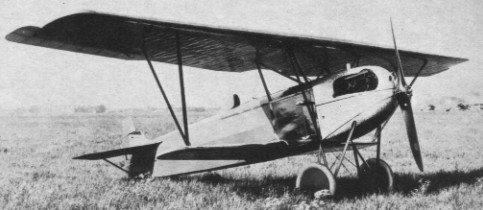
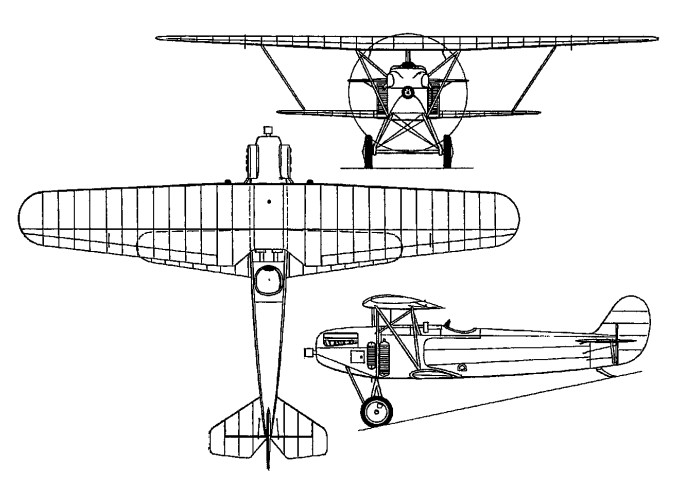
The D.IX was used as the design basis for the D.XI, a single bay, unequal¬ span biplane of sesquiplane configuration. Powered by the 300 hp Hispano Suiza 8Fb eight-cylinder liquid-¬cooled engine of the D.IX, it was armed with two forward firing 7.92mm LMG 08/15 machine guns mounted in the engine cowling in front of the cockpit. The D XI had a fabric-covered steel-tube fuselage and plywood covered wooden wings and first flew on May 5, 1923.
One hundred and twenty-five were ordered by the Soviet government, and a further 50 were ordered on behalf of Germany’s Reichswehr by the financier Hugo Stinnes for the clandestine German air training centre, which, in 1924, was being established at Lipetsk, north of Voronezh, in the Soviet Union. In the event, the German order was cancelled and, in 1925, these 50 D XIs were sold to Romania.
At the beginning of 1924, three were supplied to the USAAC at McCook Field and tested as PW 7s with the 440 hp Curtiss D 12 (V-1150) engine. The first of these had standard plywood-covered wings with V-type interplane struts, and the second and third had fabric wing skinning and N-type strutting.
Two were supplied to Switzerland in 1925 for evaluation by that country’s Fliegertruppe.
A total of 177 D.XIs were built, the others going to the Argentine.
Span: 11.60 m (38 ft 0.75in)
Length: 7.00 m (22 ft 11.5in)
Height: 3.20 m / 10 ft 6 in
Wing area: 21.80 sq.m / 234.65 sq ft
Empty weight: 865 kg / 1907 lb
Gross weight: 1250 kg (2756 lb)
Maxi¬mum speed: 225 km/h (140 mph).
Range: 440 km / 273 miles
 All Aero