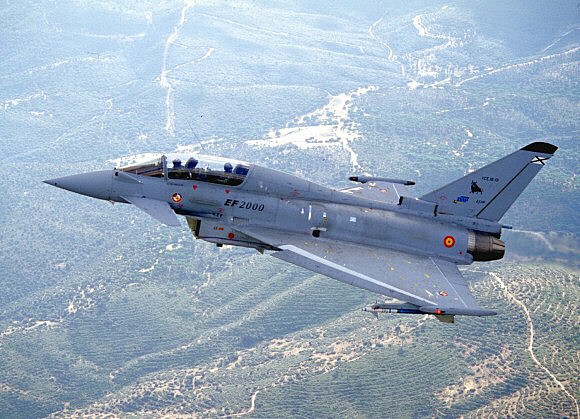
The Eurofighter program started in 1992. The aircraft is a canard delta with a maximum take-off weight of 17,000kg, a wing area of 50sq.m, and two turbofans giving a total thrust of l80kN. The prototypes was to have either Turbo-Union RB.199 or General Electric F404 engines, but production aircraft were to be powered by Eurojet EJ.200s, which was being developed by a consortium consisting of Rolls-Royce, Fiat, MTU, and SENER. A multimode pulse-Doppler radar fitted, and armament was to include an internal gun plus AIM-120 Amraam and AIM-132 Asraam. The Eurofighter will be optimised for air-to-air roles but will have a secondary air-to-surface capability.
Eurofighter EF-2000 / Typhoon Article
The design features a delta wing design with canards set well forward of the wing. These features combined with two powerful EJ200 engines and digital flight control systems produce a highly agile fighter.
The Eurofighter design has been named Typhoon by the Royal Air Force, dropping the EF2000 project name. Spain and Italy and the industry have taken on the name Typhoon as well.
The first prototype DA.1 flew in Germany on 27 March 1994. Seven development aircraft (DA) were built, as well as several Instrumented Production Aircraft for evaluation, weapons and systems testing.
Tranche 1 production aircraft are used primarily for evaluation, instructor and pilot conversion training, but have also entered operation attending large-scale exercises and taking on the air defense role.
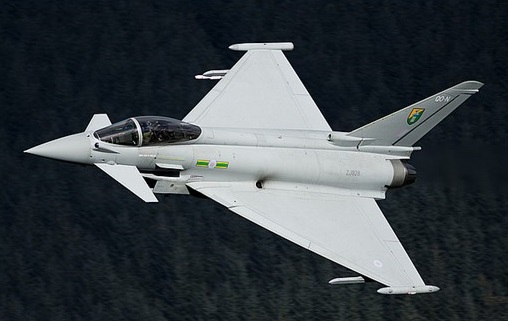
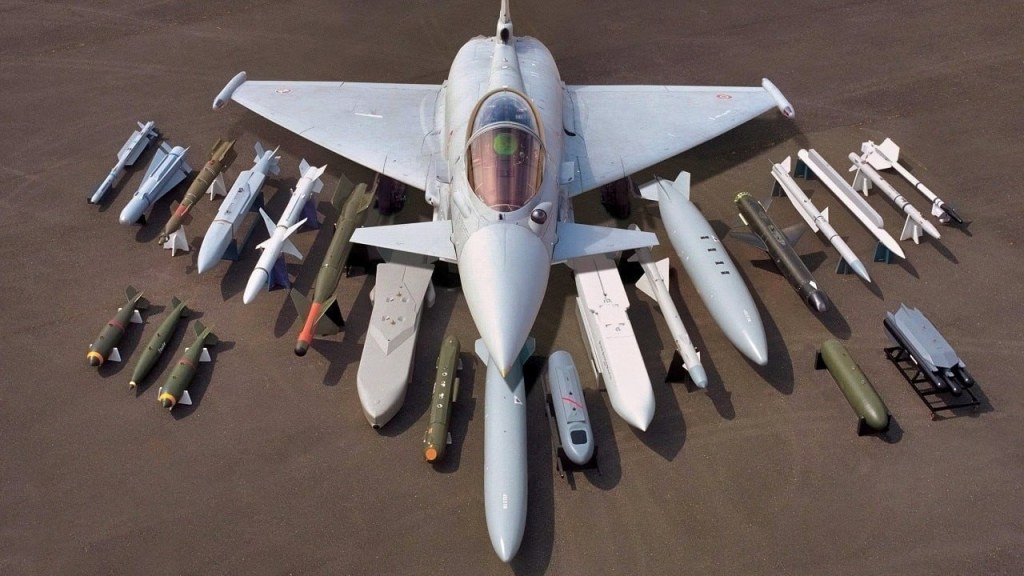
A total of 620 aircraft have been ordered by the participating countries. Delivered aircraft were being upgraded to the latest Tranche 1 production standard, Block 5, to bring all Tranche 1 aircraft to a near-common standard, including limited air-to-ground capability with a selection of precision guided weapons.
The RAF is primarily replacing the Tornano F.3 air defence fighters, but has also retired its remaining Jaguar fighter-bombers. The Eurofighters for the Luftwaffe will replace its fleet of F-4F Phantom IIs (and fill the gap left by the retirement of the MiG-29 Fulcrum-C). Italy has retired its last F-104ASA Starfighters and returned the leased RAF Tornado F.3s. However because of the delays in the program, it had to lease ex-USAF F-16 ADF to fill the gap. It has equipped its third wing with the Typhoon. Spain has equipped its first squadron with the Eurofighter, but the Mirage F1 aircraft have been put through a modernisation program to keep them in service for some years.
Although Greece was the first to sign a contract for delivery of a first batch of Eurofighters, having initially ordered 60 aircraft with an option for 30 more. However the contract was cancelled and any order would be postponed until after the Olympic Games. It remains to be seen if Greece would renew the Eurofighter contract.
Austria ordered 18 Eurofighter Typhoons, with an option for six more, the contract was revised in 2007 and the number was reduced to 15 aircraft of Tranche 1 standard. .
Saudi Arabia signed a declaration of understanding with regards to the purchase of 24 Typhoons in Trache 2 standard to replace its Tornado ADV fleet. Follow-on is expected as it is reported Saudi Arabia has a requirement for at least 72 Typhoons.
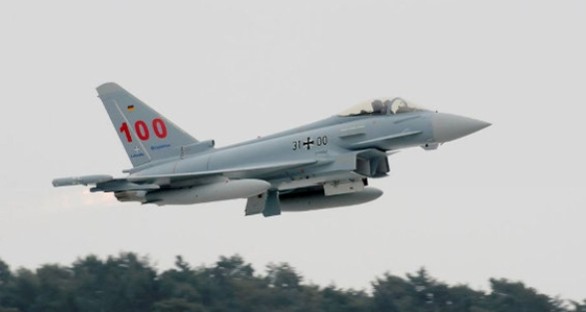
The Eurofighter Typhoon was once the epitome of European airpower. Fast, agile, and lethal, it was a Cold War-era air superiority fighter optimized for an age when speed, maneuverability, and firepower conferred dominance in the skies.
But as air superiority and supremacy is increasingly a function of stealth, sensor fusion, and network-centric operations, the Typhoon is beginning to show its age by 2025. It is not yet entirely obsolete, but it is fighting an increasingly desperate rearguard action against the steadily advancing forces of future aerial warfare.
The uncomfortable reality is that fourth-generation platforms like the Eurofighter Typhoon, no matter how upgraded, are becoming increasingly less able to hold their own in high-intensity conflicts.
With a powerful twin-engine design, excellent thrust-to-weight ratio, and canard-delta aerodynamics, it outmaneuvers most of its contemporaries. Its supercruise capability gives it an edge over other fourth-generation jets, allowing it to maintain supersonic speeds without afterburners.
Armed with the Meteor missile, one of the most advanced air-to-air weapons out there, it poses a serious threat to any enemy aircraft that enters its engagement range. Recent upgrades, such as the integration of the CAPTOR-E AESA radar and enhanced electronic warfare suites, have further extended its lifespan and improved its lethality and survivability.
Yet, despite all of these upgrades, the Typhoon remains fundamentally disadvantaged against fifth-generation stealth aircraft. The transformation of air combat over the past two decades has been revolutionary. It is no longer about raw flight performance or even missile range – rather, it is about situational awareness, sensor fusion, and the ability to strike pre-emptively without being seen.
A stealth fighter like the F-35 or China’s J-20 does not simply enjoy reduced radar visibility; it enjoys advantages derived from the fact that it is a node within an information network, receiving data from satellites, drones, and other assets that radically enhance its survivability and lethality.
The simple fact is that in a contested environment, a Typhoon will be detected, targeted and shot down long before it can locate its stealthy adversary. Even with AESA radar and electronic countermeasures, it cannot change the fundamental physics of radar cross-section reduction and detection timelines. Air combat has always favored the pilot who sees first, shoots first, and eliminates the enemy before they can react. In that equation, the Typhoon is on the losing end against modern stealth fighters.
Variants:
DA
IPA
Tranche 1 / RAF F.2 single-seat / T.1 two-seat
Tranche 2
Typhoon
Engines: two 90 kN (20,250 lb st) Eurojet EJ200 afterburning turbofans
Length 15.96m (52 ft 4 in)
Height 5.28m (17 ft 4 in)
Wing span: 10.95m (35 ft 11 in)
Aspect ratio : 2.21
Wing area: 551.117 sq.ft / 51.2 sq.m
Empty weight: 10.995 kg (24,239 lb)
Max Take-Off Weight: 23000 kg (50,700 lb)
Max level speed clean at 11000 m (36,0069 ft): Mach 2.0 / 2125 km/h (1,321 mph)
Landing speed: 130 kt / 241 km/h
Service ceiling: 15,240+m (50,000+ ft)
g limits +9/-3
Runway requirement: 700m (2,300ft)
Armament: one Mauser Mk27 27mm cannon/ 150rds; up to 6500 kg (14,330lb) ordnance
Hardpoints: 13
Auxiliary fuel: three tanks
Crew: 1
DA.1
Engines: 2 x Eurojet EJ.200 turbofans, total thrust of l80kN.
MTOW: 17,000kg.
Wing area: 50sq.m.
DA.2
DA.7
 All Aero