The first three marks of Olympia, which formed the bulk of the production of this type, differed little from the DPS Meise, but in the 1950s Elliotts began development of a new family of high performance Olympia variants
incorporating laminar flow wings, and leading to the Olympia 419, which was sufficiently different from the first three marks of this design as to be almost a new type.
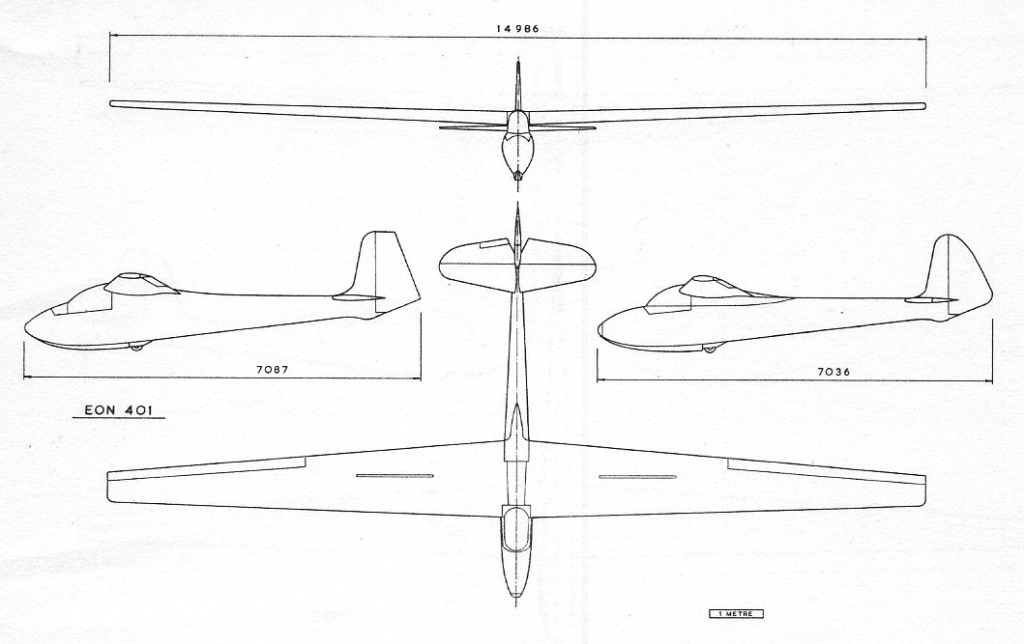
First of these new variants was the Olympia 4, later known as the 401, first flying in 1954, which was a Mk 2, G-ALNF, fitted with a laminar flow wing of NACA 64-series section, identical in span (15m) and plan form to the previous wing. The 401 had a revised fuselage nose section, square-cut rudders and elevators. Frise ailerons were featured but these were found to have only marginal power at low speeds and, after the 401’s debut in the 1954 World Gliding Championships, these were enlarged and the wing itself modified. G-ALNF was then fitted with a 17m span wing of the same aerofoil sections at root and tip, thus becoming the Olympia 402; aileron chord and span were increased. It was flown by Bill Ivans of the USA into fifth place in the 1956 World Championships, but was lost in an accident on the last day of the competition.
For the 1956 World Championships the Olympia 4 prototype was converted to 17 m / 55 ft 3.5 in as the Olympia 402.
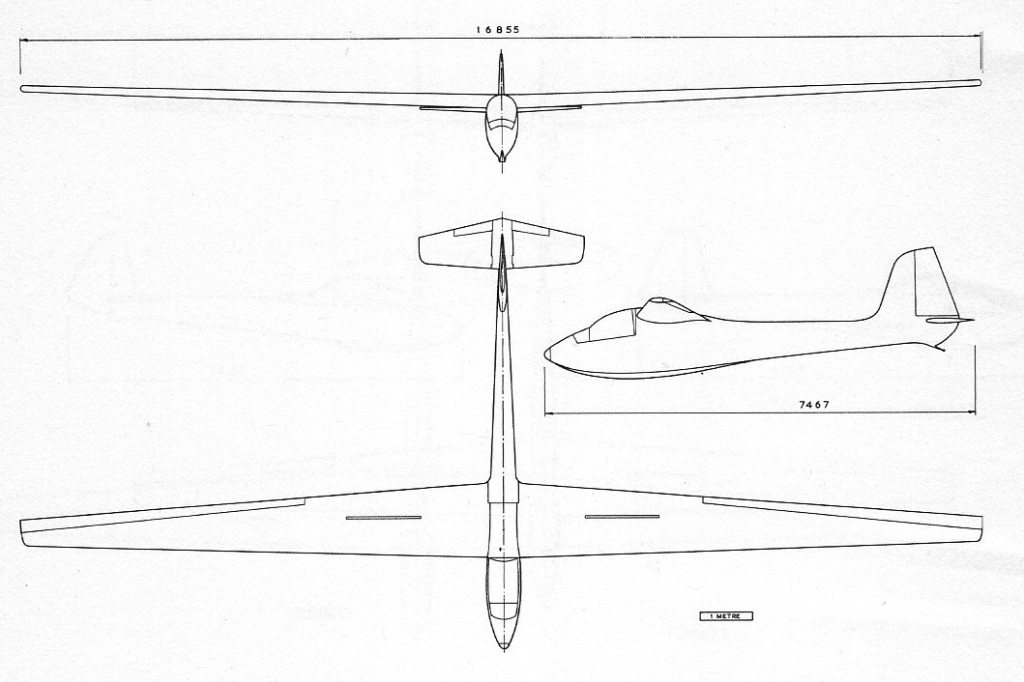
The Olympia 4 / 401 was succeeded by the Olympia 403 prototype, G-APEW, which retained the 17m span wing with a slightly thickened root but introduced some important design changes; this made its debut at the 1957 British national championships. The tail surfaces were entirely redesigned with increased area, the tailplane now being an all-moving surface which could be hinged upwards for transport. It had an anti-balance and trimming tab which at first covered the full span but was later reduced to half span. The fuselage was extended 10in forward by inserting an extra bay between the main bulkhead and the cockpit, and both the cockpit canopy and fuselage ‘neck’ were widened, that part of the fuselage under the wing being redesigned. The first flight of the 403 was in 1957.
The 403 was subsequently fitted with type 419 tailplane.
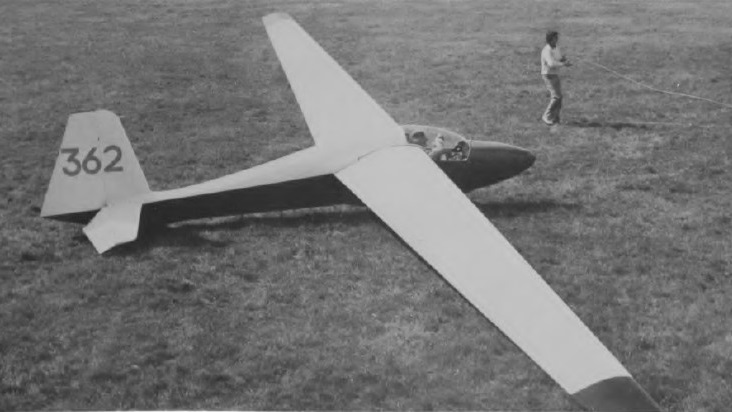
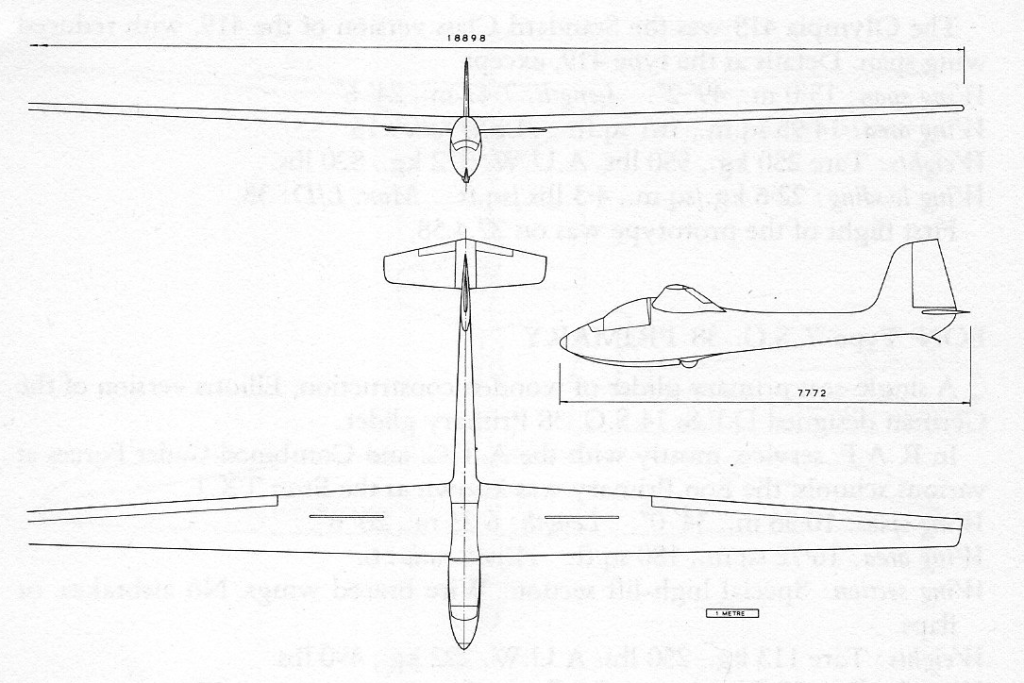
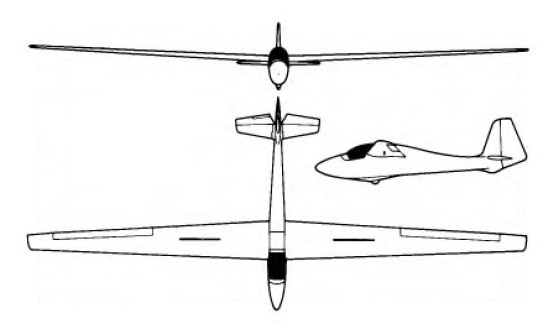
The next variant was the Olympia 419, which had the wing span increased to 18.9m (62ft), longer span Frise ailerons, a slightly longer nose than the 403 and greater rudder area, these changes giving better low speed performance and tailplane balance than the 403. The NACA 64-series laminar flow wing section was used. The 419 was constructed mainly of spruce, and all surfaces were covered by birch ply except for the rudder, tailplane and wings inboard of the ailerons. Balsa wood was used extensively as a filling for the wing ribs and as a non-structural material for wing tips and fairings.
The undercarriage consisted of a jettisonable twin wheel main unit and a tailskid, and the main landing skid under the forward fuselage was of stainless steel. Both the Olympia 419 prototype and the Olympia 415, which was a 15m span version of it, first flew in 1958; the latter did not go into production but the 419 was marketed at a price of £2,150 and in the end eight were built. These put up some good performances in both World and British National championships flown by such pilots as Nicholas Goodhart and Peter Scott.
On the 419X there was a main skid only, with droppable wheels.
The Olympia 415 was the Standard Class version of the 419, with reduced wing span. The first flight of the prototype was on 27 April 1958.
Variants:
EoN Type 5 Olympia 4
New wing section
Wingspan: 15.0 m / 49 ft 2 in
Length: 7.27 m / 23 ft 10 in
Wing area: 15.33 sq.m / 165 sq.ft
Aspect ratio: 15
Wing section: NACA 64,3 618 root / 64,4 421
Empty weight: 204.12 kg / 450 lb
AUW: 322.0 kg / 710 lb
Max L/D: 36
EoN Type 5 Olympia 401
Revised 4, with new nose and square-cut empennage. 180 mm (7 in) shorter.
Wingspan: 15.0 m / 49 ft 2 in
Length: 7.09 m / 23 ft 3 in
Wing area: 15.33 sq.m / 165 sq.ft
Aspect ratio: 15
Wing section: NACA 64,3 618 root / 64,4 421
Empty weight: 204.12 kg / 450 lb
AUW: 322.0 kg / 710 lb
Max L/D: 36
EoN Type 5 Olympia 402
As 4, modified for 1956 World Gliding Championships with 17.0 m (55 ft 3.5 in) span.
Wingspan: 17.0 m / 55 ft 3.5 in
Length: 7.27 m / 23 ft 10 in
Wing area: 15.33 sq.m / 165 sq.ft
Wing section: NACA 64,3 618 root / 64,4 421
Empty weight: 204.12 kg / 450 lb
AUW: 322.0 kg / 710 lb
Max L/D: 36
EoN Type 6 Olympia 403
1957 development of Olympia 402, with strengthened and shortened fuselage (7.47 m (24 ft 6 in). New fin and rudder, all moving tailplane.
Eon Type 6 Olympia 415
1958 Standard class (15.0 m (49 ft 3 in)) span version of 419.
Span: 49 ft 3 in / 15.0 m
Length: 24 ft 6 in / 7.47 m
Wing area: 161 sq.ft / 14.95 sq.m
Aspect ratio: 15
Empty weight: 550 lb / 250 kg
Max weight: 820 lb / 372 kg
Wing loading: 22.6 kg/sq.m / 4.3 lb/sq.ft
Min sinking speed: 1.84 ft/sec at 46 mph
Best glide ratio: 35:1 at 52 mph
Eon Type 6 Olympia 419 / 419X
Long span, long fuselage version of 403.
Span: 62 ft 0 in / 18.9 m
Length: 25 ft 6 in / 7.77 m
Wing area: 186 sq.ft / 17.28 sq.m
Aspect ratio: 19.9
Empty weight: 606 lb / 275 kg
Max weight: 900 lb / 408 kg
Wing loading: 21 kg/sq.m / 4.3 lb/sq.ft
Min sinking speed: 1.84 ft/sec at 46 mph
Best glide ratio: 38:1 at 52 mph
EoN 463
Span: 49 ft 2.5 in / 15.0 m
Length: 21 ft 0 in / 6.4 m
Height: 5ft 8 in
Wing area: 132 sqft / 12.26 sq.m
Aspect ratio: 18.0
Wing section: NACA 643618/421
Empty weight: 400 lb / 181 kg
Max weight: 630 lb / 286 kg
Water ballast: None
Max wing loading: 23.33 kg/sq.m / 4.78 lb/sq ft
Max speed: 136 mph / 117.5 kt / 218 km/h (in smooth air)
Max rough air speed: 74 kt / 137 km/h
Stalling speed: 30 kt / 56 km/h
Min sinking speed: 2.2 ft/sec / 0.67 m/sec at 42.5 mph / 37 kt / 69 km/h
Best glide ratio: 32:1 at 48 mph / 42 kt / 78 km/h
 All Aero