The initial version, known as the Crabpot, was designed by H. Kendall for the 1947 B.G.A. Two-seat Sailplane Competition. Conventional wooden construction, apart from the wings which had several spanwise webs and few ribs. The webs were 15mm thick, and the ribs were spaced at from 900 to 1200 mm pitch.
A cantilever wing, no flaps but airbrakes were fitted. All moving tailplane.
A project only, it won the competition.
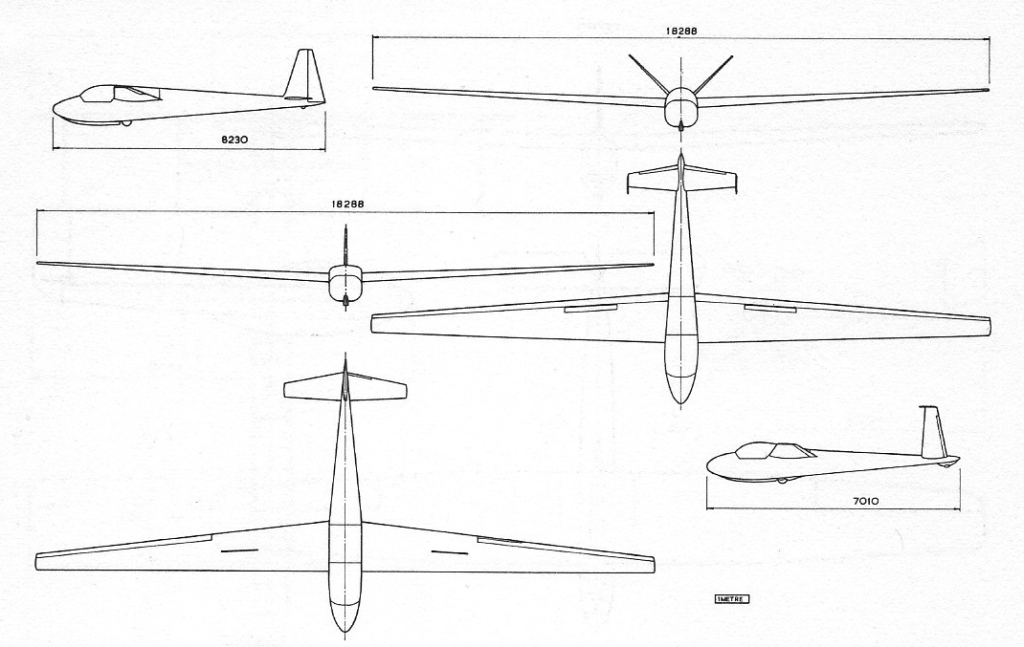
Having one the competition, the Crabpot was re-designed. The wing section was altered, a “V” tail introduced, and the fuselage shortened. The wing material was altered and it was decided to manufacture it using an asbestos reinforced low pressure thermos setting plastic structure, a method that involved the use of heated concrete moulds and tailored felts. The wing was manufactured by F.G. Miles Ltd at Redhill Aerodrome, under the designation Miles M.76, but when tested, it broke up at a fraction of the design load. The K.1, as the Crabpot was by then known, was later built, using the traditional wooden construction methods, by Elliots of Newbury, as the EoN Type 9.
Only one was built, the first flight being at Lasham in March 1954, with full span ailerons. No CofA was issued as the K.1 was abandoned due to unsatisfactory flying characteristics, particularly unsolvable spinning problems.
Kendall Crabpot / K.1
Wingspan: 18.3 m / 60 ft 0 in
Length: 8.24 m / 27 ft 0 in
Wing area: 18.58 sq.m / 200 sq.ft
Aspect ratio: 18
Wing section: NACA 43018 root, NACA 43012A tip
Empty weight: 232 kg / 516 lb
AUW: 414 kg / 911 lb
Wing loading: 21.0 kg/sq.m / 4.3 lb/sq.ft
Max L/D: 27 at 77 kph / 49 mph
EoN Type 9
Wingspan: 18.3 m / 60 ft 0 in
Length: 7.01 m / 23 ft 0 in
Wing area: 18.58 sq.m / 200 sq.ft
Aspect ratio: 18
Wing section: NACA 66,3,418, NACA 64,2,415 tip
Empty weight: 300 kg / 661.5 lb
AUW: 453.6 kg / 1000 lb
Max speed: 200 kph / 125 mph
Stall: 64 kph / 40 mph
Max L/D: 35
 All Aero