
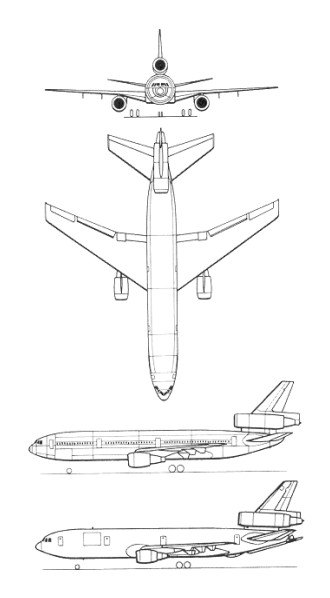
Douglas designed the DC-10 in 1966, competing directly with Lockheed to produce an airbus capable of operating from normal-length runways. By designing the DC-10 around three General Electric CF6-6 turbofan engines, Douglas avoided the financial difficulties encountered by Lockheed with the Rolls-Royce RB.211. In a multi-company manufacturing agreement, Convair produces the fuselage and Aeritalia the fins (vertical stabilizers). The -10 is a short/medium-haul version; the long-range -30 and -40 have an extra forward-retracting main gear, uniquely mounted on the centreline. An aircraft with a fixed wing sweep (the DC-10 wing, designed just before the advanced supercritical form was introduced, is broad and strongly swept) cannot be best for all ranges, but the DC-10’s sales record of 250 testifies to its attraction as a sophisticated wide¬bodied jet that can fly global routes.
The Series 10, able to accommodate up to 380 economy class passengers on domestic routes, was first flown on 29 August 1970, certified on 29 July 1971, and made its first scheduled passenger flight with American Airlines on 5 August 1971. Introduction of DC-10 service-between Los Angeles and Chicago came one week after American formally accepted the trijet from McDonnell Douglas. It was followed by the inter-continental range Series 20, which flew for the first time on 28 February 1972.
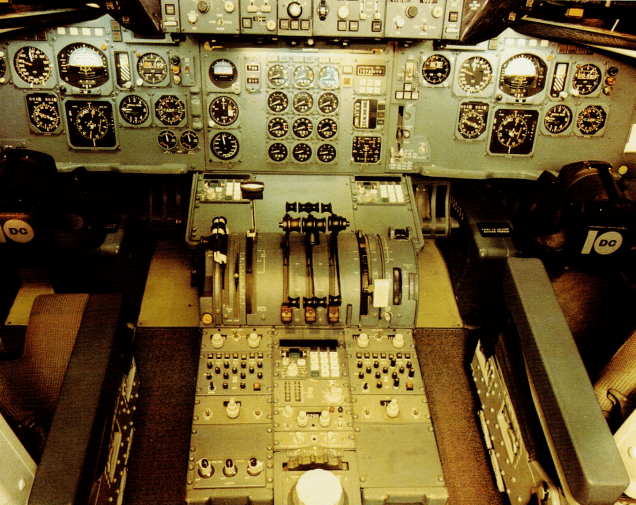
Conversion of the CF6-50A engines to -50C standard increases the thrust from 49,000 lbs to 51,000 lbs.
Turkish airlines took delivery of three DC-10-10 between December 1972 and February 1973; TC-JAU, TC-JAV, and TC-JAY. TC-JAV was lost at Paris in 1974.
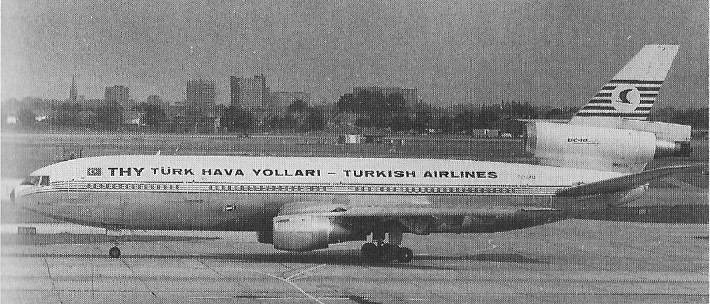
First flight of the long range Pratt & Whitney JT9D powered McDonnell Douglas DC 10 20 took place on February 28, 1972. Northwest Airlines having ordered 14, with 14 more on option

A derivative of the commercial DC-10-30CF, selected in 1977 as the USAF’s advanced tanker/cargo aircraft (ATCA), the first KC-10A flew in July 1980. The aircraft has high-flow-rate, 5,680lit/min refuelling boom plus an independent, 2,2701it/min hose-drogue system. As a transport the KC-10 has a cargo capacity comparable with that of the C-5 to 8,300km range, but is superior over longer ranges up to 18,500km.
Some 445 DC 10s were delivered since the first went into service in 1971, the last in July 1989 to Nigerian Airways.

DC 10 Srs 10
Engines: 3 x General Electric CF6 6D turbojets, 40,000 lbs thrust each.
Length: 181 ft 4.75 in.
Wingspan: 155 ft 4 in.
Ceiling: 35,000 ft.
Range: 2,429 mls.
DC-10-30
Engines: 3 x CF6-50C, 51,000 lbs thrust.
Wing span: 165.3 ft.
Max takeoff weight: 259.45 tonnes.
Max landing weight: 182.79 tonnes.
Fuel capacity 111.40 tonnes.
Pax cap: 247.
Range: 10,232 km.
DC-10-30ER
Engines: 3 x CF6-50C2, 233.5 kN.
Wing span: 50.4m.
Length: 55.5m.
Height: 17.7m.
Max speed: 0.88M @ 7620m.
Max range (full load): 7410 km.
Crew: 3.
Accommodation: 243 pax.
DC-10-30CF / KC-10A Extender
Engine: 3 x GE CF6 turbofan.
Installed thrust: 701 kW.
Span: 50.4 m.
Length: 55.3 m.
Wing area: 339 sq.m.
Empty wt: 109,350 kg.
MTOW: 267,620 kg.
Payload: 78,840 kg.
Max speed: 956 kph.
Initial ROC: 20 min to 8530 m.
Ceiling: 12,800 m.
T/O run: 2590 m.
Ldg run: 790 m.
Fuel internal: 200,940 lt.
Range: 11,110 km with 45,400 kg payload.
Air refuel: Yes.
McDonnell Douglas KC 10 A Extender
Engine : 3 x General Electric CF6 50C2, 229064 N / 23350 kp
Length : 181.759 ft / 55.4 m
Height : 58.071 ft / 17.7 m
Wingspan : 165.354 ft / 50.4 m
Wing area : 3957.923 sqft / 367.7 sq.m
Max take off weight : 590102.1 lb / 267620.0 kg
Weight empty : 241072.7 lb / 109330.0 kg
Max. payload weight : 349029.5 lb / 158290.0 kg
Max. speed : 530 kts / 982 km/h
Landing speed : 138 kts / 256 km/h
Cruising speed : 490 kts / 908 km/h
Initial climb rate : 2755.91 ft/min / 14.0 m/s
Service ceiling : 32808 ft / / 10000 m
Wing load : 149.24 lb/sq.ft / 728.0 kg/sq.m
Range : 9989 nm / 18500 km
Crew : 6
Fuel capacity : 132330 lt
 All Aero