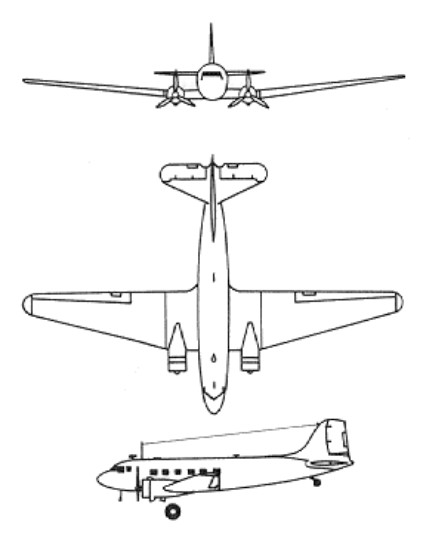
The DC-3 resulted from American Airlines’ requirement for a sleeper aircraft for its US transcontinental route. The DC-2 fuselage was too small for this, so, reluctantly, in the autumn of 1934 Douglas agreed to build the DST (Douglas Sleeper Transport) as an enlarged DC-2, with lengthened fuselage, increased span and, an increase of 66cm in fuselage width – allowing up to 28 seats or 14 sleeping berths.
The prototype DST, with 633.4-745kW Wright Cyclone SGR-1820 engines, made its first flight on 17 December 1935. The type entered service with American Airlines on 25 June 1936 over the New York-Chicago route, with transcontinental sleeper services starting on 18 September. The DC-3/DST soon proved itself and orders grew rapidly, with KLM becoming the first operator outside the US.
The first military version, the C 39, was an odd mixture of the new wing mated with the small DC 2 body. Similar aircraft procured in smaller numbers were the C 38 personnel trans¬port with Cyclones and the corresponding C-41 with Twin Wasps.
Discounting about four civil DC 3s sold as VIP transports to overseas air forces, there was no true military DC 3 until October 1941, when deliveries began from Santa Monica of the C 53 Skytrooper. This simple conversion of the DC 3 had a wooden floor, fixed aluminium seats for 28 troops, and a glider towing cleat. Some were later supplied to the RAF as the Dakota II, and the US Navy and Marines as the R4D 3, and subsequent versions included the C 53B, C and D.
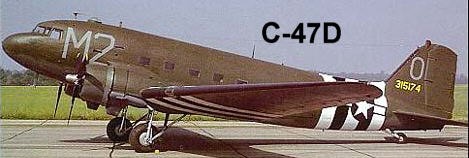
The main military type, put into large scale production in late 1941 at Santa Monica, Tulsa and Oklahoma City, was the C 47 Skytrain. This had been designed earlier in 1941 hence the earlier type number as an all purpose military transport with strong freight floor, large double doors, tie down fittings and folding wooden troop seats. The engine chosen was the 1200 hp R 1830 92 Twin Wasp. A first batch of 953 was followed in 1942 43 by 4991 C 47A with 24 volt electrics, and in 1943 by 3108 C 47B for high airfields (especially in India and China) with R 1830 90C engines with two stage blowers. Named Skytrain by all US forces, and designated R4D by the Navy, some 1200 C 47, 47A and 47B were supplied to the RAF under lend lease as the Dakota I, III and IV, respectively. Douglas also built 133 TC 47B trainers (R4D 7) with navigation classroom interiors, and one C 47C twin float amphibian version. The U.S. Navy version is designated R4D; but by 1955 most of these had been modified into R4D-8s, with more powerful engines, more swept wings with tips, taller squared-off fin and rudder with long dorsal fin, and room for up to 38 passengers.
The single C 47C amphibious floatplane was a 1943 conversion of a C 47A Skytrain intended to increase the type’s versatility.
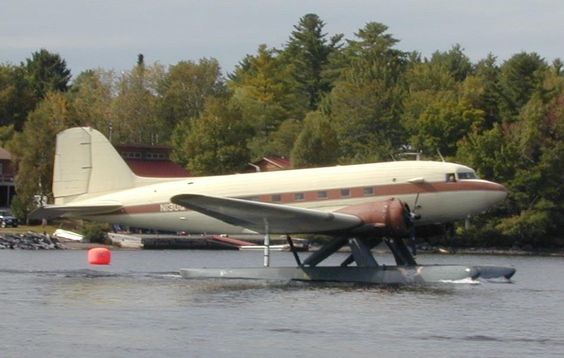

The sole 1943 XC-47C, 42-5671, had Edo amphibious floats with nose-wheels in addition to wheels under the steps, and each housed a 300 gal fuel tank.

Other oddballs included the XCG 17 glider converted from a production C 47A, and the unique DC 2½ flown out of China in an emergency with one DC 3 wing and one DC 2 wing, the original having been damaged beyond immediate repair. The glider was outstandingly successful, carrying 40 troops, towing at 464 kph (288 mph) behind a C 54 and landing at only 56 km/h (35 mph), but only one was built.
Wartime impressed civil DC 3s included the C 48 (R 1830) with civil furnishing (some were DST sleeper transports), C 49 (R 1820) usually with cargo floor and astrodome, C 50 (R 1820), C 51 (R 1820) for paratroops, C 52 (R 1830) taken over on the civil production line and completed as paratroop transports, C 68 (R 1830) previously the DC 3A late 1930s civil type, and C 84 (R 1820) previously the DC 3B. In 1945 17 purpose built VIP transports were delivered, designated C 117A. The DC-3/DST was operated as the C-38 transport.
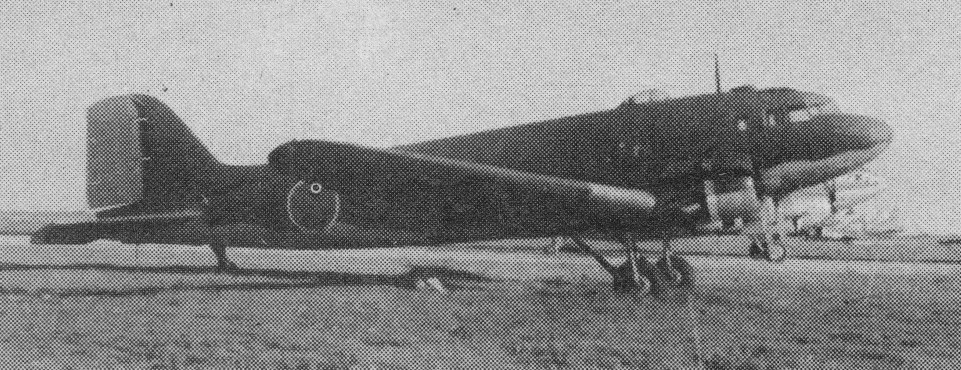
In 1940 the Japanese navy introduced the Type 0 transport, a Showa built version of the 21 passenger DC 3.
On 21 February 1942, some 25 Douglas DC-3 aircraft built under Japanese licence but bearing US national insignia, appeared over the city of Kupang on the Portuguese-owned Pacific island of Timor and dropped 250 troops from an altitude of only 300 ft. this was the first airborne operation carried out by the DC-3.
Operation Husky, the Allied invasion of Sicily beginning 10 July 1943, involved 400 Dakota C-47 transport aircraft and 170 Waco CG-4A cargo gliders. The operation verged on failure. Ninety-seven of the British and US gliders released from their towropes too early plunged into the sea, and another 24 were reported missing: only 12 of the gliders, all British, landed in the target zone. Then strong anti-aircraft fire confused the paratroops in the Dakotas, so they jumped too soon and were scattered over almost 60 miles. Six of the Dakotas were shot down, and only 73 British paratroops reached their target, the Ponte Grande bridge.
In mid-June 1943, for the first time, a Dakota FD900 of RAF Transport Command landed in Prestwick, Scotland, towing a glider. The two planes had taken off twenty-four hours earlier from Dorval (Montreal). Piloted by Sqn.Ldrs. Seys and Gobel, the Waco CG-4A had been built in a New York piano factory, and carried a full load of vaccine and radio and engine parts for the Soviet Union.
Accomplishments of the DC 3 in the Second World War include almost 1000 crossed the Channel on the night of D Day, June 6, 1944, many towing gliders, while in China a C 47 took off at a high altitude strip with 75 evacuees on board. Total wartime output by the US (almost all Douglas) was 10123.
In 1949 Douglas built two prototypes of a much improved Super DC 3, aimed chiefly at the airlines, with 1475 hp R 1820 C9HE engines and greatly altered airframe. Few, were sold, the main customers being the US Navy/Marines (R4D 8) and Air Force (C-117D).
Circa 1949-50, British European Airways Dakotas received cockpit and cabin upgrades and become known as the Pioneer in passenger service and Pioneer Leopard for cargo.
In February 1938 Mitsui in Japan acquired a licence to build the DC 3, on the secret orders of the Japanese navy. During 1939 45 the Japanese companies Showa and Nakajima respectively delivered 416 and 71 of the L2D 1 to L2D 4 versions, with 1300 hp Kinsei engines and cockpit windows extending much further aft than in the US aircraft. These machines received the Allied code name ‘Tabby’.

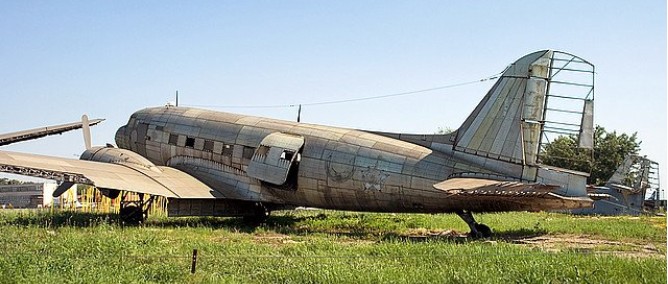
Much greater licence production was undertaken in the Soviet Union. Under Boris Lisunov, who had studied the DC 3 at Santa Monica, the Li 2 version considerably altered incorporating 1293 changes, and with entrance on the right and was in full production during 1939 43, about 3500 being built. The Li-2 used various engines, including the ASh-621R driving SISh-21 propellors, or AV-7N or AV-161 engines. Originally powered by 671kW Shvetsov M-62 radials in the PS-84 first version, but later fitted with uprated Shvetsov ASh-62 radials, most had the M 621R engine, and many had a gun turret behind the flight deck. Some were used as bombers with four 250kg bombs under the centre section and six light bombs on the outer wings.
Postwar Allied reporting name was ‘Cab’, this also covering the 707 lend lease C 47A and B which reached the Soviet Union in 1942 43. The Li-2 was designated PS-84 in Aeroflot service. Production comprised a number of variants, some of them armed with turreted armament; the Li-2G freighter, Li-2P personnel transport, Li-2PG convertible model and the Li-2V high-altitude model are best known of the variants.
The Yugoslav Air Force operated at least 11 Li-2s between 1945 and 1959. After the deterioratiom of relations between the Soviet Union and Yugoslavia in 1948, spare parts became difficult to obtain, and so ten aircraft were re-engined with Pratt & Whitney R-1830-900 engines and Hamilton Standard propellers from 1953 onwards. These aircraft were unofficially designated Li-3 by the Yugoslav Air Force. All Li-3s were on strengrh of the 111 ppa (transport regiment) at Zagreb. At least five of them seem to have been re-serialled from the four-digit 70xx series to the five-digit 711xx series, probably in late 1969. Shortly afterwards all Li-3s may have been withdrawn from use.
The most dramatic of all conversions has been the various series of AC 47 night interdiction gunships usually armed with three 7.62 mm (0.30 in) General Electric Miniguns with no fewer than 54 000 rounds of ammunition. While the basic air¬craft had become familiarly called the ‘Gooney Bird’ at least to US personnel the AC 47 was also known as ‘Puff the Magic Dragon’ or ‘Spooky’. The 25 initial conversions proved so useful in Vietnam that they spurred on the later AC 119 and AC 130 programmes.
404 C-53 variant were purchased or impressed. They were called Dakota Is and this version was powered by Pratt & Whitney R-1830-92 (1.200 hp) engines. It was primarily used as a troop transport and glider tug. A single XC-53A aircraft (42-6480), with full-span, slotted flaps and hot-air leading edge de-icing equipment.
In 1949 the Cyclone 9HE weighed less than 1400 lb and delivered nearly 1500 bhp. The first two were delivered to Douglas for installation in the new DC-3 Super. Apart from new engines, the DC-3 Super has a new tail unit and outer-wing panels, a strengthened undercarriage with complete wheel retraction, and re-arranged internal accommodation. The Cyclone 9HE engines would boost speed by 45 mph to 234 mph and maximum loaded weight increase from 25,200 lb to 27,300 lb.
In World War II the RCAF had three Dakota squadrons. In 1944, 437 was created in England and served in Northwest Europe; in that same year, 435 and 436 Squadrons were formed in India for service with the British XIV Army in Burma. Between 1943 and 1989 the RCAF and Canadian Forces (CF) Air Command employed 169 Dakotas.
The DC-3 was built in numerous versions and with a wide range of Wright Cyclone and Pratt & Whitney Twin Wasp engines ranging in power from 742 to 894kW. The aircraft were operated on wheels and skis – one even had floats (the XC-47G-DL) – and there was the XCG-17 experimental troop-carrying glider version. Original US military contracts covered 10,047 aircraft of which more than 9,500 were versions of the C-47 Skytrain with reinforced floor and double doors, and 380 C-53 Skytroopers. The US Navy ordered the DC-3 as the R4D. A wide range of military designations was given to civil aircraft impressed by the services before delivery including C-48, C-49, C-50, C-51, C-52, C-68 and C-84. Many military DC-3 were supplied to the US’s allies and the 1,900 plus supplied to the RAF were given the name Dakota – a name which has been widely used in place of the DC-3 designation.
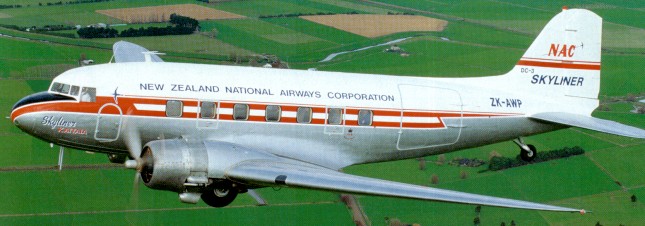
National Airways Corporation operated three models of DC-3 and applied its own model suffixes, unique to New Zealand versions. The DC-3C was the basic internal passenger version with double rear doors on the port side of the fuselage. The DC-3C freighter retained the dual rear doors on the port side, with the exception of ZK-BKE, which was the only genuine DC-3 to serve in the fleet, having been built in 1941 for United Airlines and had starboard side doors before being called up into military service. The DC-3D, with the smaller single door of prewar DC-3, an astrodome and a wireless operator’s station, was used initially on regional services.
NAC ran its DC-3 with a maximum all-up weight of 26,900 lb for landing and take-off. The DC-3C Freighter could lift a payload of 4,244 lb, the DC-3C passenger 3,344 lb and the DC3D 3,244 lb. The DC-3C Freighter was the lightest, with a fleet operating weight of 17,400 lb compared with 18,200 lb for the DC-3C and 18,400 lb for the DC-3D.
Prior to Skyliner conversion in the 1960s, they could carry up to 4,824 lb of fuel in two 168 imperial gallon tanks between the front and centre spars in the centre section. The aircraft also had two auxiliary tanks each of 167 imperial gallons between the centre and rear spars on the centre line, but these were removed in the Skyliner conversion, although provision for one remained on all but the DC-3D, which retained provision for two.
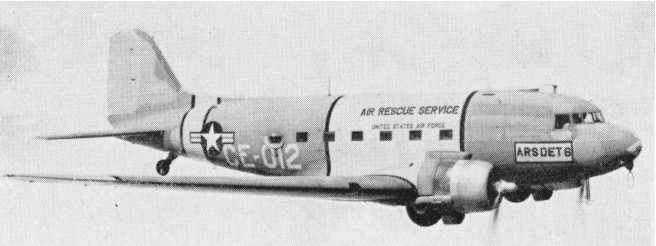
The LC 47H was a winterised C 47H. Prior to 1962, before a change in the US Navy designation system, the aircraft would have been a R4D 5L.
The R4D 8s were a Super DC 3 with modified outer wing panels, longer fuselage, enlarged tailplane, tall square topped fin, fully enclosable undercarriage and powered by 2 x 9 cylinder Wright Cyclone R1820 80s of 1,475hp.
Principal versions – C-47, R4D-1 and Dakota Mk I (initial model), C-47A, R4D-5 and Dakota MkIII (revised electrical system), C-47B, R4D-6 and Dakota Mk IV (high ¬altitude blowers), Lisunov Li-2 (2,000+ Soviet-built aircraft), and Nakajima/ShowaL2D “Tabby” (485 Japanese aircraft).
In 1963 Libya started its own Air Force when the US turned over two T-33 and a C-47 at Wheelus AFB.
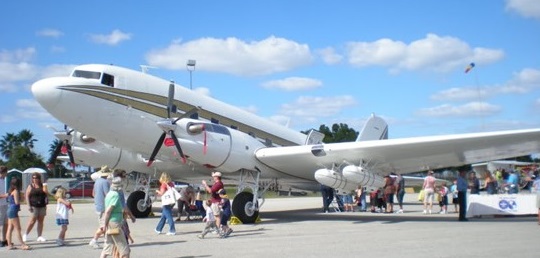
Basler Conversions of Wisconsin have FAA approval to fit Pratt and Whitney PT6A 67R turboprop engines driving Hartzell five-bladed propellers to DC 3s, enabling up to 42 passengers or a useful load of around 5900 kgs in the revitalised aircraft, being marketed as the Turbo 67R. The fuselage is stretched approximately 42 inches from its original length, with all-new electrics, and extended fuel storage with an additional 200 gallons of fuel carried in the engine nacelle-mounted fuel tanks.
Schafer Aircraft Modifications Inc was founded 1977, and from 1979 developed modifications for other aircraft. Included was developing a turboprop conversion and fuselage stretch for the DC-3 as DC-3-65TP Cargomaster.
The aircraft was ordered in very large numbers by the US armed forces and when production ceased in 1947, Douglas had built 10,654 examples of all civil and military variants. Nakajima and Showa in Japan built 485 (L2D) and about 2,000 had been built in the USSR as PS-84, but later redesignated Lisunov Li-2.
As late as 1990 there were 3,500 Dakotas still flying world wide.
Prototype DST (Douglas Sleeper Transport) / C 38
Engines: 2 x Wright Cyclone SGR-1820, 633.4-745kW
Douglas DC-3
Engines: Two Pratt & Whitney R-1830-92, 1200 hp / 880kW
Maximum speed: 237 mph (379 km/h)
Maximum weight: 28,000 lb (12,600 kg)
Range: 1110 miles (1776 km)
Maximum passengers: 28
Span: 95 ft (28.5 m)
Length: 64 ft 5 in (19.3 m)
Height: 16 ft 11 in (5 m)
Wing area: 987 sq ft (91.7 sq m)
Crew: 2
DC 3
Engines: 2 x 900 h.p. Wright Cyclones.
Length: 64.5 ft. (19.6 m.)
Wing span: 95 ft. (29 m.)
Weight empty: 16,290 lb. (7,390 kg.).
Crew: 2.
Pax cap: 21.
Max cruise: 185 m.p.h. (298 km.p.h.).
Ceiling: 23,000 ft. (7,000 m.).
Range: 1,500 miles (2,400 km.).
NAC DC-3C
Payload: 3,344 lb
Operating weight: 18,200 lb
Maximum all-up weight: 26,900 lb
Fuel capacity: 4,824 lb / two x 168 imperial gallon tanks
NAC DC-3C Freighter
Payload: 4,244 lb
Operating weight: 17,400 lb
Maximum all-up weight: 26,900 lb
Fuel capacity: 4,824 lb / two x 168 imperial gallon tanks
NAC DC3D
Payload: 3,244 lb.
Operating weight: 18,400 lb
Maximum all-up weight: 26,900 lb
Fuel capacity: 4,824 lb / two x 168 imperial gallon tanks
C 39
C-¬41
Engines: 2 x Twin Wasps.
C 47 Skytrain / R4D / Dakota I
Engines : 2 x Wright Cyclone R-1820-G202A, 1200 hp
Wing Span : 95ft (28.96m)
Length : 64ft 5.5in (19.65m)
Height : 16ft 11in (5.16m)
Range : 1,500 miles (2,414km)
Speed : 229 mph (369 km/h)
MTOW: 25,200 lb
C 47A Skytrain / R4D / Dakota III
Engines: 2 x Pratt&Whitney R-1830-93, 1200 hp
Length: 64.206 ft / 19.57 m
Height: 16.929 ft / 5.16 m
Wingspan: 95.013 ft / 28.96 m
Wing area: 986.951 sqft / 91.69 sq.m
Max take off weight: 26030.0 lb / 11805.0 kg
Weight empty: 16974.1 lb / 7698.0 kg
Max. speed: 199 kts / 369 km/h
Cruising speed: 161 kts / 298 km/h
Service ceiling: 23196 ft / 7070 m
Cruising altitude: 10007 ft / 3050 m
Wing load: 26.45 lb/sq.ft / 129.0 kg/sq.m
Range: 1304 nm / 2415 km
Crew: 3+28
Elec¬trics: 24 volt
C 47B Skytrain / R4D / Dakota IV
Engines: two 1,200-hp (895-kW) Pratt & Whitney R-1830 90C Twin Wasp radial piston.
Max speed: 230 mph.
C-47 Skytrain
Engines: two 1,200-hp (895-kW) Pratt & Whitney R-1830-92 Twin Wasp radial
Maximum speed 229 mph (368 kph) at 7,500 ft (2,290 m)
Initial climb rate 1,130 ft (345 m) per minute
Service ceiling 23,200 ft (7,075 m)
Range 1,500 miles (2,401 km)
Empty weight 16,970 lb (7,705 kg)
Maximum take-off: 13290 kg (29 300 lb) (sometimes 14 080 kg, 31004 lb).
Wing span 95 ft 0 in (28.90 m)
Length 64 ft 5.5 in (19.63 m)
Height 16 ft 11 in (5.20 m)
Wing area 987.0 sq ft (91.70 sq.m)
Payload: 28 troops, or 18 litters, or 10,000 lb (4,536 kg) of freight.
C-47B-35-DK
Engines: two 1,000 hp Curtiss-Wright R-1820-G2 Cyclone 9 cylinder radials, or 1,200 hp Pratt & Whitney R-1830-92 twin Wasp two-row 14 cylinder radials.
Wingspan: 28.96 m
Length 19.66 m
Height 5.17 m
Cruising speed 266 km/h
Ceiling 21,900 ft
TC 47B / R4D 7
C 47C
Undercarriage: twin float amphibian
Ex-C 47A
C-47D
Engines: 2 x Pratt & Whitney R1830-90, 1,200 h.p.
Wingspan: 95 ft
Length: 63 ft. 9 in.
Loaded weight: 30,000 lb.
Max speed: 224 m.p.h.
Ceiling: 24,100 ft.
Typical range: 1,500 miles at 185 m.p.h. at 10,000 ft. with normal load
Crew: 3
Capacity: 21 passengers
LC 47H / R4D 5L Skytrain
AC 47
Armament: 3 x 7.62 mm (0.30 in) General Electric Miniguns / 54 000 rounds
C 48
impressed civil DC 3
Engines: R 1830
C 49
impressed civil DC 3
Engines: R 1820
C 50
impressed civil DC 3
Engines: R 1820
C 51
impressed civil DC 3
Engines: R 1820
C 52
impressed civil DC 3
Engines: R 1830
XC-53A
No built: 1 (42-6480)
C 53 Skytrooper / Dakota II / R4D 3
Engines: 2 x Pratt & Whitney R-1830-92, 1.200 hp
C 53B
Engines: 2 x Pratt & Whitney R-1830-92, 1.200 hp
C 53C
Engines: 2 x Pratt & Whitney R-1830-92, 1.200 hp
C 53D
Engines: 2 x Pratt & Whitney R-1830-92, 1.200 hp
DC 3A / C 68
impressed civil DC 3
Engines: R 1830
DC 3B / C 84
impressed civil DC 3
Engines: R 1820
C 117A
VIP transports
17 built
C-117A-11-KK
R4D 8 / C¬117D
Engines: 2 x Wright Cyclone R 1820 C9HE, 1475 hp
XCG 17
glider – ex-C 47A
Capacity: 40 troops
Tow speed: 464 kph (288 mph)
Landing speed: 56 km/h (35 mph)
No built: 1
Basler Conversions Turbo 67R.
Engines: 2 x Pratt and Whitney PT6A 67R turboprop
Passengers: 42
Useful load: 5900 kgs
Lisunov Li 2
Engines: 2 x Shvetsov ASh-621R, 1000 hp
Propellors: SISh-21
Wingspan: 95 ft 0 in
Max speed: 225 mph
Lisunov Li 2
Engines: AV-7N
Lisunov Li 2
Engines: AV-161
Lisunov Li 2 / PS-84
Engines: 671kW Shvetsov M-62 radials
PS-84I
Medevac version
Lisunov Li 2
Engines: Shvetsov ASh-62 radials
Lisunov Li 2
Engines: M 621R
Lisunov Li-2DB
Long range fuel tanks.
Li-2F
Aerial photography
Lisunov Li-2G
Freighter
Li-2LL
Flying labratory
Li-2 Metro
Flying labratory
Lisunov Li-2P
Passenger transport
Lisunov Li-2PG
convertible
Li-2PR
Glass nose
Lisunov Li-2R
Survey aircraft with bulged windows.
Li-2RE
Flying labratory
Li-2REO
Flying labratory
Lisunov Li-2T
Cargo and troop carrying
Cargo door on left hand side
UChShLi-2
Navigator trainer
Li-2US
Navigator trainer
Lisunov Li-2V
high-altitude model
Ski equipped, boosted engines.
Li-2VP / PS-84VP
Bomber / Transport version
Naka¬jima L2D 1
Engines: 2 x 1300 hp Kin¬sei
Naka¬jima L2D-2
Engines: 2 x 1300 hp Kinsei
Naka¬jima L2D-3
Engines: 2 x 1300 hp Kin¬sei
Naka¬jima L2D 4
Engines: 2 x 1300 hp Kinsei
Showa Type 0
Passenger capacity: 21
Showa L2D 1
Engines: 2 x 1300 hp Kinsei
Showa L2D-2
Engines: 2 x 1300 hp Kinsei
Showa L2D-3
Engines: 2 x 1300 hp Kinsei
Showa L2D 4
Engines: 2 x 1300 hp Kinsei
 All Aero