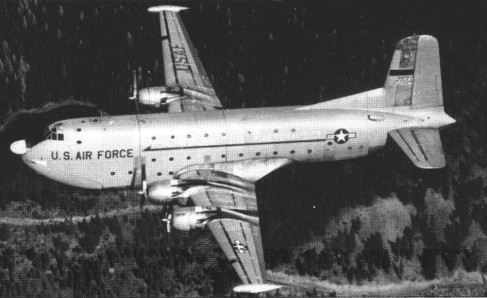
Although the production run of the C-74 Globemaster had been held to 14 airframes, the success of this oversized transport led the US Air Force and Douglas to agree upon construction of an improved long-range transport. The fifth C-74 airframe was used to create the service-test YC-124 Globemaster II which retained the earlier aeroplane’s wings, tail surfaces, and 2610kW R-4360-49 engines. The YC-124 flew on 27 November 1949. The new fuselage was double-decked and the aircraft had enormous clamshell loading doors at the nose with an associated built-in loading ramp, an electric hoist amidships, and two overhead cranes (each with a capacity of 7257kg which could traverse the entire length of the 23.47m-long cargo hold. When used in a transport role (with two decks installed), the Globemaster II could carry a maximum of 200 fully-equipped troops, or 123 stretcher cases plus 45 ambulatory patients and 15 medical attendants.
Douglas C-124 Globemaster II Article
A pre-production aircraft and 28 C-124A models were retrofitted with the ‘thimble’ nose fairing containing ASP-42 radar. Douglas then manufactured no fewer than 243 C-124C models, with the radome as standard, increased fuel, wingtip fairings housing combustion heaters to de-ice the wing and tailplane leading edges and to heat the cabin, and other improvements. The first service Globemaster began duty in May 1950, the month before the outset of the Korean War. Although production was finished by May 1955, the Globemaster II remained a standard in USAF service for years thereafter.
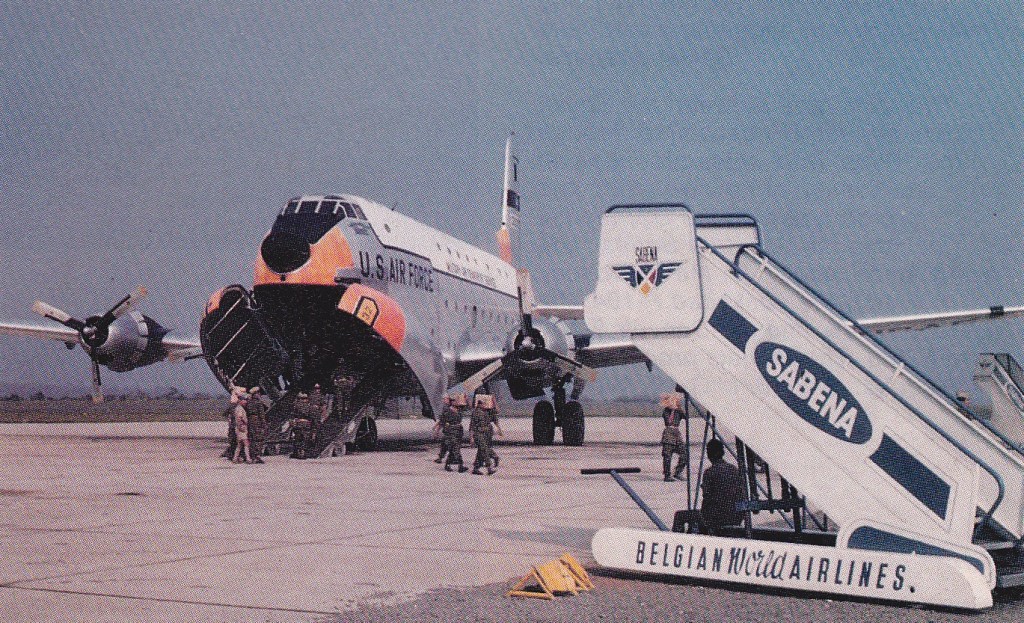
The Globemaster IIs remained in service until replaced by the Lockheed C-5A Galaxy during 1970.
The YKC-124B Globemaster II was Douglas’ bid for a major order for air refuelling tankers. In 1951, engineers began working on a C-124 airframe to be powered by 5,500-shp Pratt & Whitney YT34-P-1 turboprop engines. Gas turbine power produced a kind of ‘Super Globemaster II’ with greater speed, altitude and range capability than the ‘recip’ aeroplane but for reasons not now clear, the USAF decided instead to order the Boeing KC-97 Stratofreighter as its standard tanker even though the latter aircraft did not perform so well. By the time the turboprop Globemaster II flew on 2 February 1954, it had been redesignated YC-124B and was used for proof-of-concept evaluations. Though no orders resulted from its 32-month test programme, the YC-124B contributed substantially to knowledge needed when the C-133 Cargomaster came along.
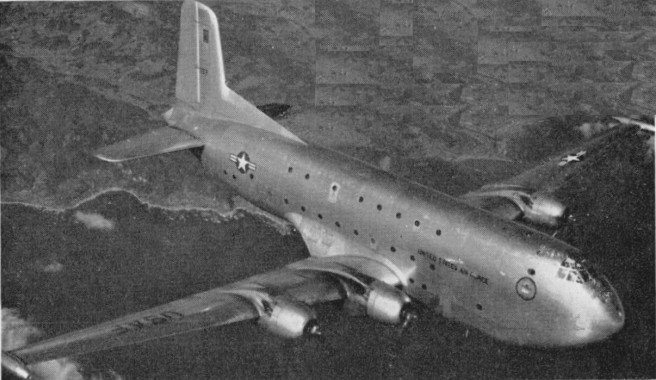
YC-124 Globemaster II
Engines: 4 x R-4360-49.
C-124A
Engines: Pratt & Whitney R-4360-20W, 3500 hp
YC-124B
Engines: 4 x 5,500 h.p. Pratt & Whitney T34-P-1 turboprops
C-124C Globemaster II
Engines: 4 x Pratt & Whitney R-4360-63A Wasp Major, 3800 hp / 2795kW
Wing span 173 ft 3 in / 53.1 m
Length 130 ft 5in / 39.8 m
Height 48ft 3.5in / 14.7 m
Wing area: 2,506sq.ft. / 233.0 sq.m
Empty weight: 101,165 lb.
Max weight: 194,5001b.
Max speed: 298 mph at 20,800 ft
Cruise speed: 520 km/h / 323 mph
ROC: 800 fpm
Service ceiling: 21,800 ft.
Range w/max.fuel: 6500 km / 4039 miles
Range w/max.payload: 1970 km / 1224 miles
Crew: 5
Passenger capacity: 200

 All Aero