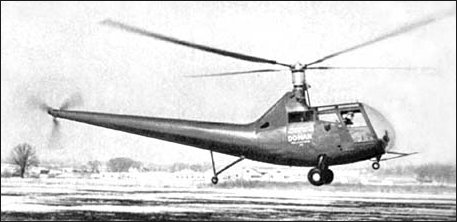
Doman Helicopters Inc. was founded in 1945 for the purpose of exploiting patents taken out by Gliden S. Doman, who during World War II had worked with Sikorsky. The patents related to a new system for controlling and attaching helicopter blades.
These included a new hub system which was essentially similar to the mechanism used on a variable pitch propeller. The rotor system also incorporated a gimbal mounting to provide the necessary tilting of the rotor disc and rotating it by means of a unique constant-velocity driving system. No blade-flapping hinges, drag hinges or hinge dampers were required and bearings subject to centrifugal loads with oscillating motion are reduced to a minimum. The Doman rotor incorporates the speed reduction gearing as an integral part of the rotor assembly. All moving parts are contained within a common housing which precludes damage from weather or foreign matter.
Doman’s theories were tested initially by installing an experimental system on a USAF Sikorsky R-6 in 1947. The rotor had four blades, and though their length was increased from 11.58 to 12.2 metres, this resulted in improved hovering ability and did not lower the top speed.
The helicopter was known as the Doman LZ-1A and it started flight tests in early 1950 with good results. The first flights took place early in 1950 and it should be noted that during one experimental flight this rotorcraft flew for forty minutes without the pilot needing even once to touch the cyclic pitch control.
It was followed by the larger LZ-2A Pelican.
LZ-1A
Engine: 1 x Franklin 0-405-9, 245hp
Rotor diameter: 12.2m
Length: 10.34m
Height: 3.35m
Gross weight: 1350kg
Empty weight: 871kg
Cruising speed: 136km/h
Rate of climb: 275m/min
Range: 640km
Number of seats: 2
 All Aero