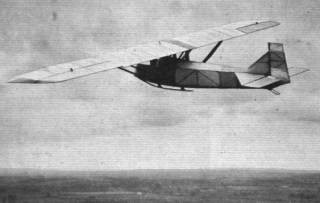
The German RRG Prufling of 1926 was a secondary training glider designed for club use. It was to be cheap to build, given the difficult financial situation of many Germans after the First world war, as well as simple enough that skilled non-professional builders and gliding clubs could successfully build them from plans.
The concept took shape shortly at the Martens gliding school at the Wasserkuppe in the rhön-Rossitten-Gesellschaft GBR at the end of 1925. Chief Martens instructor Fritz Stamer and Alexander Opisem were to produce two gliders in a few days; a Zogling and Prufling. Some parts, such as wings, and to a lesser extent, horizontal tails, the two aircraft were similar.
Both were almost rectangular in shape, two-spar wooden structures, with two-piece wings with fabric covering everywhere except the front edges of which were covered with plywood. In Pruflings the tips of the wings were more rounded and his wingspan 500 mm more. The ailerons were simple, though Pruflings were a little longer. Both had triangular tailplanes carrying elevators, which were rectangular pieces cut-out for rudder movement, though the tail Pruflings was more strongly swept and wider in chord.
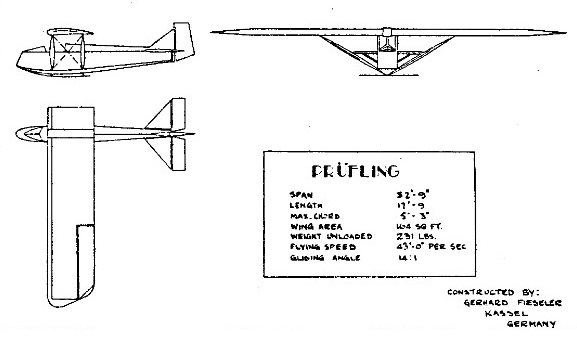
The main difference between the two was in the fuselage. In the Zogling was very simple to open a longeron of the fuselage, Prufling more regular hexagonal cross section, wood-frame structure, covered with plywood forward from under the wing, and fabric aft. The wing was supported over the fuselage with a pair of parallel lift struts on each side, tying it almost in the middle of the span when the spars to the lower fuselage longerons. The open cockpit was under the wing center section was supported by two pairs of struts to the upper longerons of the fuselage. Front pair located in the front part of the cabin was a single, upright struts and in the back, just back, had a friend with an inverted V-steam. In the center there was a noticeable gap between the wings, connected by short wooden the link of the chord. The horizontal tail was located on the top longerons. with a triangular fin to wear vertically, straight edged balanced rudder, which was at an angle just below the heel and extended down to the keel. In Prufling landed on the rubber suspension below the frame forward the whole ply skin of the fuselage, helped a very small skid.
It first flew in 1926 and was soon in use with the corresponding RRT rhön Rossitten gliding clubs.
The plans were sold and many of them were built inside and outside of Germany. As an example, one was flying from the Lancashire Aero club and the other with the London gliding club in the early 1930s. Despite this success, Prufling was something of a disappointment as an additional training aircraft, for their performance was not much better than a typical primary. Handling also was not good, with lack of stability.
Wingspan: 10.50 m / 34 ft 5 in.
Wing area: 15.24 sq.m / 164.0 sq ft.
Aspect ratio: 7.23
Length: 5.484 m / 18 ft 0 in
Empty weight: 105 kg / 231 lb
Gross weight: 195 kg / 430 lb
Wing loading: 12.8 kg/sq.m / 2.6 lb/sq ft
Seats: One
 All Aero