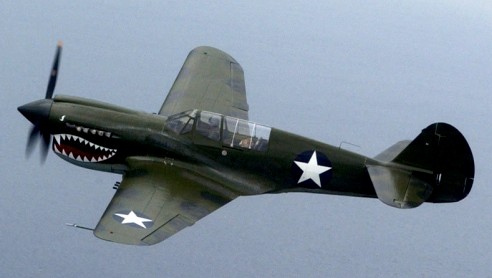
In July 1937 Curtiss installed an 1160 hp supercharged Allison V 1710 19 V type engine in the 10th production P 36A, designated XP 40 (Model 75P).
The XP 40, flown for the first time on October 14, 1938, and evaluated by the USAAC in the spring of 1939, brought Curtiss a $13 million contract for 524 produc¬tion aircraft, fitted with 1040 hp Allison V-1710 33 engines, in April of that year. The first three of these were used as prototypes, the first flight by a production P 40 (Curtiss Model 81 A) being made on April 4, 1940.
In April 1939 the US Army Air Corps awarded what was at that time the service’s largest ever fighter contract, covering 524 examples of the P-40. Deliveries of the P 40 order, which had meanwhile been reduced to 200, began in May 1940. Two 0.30 in (7.62 mm) guns were installed above the nose, in the upper engine cowling. The USAAC (or USAAF, as it became in June 1941) gave the name Warhawk to all variants of the P 40.
France, already a major customer for the radial engined Hawk 75A, ordered 140 Model 81 Als (similar to the P 40), but France had fallen before these could be delivered. They went instead to the RAF, operational with No 2 Squadron in August 1941. These aircraft were given the RAF name of Tomahawk I/IA/IB, equipped with four 0.303 in (7.7mm) Browning machine guns (two in the cowling, one in each wing), and used for low-level tactical reconnaissance. The next US production version was the P 40B, of which 131 were built for the USAAF, having the same powerplant as the P 40 but with an additional 0.30 in (7.62 mm) gun in each wing, the calibre of the two nose guns increased to 0.3 in (12.7 mm), and armour protection for the pilot. The RAF received the 110 similar Model 81 A2s of this type intended for France, naming them Tomahawk IIAs. Variant P 40C followed, being similar to the P 40B but with a further 0.30 in (7.62 mm) gun in each wing and improved self sealing fuel tanks. The first flight took place on April 10, 1941, and 193 were built for the USAAF. Again an order intended for France, for 635 similar Model 81 A3s, went instead to the RAF, these becoming the Tomahawk IIB. A further 295 of this version, supplied to the RAF, were passed on to China (100) and the USSR (195) under the Lend Lease programme.
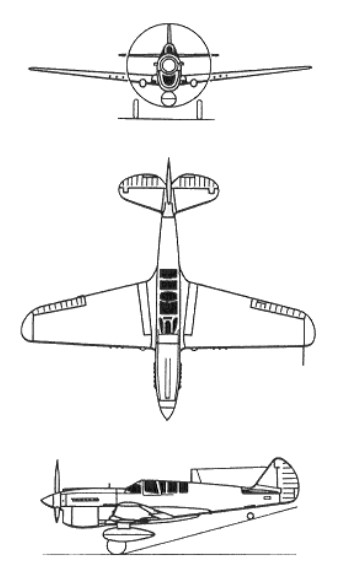
In 1941 Curtiss introduced major design changes which earned the Warhawk the new Curtiss Model number 87. The new model was powered by an 1150 hp Allison V 1710-39 engine, equipped with a modified propeller reduction gear which permitted the fuselage, to be shortened by 152 mm (6 in). The undercarriage main wheel legs were also shortened; the rear fuselage was redesigned, and a deeper nose radiator was fitted. Provision was made for carrying one 227 kg (500 lb) bomb or a 197 litre (43 Imp gal) drop tank under the fuselage, and smaller bombs could be carried under the wings. Armament was reduced to two 0.5 in (12.7 mm) machine guns in each wing, the over nose guns being removed. Most examples of this new fighter-bomber version went to the RAF, which received 560 Model 87 Als as the Kittyhawk 1. Twenty three similar Model 87 A2s were built for the USAAF as the P 40D, and two were retained by Curtiss for further development. An increase in armament to six 0.5in (12.7 mm) wing guns led to the Model 87 A3, of which the RAF allocation was 1500 as Kittyhawk 1As, under Lend Lease, while 820 were delivered to the USAAF as the P 40E.
Meanwhile, one of the two P 40Ds retained by Curtiss became the XP 40F (or Model 87D) with the installation of a Rolls Royce Merlin 28 V type engine; this made its first flight on June 30, 1941. The Rolls engine offered a far better performance at altitude than the Allison, as a result of which a total of 1311 Merlin engined P 40Fs were built for the USAAF. Approximately the first 260 of these had the old style P 40 fuselage, but later models had a 53 cm (20 in) longer, redesigned rear fuselage, which improved low speed stability. They had the American (Packard) built version of the Merlin engine, designated V 1650 1 and developing 1300 hp; the air intakes were removed from the top of the engine cowling. These Warhawks were able to carry a 644 litre (142 Imp gal) drop-tank under the fuselage. A consignment of 250 aircraft for the RAF, to have been called Kittyhawk II, were not delivered.
US designations continued with the P40G, allocated to 60 of the original P 40s brought up to six wing gun standard in late 1940. The P 40H and J were experimental projects, which never left the drawing board the latter was to have utilized a turbocharged Allison powerplant, but was deemed unnecessary after the Merlin engined version appeared.
The next Warhawk to go into production, and the heaviest, was the P 40K. Built in parallel with the P 40F, it had a 1325hp Allison V 1710 73 engine, the longer fuselage of the later F models, and a small dorsal fin. With an all up weight of 4540 kg (10000 lb), it was nevertheless capable of 579 km/h (360 mph). Twenty one were delivered to the RAF as Kittyhawk IIIs, and the USAAF received a total of 1279. The K series P-40s were produced by the Curtiss plant at Buffalo to a total of 1300 units during the latter part of 1942.
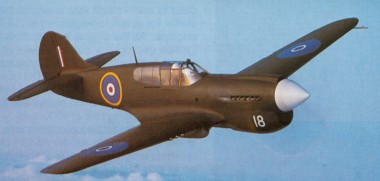
The first sub type, the K 1, appeared in August 1942 and replaced the “E” model on the production line. However the Merlin engined “F” series was also in full production by this time so the “F” and “K” continued until they were supplanted by the “L” and ‘V’ models respectively in late 1942. Early “F” and “K” examples had the original “short” fuselage of all previous P 40 models but, from the P-40F 5 onwards and the K 10 onwards a new one foot eight inch section was introduced aft of the existing fuselage. This additional section supported the fin and rudder but the tailplane and tailwheel were left in their original positions.
The “K’s” were very similar to the preceeding “E’s” (and succeeding M’s” for that matter) with the primary difference being the engine; the V 1710 73 (or V-1710 F4R to use the GM Allison designation) of preceeding P 40E.
The main external differences from the P 40E were the addition to the P 40K-1 and K 5s of a curved dorsal fin (some late “E’s” had this) and the introduction of flared or “fishtail” exhaust ports (round on E, F and L). On the P 40K 10 and K-15s the differences were the lengthened rear fuselage with fin and rudder moved aft of tail plane, a strenthened windscreen assembly with extra bracing strut incorporated in port side only of curved side panel, and a radio mast introduced aft of the cockpit.
This version was followed by the P 40L, a lighter weight, ‘stripped’ development of the P 40F, often known for that reason as the ‘Gipsy Rose Lee’. It had two fewer wing guns, a lower fuel capacity, and no armour protection, but this resulted in only about 113 kg (250 lb) of weight being saved, and production was therefore limited to the 700 delivered to the USAAF. These were a mixture of long and short fuselage models, all powered by V¬1650 1 Packard Merlins. Similar to the K, but with the 1200 hp Allison V 1710 81 engine, the P 40M went in the main to the RAF (595 aircraft, also known as Kittyhawk IIIs), only five being delivered to the USAAF.
Other major external changes which followed were the revised cockpit canopy on P 40N 5 and subsequent models and the fitting of smaller diameter mainwheels (from 30 inch down to 27 inch) except on the P 40N 40 CU. On the “N” model also, the old “ring and bead” type gunsight atop the fuselage nose gave way to a single “bead” just aft of the engine; undercarriage position pins (introduced on the P 40M) protruded above the wing just aft of the undercarriage housing billets when the undercarriage was down; and the large external rear view mirror fitted to most P 40E, F, K, L and M on the support port edge of the windscreen rim was replaced by a smaller interior mirror centrally placed.
Numerically, the major production version in the Warhawk series, and the last, was the P 40N of 1943 after an extensive programme of structural weight saving to provide a higher performance. The USAAF received 4634 of this variant, and the RAF 586 as the Kittyhawk IV. They were powered mainly by the 1200 hp Allison V 1710 81 or 99 engine, but the final 220 of the batch had a 1360 hp V¬1710 115 powerplant. Armament comprised four 0.5 in (12.7 mm) wing guns on early models, and six of the same calibre on the later ones, which were also equipped to carry a 680 kg (1500 lb) bombload. The aircraft also featured a lengthened fuselage and redesigned canopy. Thirty P 40Ns were converted to two seat advanced train¬ers; two Ks and one N were converted (two of them with ‘bubble’ canopies) to XP 40Q to test engine cooling equipment, wing radiators and a four blade propeller.
Three hundred P¬40Fs and Ls were redesignated P 40R1 and R2 respectively when they were refitted with V 1710 81 engines.
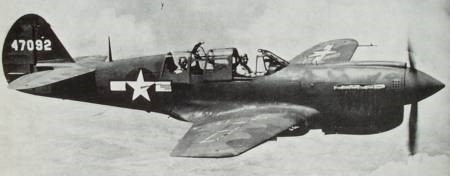
Prior to the final termination of P-40 development, some effort was expended in combining aerodynamic refinement with increased power to produce a higher-performance model. A P-40K airframe was fitted with an Allison V-1710-121 engine rated at 1,425hp for take-off and 1,100hp at 7620m. Semi-flush low-drag radiators were incorporated in the wing centre section and a four-bladed propeller was fitted, the designation XP-40Q being assigned. A second, similarly re-engined P-40K for the P-40Q programme reintroduced the nose radiator scoop, but featured an all-round vision bubble-type canopy (previously tested on a P-40N). The definitive XP-40Q (converted from a P-40N-25 airframe) had clipped wing tips, the cut-down aft fuselage with bubble canopy and coolant radiators faired into the wing leading edges. Four 12.7mm guns were carried but proposed production models were to have carried, either six 12.7mm or four 20mm weapons. No production was undertaken.

When Warhawk production ended in November 1944, Curtiss had built, in addition to the XP 40, a total of 1704 Model 81s and 12 034 Model 87s; annual output being at its highest in 1942 (4453 built) and 1943 (4258), with the greatest number in any one month occurring in August 1943, when 463 were delivered. In addition to widespread use by the USAAF in Europe, North Africa and the Pacific theatres of war, aircraft from the Lend Lease and ex French allocations to the RAF (1180 Tomahawks and 3262 Kittyhawks) were also employed by the Royal Canadian, South African, Australian and New Zealand Air Forces; these too served in the Far East, the Western Desert and Italy as well as in the European theatre. China and the USSR also received P 40s under Lend Lease, the USSR receiving a total of 2097 aircraft. Their chief role was as close support low level attack aircraft.
The principal versions were P-40 and, in British service, Tomahawk Mk 1(339 aircraft with the 1,160-hp/865-kW V-1710-19 engine), P-40B and Tomahawk Mk IIA (241 aircraft with heavier armament), P-40C and Tomahawk Mk IIB (1,123 aircraft with a revised fuel system), P-40D and Kittyhawk Mk 1(582 aircraft of a P-40C version with 1,150-hp/857-kW V-1710-39, shorter fuselage and shorter landing gear legs), and P-40E and Kittyhawk Mk IA (3,820 aircraft with two additional wing guns).
A total of 301 P-40 were allocated to the RNZAF. Thirteen squadrons covered the Pacific region. The P-40 was the only fighter used by the RNZAF in air-to-air combat, claiming 99 victories.
A total of 13,783 were built, making it the third most numerous American fighter of the war. The final delivery, P-40N-40 and P-40R, was in December 1944.
Curtiss P-40 Pilot’s Check List
Replicas:
Loehle P-40
Jurca MJ-12 P-40
Rowley P-40
Grady Curtiss P-40
XP 40 / Model 75P
Engine: 1160 hp supercharged Allison V 1710 19
P 40 Warhawk / Model 81 A
Engine: 1040 hp Allison V¬1710 33
Armament: Two 0.30 in (7.62 mm) guns
Model 81 Al / Tomahawk I/IA/IB
Engine: 1,160-hp/865-kW V-1710-19
Armament: four 0.303 in (7.7¬mm) Browning machine guns
P 40B / Model 81 A2 / Tomahawk IIA
Engine: 1040 hp Allison V¬1710 33
Armament: 4 x 0.30 in (7.62 mm) guns
P40C / Model 81 A3 / Tomahawk IIB
Engine: Allison V-1710-33, 1040 hp
Wingspan: 37 ft 3.5 in / 11.36 m
Length: 31 ft 8.5 in / 9.7 m
Height: 12 ft 4 in / 3.75 m
Empty weight: 5812 lb / 2636 kg
Loaded weight: 7459 lb / 3393 kg
Max speed: 345 mph / 555 kph
ROC: 2650 fpm / 807 m/min
Service ceiling: 30,000 ft
Range int.fuel: 730 mi / 1175 km
Armament: 6 x 0.303in
Bombload: nil
Seats: 1
Model 87 / P-40D
Engine: 1150 hp/857-kW Allison V 1710-¬39
External load: one 227 kg (500 lb) bomb or 197 litre (43 Imp gal) drop tank + small bombs
Hardpoints: 3
Armament: 4 x 0.5 in (12.7 mm) machine¬guns
Model 87 Al / Kittyhawk 1
Engine: 1150 hp/857-kW Allison V 1710-¬39
External load: one 227 kg (500 lb) bomb or 197 litre (43 Imp gal) drop tank + small bombs
Hardpoints: 3
Armament: 4 x 0.5 in (12.7 mm) machine¬guns
Model 87 A2 / P 40D
Engine: 1150 hp Allison V 1710¬39
External load: one 227 kg (500 lb) bomb or 197 litre (43 Imp gal) drop tank + small bombs
Hardpoints: 3
Armament: 4 x 0.5 in (12.7 mm) machine¬guns
Model 87 A3 / Kittyhawk 1A / P-40E Warhawk
Engine: one Allison V-1710-39, 1,150-hp (857-kW).
Maximum speed 335 mph (539 kp h) at 5,000 ft (1,525 m)
Climb to 10,000 ft (3,050 m) in 4 minutes 48 seconds
Service ceiling 29,000 ft (8,840 m)
Range 850 miles (1,368 km).
Empty weight: 6,350 lb (2,880 kg)
Maximum take-off weight: 9,200 lb (4,173 kg).
Wing span 37 ft 4 in (11.38 m)
Length 31 ft 2 in (9.50 m)
Height 10 ft 7 in (3.22 m)
Wing area: 236.0 sq ft (21.92 sq.m).
Armament: six 0.5-in (12.7-mm) machine guns, up to 700 lb (318 kg) of bombs.
Model 87D / XP 40F
Engine: Rolls Royce Merlin 28 V type
Hawk 87D / P 40F Warhawk / Kittyhawk II
Engine: Packard V-1650-1 Merlin, 1300 hp
Wingspan: 37 ft 3.5 in / 11.36 m
Length: 31 ft 2 in / 9.55 m or 33 ft 4 in / 10.14 m
Height: 12 ft 4 in / 3.75 m
Empty weight: 6550 lb / 2974 kg
Loaded weight: 8720 lb / 3960 kg
Max speed: 364 mph / 582 kph
ROC: 2400 fpm / 732 m/min
Service ceiling: 30,000 ft
Range int.fuel: 610 mi / 976 km
Drop-tank capacity: 644 litre (142 Imp gal)
Armament: 6 x 0.50in, 281 rds each
Bombload: 1000 lb
Seats: 1
P40G Warhawk
Armament: six wing gun
P 40K / Kittyhawk III
Engine: 1325¬hp Allison V 1710-73 / V-1710 F4R
All up weight: 4540 kg (10000 lb)
Max speed: 579 km/h (360 mph)
Vne: 478 mph (415 kt)
P 40K-1
Engine: 1325¬hp Allison V 1710-73 / V-1710 F4R
P 40K-10
Engine: 1325¬hp Allison V 1710-73 / V-1710 F4R
P 40L
Engine: V¬1650 1 Packard Merlins
P 40M / Kittyhawk III
Engine: 1200 hp Allison V 1710 81
Hawk 87M / Curtiss P-40N / Kittyhawk IV
Engine: 1 x Allison V-1710-81 or –99, 1,360hp / or 1360 hp V¬1710 115
Length: 33 ft 4 in (10.2m)
Wingspan: 37 ft 4 i n (11.42m)
Wing area: 235.947 sq.ft / 21.92 sq.m
Height: 12.37ft (3.77m)
Empty Weight: 6,005lbs (2,724kg)
Maximum Take-Off Weight: 8,858lbs (4,018kg)
Wing load: 37.52 lb/sq.ft / 183.0 kg/sq.m
Maximum Speed: 378mph (609kmh; 329kts) at 3210m
Range: 240miles (386km)
Maximum range: 938 nm / 1738 km
Rate-of-Climb: 2,143ft/min (653m/min)
Service Ceiling: 38,156ft (11,630m)
Armament:
6 x 12.7mm M2 Browning air-cooled machine guns
2,000lbs of external ordnance
Accommodation: 1
Hardpoints: 3 (centre fuselage and two underwing)
P 40N-1-15
Engine: 1200 hp Allison V1710 81.
Span: 37 ft 4in (11.42m).
Length: 33 ft 4in (10.2m).
Max wt: 8850 lbs (4018 kg).
Max speed: 378mph (609 kph).
P-40N-20-35
Engine: Allison V-1710-99
Wingspan: 37 ft 4 in
Length: 33 ft 4 in
Height: 12 ft 2 in
Empty weight: 6550 lb
Loaded weight: 8850 lb
Max speed: 375 mph
Cruise: 300 mph
Normal range: 610 mi
P-40N-40
Engine: Allison V-1710-115, 1200 hp
XP-40Q
Engine: Allison V-1710-121, 1,425hp take-off /1,100hp at 7620m
Propeller: four-bladed
Armament: Four 12.7mm guns
P-40Q
Wingspan: 10.75 m / 35 ft 3 in
Length: 10.16 m / 33 ft 4 in
Max. speed: 679 km/h / 422 mph
P 40R1
Engine: V 1710 81
P 40R2
Engine: V 1710 81

 All Aero