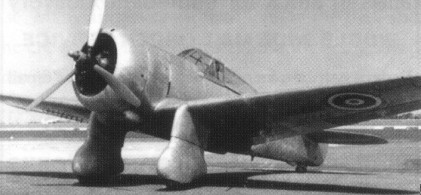
One of the first mono¬plane fighters to be put into full scale military service, designed by Donovan R Berlin, the Model 75 Hawk began as an entrant in a 1935 design competition. Work on the prototype began in October 1934, and it flew for the first time on 15 May 1935, powered by a 900 hp / 671kW Wright R 1670-5 two row radial engine. Featuring a monocoque fuselage and a multi-spar wing, proposed armament comprised one 12.7mm and one 7.62mm machine gun.
The competition was delayed by the other prospective entrants until August 1935, when the Curtiss entry was designated Model 75A during the trials. After this, all entrants were recommended to improve upon their designs. The unsatisfactory behaviour of the Wright engine resulted in its replacement by a 700hp Pratt & Whitney R-1535 Twin Wasp Junior.
This, too, proved troublesome and was succeeded by a 950hp Wright XR-1820-39 (G5) Cyclone nine-cylinder radial with which the prototype became the Model 75B.
In the rerun of the competition in April 1936 the modified Hawk, lost the main army contract to the Seversky SEV-1XP, but in July 1936 three examples were ordered for further trials.
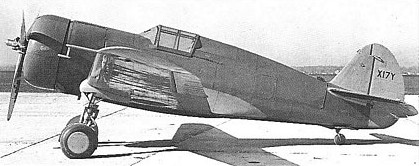
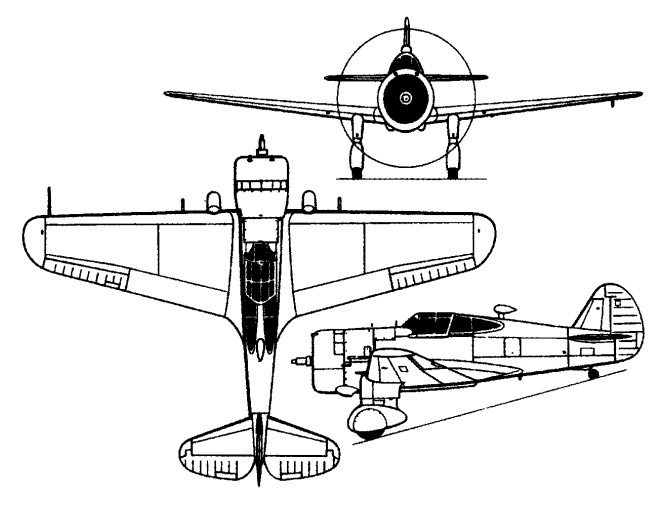
Known as YIP 36s, they had retractable tailwheels, modified cockpit canopies, and were fitted with 1050 hp R-1830-13 Twin Wasps, first flying in January 1937. Two hundred and ten Model 75As were ordered in July 1937, of which 178 were completed as P 36As, with standard armament of two 0.30¬in (7.62 mm) machine guns above the engine, and 31 as P 36Cs with uprated engines (1200¬hp R 1830 17s) and an additional 0.30 in (7.62 mm) gun in each wing. The first production P-36A first flew in April 1938.
Deliveries began in April 1938 and ended early the next year, and on December 7, 1941, four P 36As of the 46th Pursuit Squadron shot down two Japan¬ese bombers in the second stream of the attack on Pearl Harbour.
The US Army 18th and 20th Pursuit Groups operated the P-36A, the 20th employing three squadrons at Barksdale Field, Louisiana. As late as 1942, while war raged in the Aleutians, the 28th Composite Group operated P-36As in Alaska.
Only 177 P-36A were completed, the remaining machines being converted to P-36B with higher power engines.
The 1st Pursuit Group, Selfridge Field, Michigan, despatched a dozen P-36Cs to the National Air Races in Cleveland, Ohio, in September 1939, each machine painted in an elaborate, one-of-a-kind camouflage scheme.
Amid the 7 December 1941 Japanese carrier strike on nearby Pearl Harbor, First Lieutenant Lewis M. Sanders, commander of the 46th Pursuit Squadron, got aloft from Wheeler Field with four P-36As and led his men in shooting down three attacking aircraft. Second Lieutenant Philip M. Rasmussen was credited with one of the kills, as was Second Lieutenant George H. Sterling, Jr, who was killed in the action, one of the first American fatalities of the conflict.
The XP-36D was tested with two cowl-mounted 12.7mm and four wing-mounted 7.62mm guns. The XP-36E was also a solitary armament test ship with one nose 12.7mm and eight wing 7.62mm guns. The XP-36F, also a one-off conversion, had two underwing 23mm Madsen cannon plus one 7.62mm and one 12.7mm nose guns. Production efforts shifted to 31 examples of the P-36C with engine improvements.
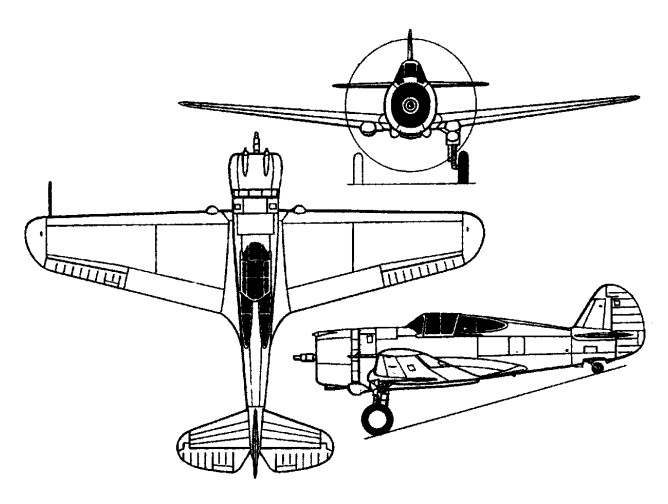
In 1937 Curtiss had built two Model 75H demonstrators for export in parallel with the three Y1P-36s ordered by the USAAC, these being of simplified design with a fixed cantilever undercarriage. Racks under each wing carried up to 136 kg (300 lb) of bombs, and powered by the 875hp Wright Cyclone GR-1820-G3 Cyclone nine-cylinder radial. One mounted an armament of one 12.7mm and one 7.62mm gun in the nose, and the other having this armament supplemented with a pair of wing-mounted 7.62mm weapons. These were sold singly to Argentina and China, both of whom became major customers for the fixed gear version.
China was the first quantity purchaser of the fixed undercarriage Hawk 75, a total of 30 being delivered under the designation Hawk 75-M between May and August 1938. A further 82 were to have been assembled by CAMCO (Central Aircraft Manufacturing Company) at Loiwing, but these were cancelled in favour of assembly of the more advanced Hawk 75A-5.
In 1938 112 examples of a less complex export version, the Hawk Model 75M, were purchased by the Chinese Nationalist air force powered by 875 hp Cyclones and armed with two 0.30 in (7.62 mm) machine guns
The delivery followed from November 1938 of 29 aircraft to Argentina under the designation Hawk 75-O, these having an armament of four 7.62mm guns, and a further 20 examples were licence-built by the FMA.
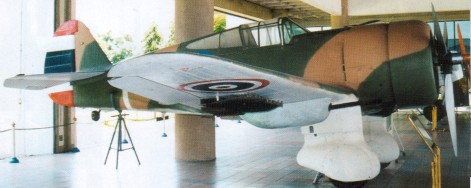
Delivered to Thailand in 1937 were 12 Hawk 75-Ns, these having two fuselage-mounted 7.62mm guns and two underwing 23mm Madsen cannon. The 75N is a ‘light-weight’ export version with a fixed spatted undercarriage and powered by a Pratt & Whitney R1830 radial. The type saw limited action, against France when Thailand invaded Indo-China in January 1941 and again in December against invading Japanese forces. Four were lost during opening battles and the remainder eventually falling into Japanese hands.
Two additional 0.30 in (7.62 mm) guns, wing mounted, were installed in the 25 Model 75Ns exported to Siam, while 30 Model 75Os ordered by Argentina had six 0.30 in (7.62 mm) guns, all mounted in the wings. A further 200 Model 75Os were licence built in Argentina, bringing overall Hawk 75 series production to 1443, including prototypes and those built outside the US.
Two export Hawk Model 75Qs went to China, one being presented to General Claire Chennault by Madame Chiang Kai-shek. In the USA, the relatively new P-36As were rapidly considered obsolescent as war clouds gathered.
Completed late in 1938 as a company-owned demonstrator, the Hawk 75-R was essentially similar to the USAAC’s P-36A. Its Pratt & Whitney R-1830-19 (SC2-G) Twin Wasp was, however, fitted with a turbo-supercharger mounted beneath the nose, just aft of the engine cowling, with a ventrally-mounted intercooler. Extensively tested by the USAAC, the Hawk 75-R was eventually returned to Curtiss as the turbo-supercharger proved unreliable and the manual monitoring of the unit was considered impracticable in combat. The turbo-supercharger was subsequently removed and the aircraft re-engined with a Cyclone.
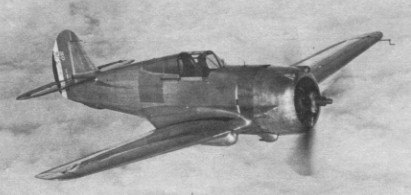
No other P 36 model entered production for the US Army, but the designation P 36G was given to 30 H75A 8 export Hawks from an abortive Norwegian order, and there were numerous experimental models. The XP 36B, a P 36A fitted with an 1100 hp R 1830 25 Twin Wasp, was the fastest P 36 variant, but did not go into production. Another P 36A, converted in March 1939, became the XP 42 (Curtiss Model 75S) which, with an R 1830 31 engine and streamlining modifications, eventually reached 552 km/h (343 mph). The XP 36D, XP 36E and XP 36F were one off armament testbeds. One XP 37 (Curtiss Model 75I), based on the P 36 design, had a longer fuselage, the cockpit further aft, and an 1150 hp Allison V¬1710 11 engine. It was the first US fighter to exceed 483 km/h (300 mph), and 13 were ordered for service trials as YP 37s; but further development was abandoned, as the XP 40 (Curtiss Model 75P) Warhawk prototype was clearly the better proposition for series production.
Against the 228 P 36 type Hawks built to USAAC/USAAF contract, more than 1200, in numerous versions, were built for export, serving in many theatres of the Second World War and with both sides involved in the conflict. First export model was the H75A-1, of which 100 were ordered by France in May 1938, deliveries beginning in February 1939. They were similar to the P 36A, with a 1050hp R 1830 SC3G Twin Wasp engine, two 73mm (0.295 in) FN Browning machine guns above it, and one in each wing. Designated H75 C1 by the French, indicating Chasse or fighter, one seat, when that country fell in 1940 some were captured by the Luftwaffe, others escaped to unoccupied France, North Africa or the UK, and some were resold to Finland. Those absorbed by the RAF were named Mohawk I; similarly, Mohawk IIs were escaped H75A 2s from the second batch of 100 ordered by France in 1938, which had 1050 hp R 1830 S1C3G Twin Wasps and two extra 7.5 mm (0.295 in) guns. Delivery of the penultimate French order, for 135 H75A 3s, was completely disrupted by the country’s collapse. Identical to the H75A-2s but for their uprated (1200 hp) Twin Wasp engines, some A 3s went to the West Indies as trainers while others rusted away at their delivery depots. Those still under construction in May 1940 eventually reached the RAF as Mohawk IIs, their six guns being exchanged after arrival for 0.303 in (7.7 mm) Brownings. Their first combat duties were in India in late 1941, although some had served earlier with the South African and Portuguese air forces. The last order from France was for 395 H75A-4s. They were similar to the 2 and 3 except for their 1200hp Wright Cyclone radial engines, and suffered a fate similar to their predecessors while undergoing delivery. Those arriving in the UK were named Mohawk IV, and rearmed to the same standard as before. RAF Mohawks continued to serve in the Burma theatre until 1944.
On Sunday 8 October 1939 at around 3.00pm two French fliers named Villey and Casenobe shot down one Messerschmitt 109 each near Landau, during an aerial combat between 5 Curtiss Hawks of the French ‘Red Devil’ Squadron (4 Sqn 2nd Fighter Group), and for Me 109s. These were the first French kills of the war.
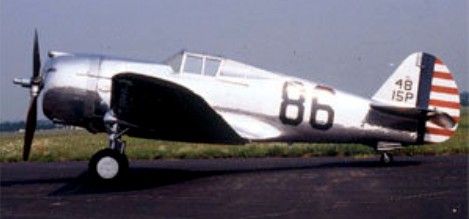
Five of an intended 48 ‘Cyclone Hawks’, or similar to the H75A-4, were licence built by the Hindustan Aircraft Company in India. Curtiss built one similar H75A 5 which, with components to assemble others, was sent to China; but further details are unknown.
Some went to the Luftwaffe, eight were sold to Finland, and those undelivered were sup¬plied subsequently as trainers to the free Norwegian forces in Canada. Holland ordered 35 Cyclone engined H75A 7s, of which 24 were sent to the Dutch East Indies air force for use against the Japanese. Thirty-¬six F175A 8s (Cyclone engines, nose guns of 12.7 mm (0.5 in) calibre) were ordered by Norway. A total of 24 Hawks reached Norway before a 1940 embargo by President Roosevelt on US fighter deliveries to Scandinavia. Six went to the free Norwegians in Canada; the rest became USAAF P 36Gs, 28 of them later going to Peru under Lend Lease. Ten Cyclone-engined H75A 9s (similar to the 4) were ordered by Iran, but never got there: they were captured by the British, shipped to India, and reassembled as Mohawks.
It was also built under licence in India and, with a fixed undercarriage, as the Hawk 75A-0 in Argentina.
Curtiss used this basic airframe to create the re engined XP 37.
In July 1937 Curtiss installed an 1160 hp supercharged Allison V 1710 19 V type engine in the 10th production P 36A, and the XP 40 (Model 75P) was born: the first of a new series of fighter monoplanes that was to reach an eventual production total of 13738 and to serve with ten Allied nations during the Second World War. The XP 40, flown for the first time on October 14, 1938, and evaluated by the USAAC in the spring of 1939, brought Curtiss a $13 million contract for 524 production aircraft, fitted with 1040 hp Allison V¬1710 33 engines, in April of that year. The first three of these were used as prototypes, the first flight by a production P 40 (Curtiss Model 81 A) being made on April 4, 1940.
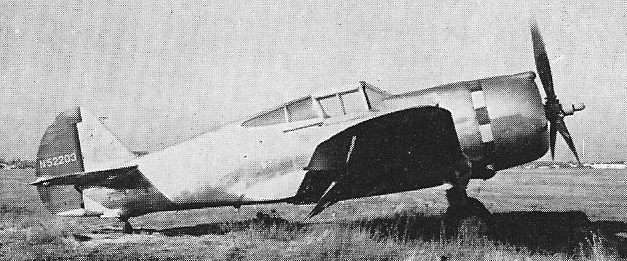
P 36A
Engine: Pratt & Whitney R-1830-13 Twin Wasp, 1050 hp
Wingspan: 37 ft 3.5 in / 11.36 m
Length: 28 ft 7 in / 8.7 m
Height: 9 ft 6 in / 2.89 m
Wing area: 236 sq.ft
Empty weight: 4541 lb / 2060 kg
Loaded weight: 6662 lb / 3020 kg
Max speed: 303 mph / 488 kph at 19,00 ft
Cruise: 259 mph
ROC: 2500 fpm / 762 m/min
Service ceiling: 32,800 ft
Range int.fuel: 680 mi / 1100 km
Armament: 1 x 0.50in Browning, 1 x 0.30in Browning
Bombload: 400 lb / 181 kg
Seats: 1
P-36 C Hawk
Engine: Pratt & Whitney R 1830-17 Twin Wasp, 1184 hp
Length: 28.51 ft / 8.69 m
Height: 9.514 ft / 2.9 m
Wing span: 37.336 ft / 11.38 m
Wing area: 235.947 sq.ft / 21.92 sq.m
Max take off weight: 6010.8 lb / 2726.0 kg
Weight empty: 4621.7 lb / 2096.0 kg
Max. speed: 271 kts / 501 kph
Cruising speed: 235 kts / 435 kph
Service ceiling: 33694 ft / 10270 m
Wing load: 25.42 lb/sq.ft / 124.0 kg/sq.m
Range: 713 nm / 1320 km
Crew: 1
Armament: 1x cal.50 MG (12,7mm), 3x cal.30 MG (7,62mm)
Hawk 75A
Engine: Wright GR-1820-G205A Cyclone, 1200 hp
Wingspan: 37 ft 3.5 in / 11.36 m
Length: 28 ft 7 in / 8.7 m
Height: 9 ft 6 in / 2.89 m
Empty weight: 4541 lb / 2060 kg
Loaded weight: 6662 lb / 3020 kg
Max speed: 303 mph / 488 kph
ROC: 2500 fpm / 762 m/min
Service ceiling: 30,000 ft
Range int.fuel: 680 mi / 1100 km
Armament: 6 x 0.303in
Bombload: 400 lb / 181 kg
Seats: 1
Model 75B
Wingspan: 11.37 m / 37 ft 4 in
Length: 8.56 m / 28 ft 1 in
Height: 2.74 m / 8 ft 12 in
Wing area: 21.55 sq.m / 231.96 sq ft
Take-off weight: 2302 kg
Empty weight: 1837 kg / 4050 lb
Max. speed: 459 km/h / 285 mph
Range: 1175 km / 730 miles
Curtiss P-36G Hawk / Mohawk
Engine: 1 x Wright R-1820-G205A Cyclone piston radial, 1,200hp.
Wingspan: 11.28 m / 37 ft 0 in
Wing area: 21.92 sq.m / 235.94 sq ft
Length: 8.69 m / 28 ft 6 in
Height: 2.82 m / 9 ft 3 in
Empty Weight: 4,676lbs (2,121kg)
Maximum Take-Off Weight: 5,880lbs (2,667kg)
Maximum Speed: 322mph (518kmh; 280kts)
Maximum Range: 650miles (1,046km)
Cruise speed: 420 km/h / 261 mph
Rate-of-Climb: 2,500ft/min (762m/min)
Service Ceiling: 32,349ft (9,860m)
Armament:
4 x 7.62mm machine guns
2 x 12.7mm machine guns
Accommodation: 1
Hardpoints: 1
Hawk 75M
Span: 11.38 m (37 ft 4 in)
Length: 8.71 m (28 ft 7 in)
Gross weight: 2406 kg (5304 lb)
Maximum speed: 451 km/h (280 mph).
Hawk 75R
Take-off weight: 2795 kg
Empty weight: 2302 kg
Wingspan: 11.37 m / 37 ft 4 in
Length: 8.69 m / 28 ft 6 in
Height: 3.71 m / 12 ft 2 in
Wing area: 21.92 sq.m / 235.94 sq ft
Max. speed: 531 km/h / 330 mph
Range: 966 km / 600 miles
Hawk 75-0
Take-off weight: 2346 kg
Empty weight: 1803 kg / 3975 lb
Wingspan: 11.38 m / 37 ft 4 in
Length: 8.71 m / 28 ft 7 in
Height: 2.84 m / 9 ft 4 in
Wing area: 21.92 sq.m / 235.94 sq ft
Max. speed: 451 km/h / 280 mph
Range: 880 km / 547 miles
H75A-1
Span: 11.38 m (37 ft4 in)
Length: 13.711 m (28 ft 7 in)
Gross weight: 2582 kg (5692 lb)
Maximum speed: 488 km/h (303 mph)
H75A-4
Span: 11.38 m (37 ft.4 in)
Length: 8.79 m (28 ft 10 in)
Gross weight.’ 2608 kg (5750 lb)
Maximum speed: 520 km/h (323 mph)
Mohawk IV
Engine: Wright GR-1820-G205A Cyclone, 1200 hp
Wingspan: 37 ft 3.5 in / 11.36 m
Length: 28 ft 7 in / 8.7 m
Height: 9 ft 6 in / 2.89 m
Empty weight: 4541 lb / 2060 kg
Loaded weight: 6662 lb / 3020 kg
Max speed: 303 mph / 488 kph
ROC: 2500 fpm / 762 m/min
Service ceiling: 30,000 ft
Range int.fuel: 680 mi / 1100 km
Armament: 6 x 0.303in
Bombload: 400 lb / 181 kg
Seats: 1
 All Aero