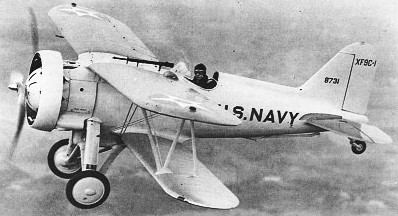
Designed to meet a lightweight shipboard fighter requirement – other contenders being the Berliner Joyce XFJ-1 and General Aviation XFA-1 – the XF9C-1 was flown on 12 February 1931.
It failed to gain acceptance as a carrier-based aircraft, but its small dimensions commended it for use from the dirigibles Akron and Macon which had been designed with internal hangar bays. The XF9C-1 was subsequently fitted with the so-called “skyhook” which engaged the retractable trapeze featured by the dirigibles, some directional instability resulting from the hook dictating the enlarging of the vertical tail surfaces.
A second prototype, the XF9C-2 with single-strut main undercarriage members, was built at Curtiss expense prior to the placing of a US Navy contract for six F9C-2s, which featured a similar tripod undercarriage strut arrangement to the XF9C-1. he XF9C-2 was purchased by the US Navy and modified to F9C-2 standard.
The F9C-2 was powered by a 438 hp Wright R-975-E3 radial engine and carried an armament of two 03-in (7,62-mm) Browning machine guns.
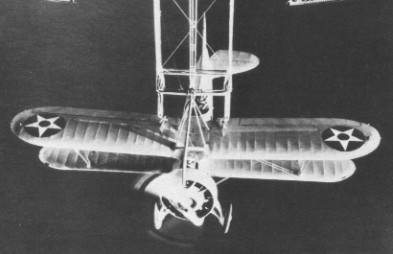
Originally intended to provide fighter protection for the dirigibles, the F9C-2s were used primarily to extend the reconnaissance capabilities of the parent craft. The Akron received her complement of aircraft in June 1932, ten months after she was commissioned and tests soon realized her potential as an aircraft carrier whose fighters could patrol beyond the horizon, controlled by radio from an airborne command post aboard the airship. Akron went down in the Atlantic on 3 April 1933 during a violent storm, but the parasite experiments continued with Macon until 12 February 1935, when her top fin disintegrated inflight, half her helium escaped and Macon went into the sea together with four of the F9C-2s. The US Navy’s affair with airships and trapeze aircraft was finished.
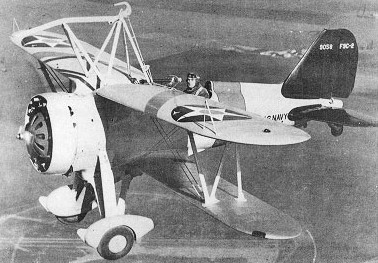
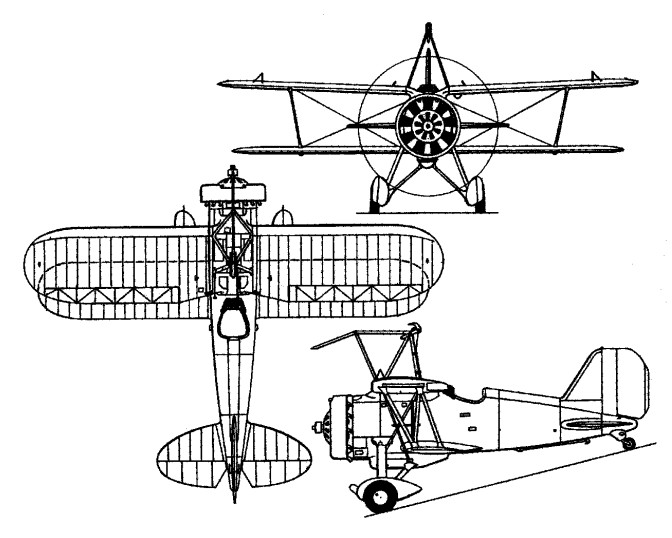
F9C-2
Engine: 438 hp Wright R-975-E3 radial
Span, 25 ft 5 in (7,75 m)
Length, (6,27 m)
Height: 10 ft 1 11.5 in (3,34 m).
Wing area, 173 sq ft (16,07 sq.m).
Empty weight, 2,089 lb (947 kg)
Loaded weight, 2,770 lb (1 256 kg)
Max speed, 176 mph (284 km/h) at 4,000 ft (1220 m)
Initial climb, 1,700 ft/min (8,63 m/sec)
Range, 350 mls (563 km)
Armament: two 0.30-in (7,62-mm) Browning machine guns.
 All Aero