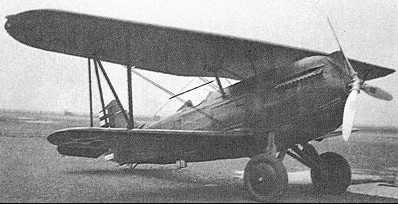
Installation of the new 600hp Curtiss V-1570-1 Conqueror engine in a P-2 airframe for participation in the September 1927 National Air Race at Spokane led to the application of the designation XP-6 (Curtiss Model 35). The prototype placed second averaging 189 mph. A similarly-powered aircraft utilising a P-1A fuselage, untapered XPW-8A wings and surface radiators in both the top and bottom mainplanes became the XP-6A. A third Conqueror-powered conversion of a P-1C airframe for a New York-Alaska flight, in July 1929, was assigned the designation XP-6B. Although these aircraft were intended purely to prove the Conqueror engine, the success of this power plant prompted a USAAC order for 18 P-6s (as YP 6s) on 3 October 1928, these being powered by the 600hp water-cooled V-1570-17Conqueror.
Although generally similar to the P-1 in construction, they embodied extensively revised fuselage contours, a deeper fuselage, and were aerodynamically cleaner. Deliveries commenced in October 1929, but with the 11th aircraft Prestone (ethylene glycol) cooling was introduced, the designation changing to P-6A. The V-1570-23 engine in the P-6A had a similar rating to that of the -17 that it supplanted; armament remained unchanged at two 7.62mm guns. In service, eight of the Army Air Corps P-6s were brought up to P-6A standards. Eight additional P-6s were delivered to the Netherlands East Indies and one to Japan under the export designation Hawk I.
Subsequent to being converted as a P-6A, the first production P-6 was fitted with a side-mounted turbo-supercharger on its V-1570-23 engine as the XP-6D, and, in 1932, 10 P-6As were fitted with F-2F superchargers as P-6Ds. In addition, two aircraft originally ordered as P-11s (P-6 airframes with the unsatisfactory 600hp Curtiss H-1640 Chieftain engine) were completed as P-6Ds. The P-6D was 122kg heavier than the P-6A and featured a three-bladed propeller, and its performance included max speeds of 306km/h at 3050m and 317km/h at 3960m, service ceiling being 9755m.
Of three P 11s ordered, two were completed as P 6s as the intended engine (Curtiss Chieftain) was found unsuitable; the third became the YP 20 with a 575 hp Wright R 1820 9 Cyclone radial engine. Modifica-tions to all three included a new control system, a tailwheel instead of a skid, spats on the main wheels, and more fin and less rudder area. The XP 22 was a P 6A, retaining the Conqueror engine but having a modified nose and radiator, single strut main undercarriage legs and revised tail unit. Forty six of these, ordered as YIP 22s, were completed as P-6Es; 45 were delivered in late 1931/early 1932, the remaining aircraft becoming the XP 23.
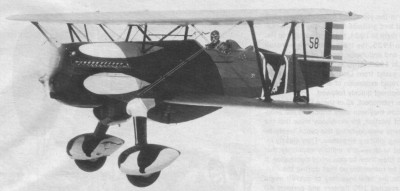
The Army Hawks engendered a bewilder¬ing assortment of experimental conversions, reconversions and redesignations, but the mainstream production models were the P 1, P 2, P 3, P 5 and P 6 fighter series.
When the V-1570-23 engine of the XP-22, complete with three-blade propeller and the cowling, plus the cantilever main undercarriage members of the XP-22 were grafted on the YP¬20 airframe in the autumn of 1931, the result was designated XP-6E. The 45 Y1P-22s ordered during the previous July and which were briefly to be referred to as P-6Cs, being designated as P-6Es by the time deliveries began on 2 December 1931. Powered by the same 600 hp Curtiss V-1570-23 Conqueror engine, the P-6E carried an armament of two 03-in (7,62-mm) Browning machine guns and 17 surviving examples were eventually assigned to ground schools during the summer of 1939. In the spring of 1932, the XP-6E was returned to Curtiss for a turbo-supercharged V¬1570-55 engine of 675 hp, a fully-enclosed cockpit with aft¬sliding canopy being fitted at the same time and the designation being changed to XP-6F. This attained 225 mph (362 km h) at 18,000 ft (5485 m) during tests. One P-6E was temporarily assigned the designation XP-6G while being used as a test-bed for the V-1570-51 (F-series) engine, while the first production P-6E was also fitted with this engine and experimental wing armament as the XP-6H. The wing armament comprised two 0.3-in (7,62-mm) guns in both the upper and lower wings, these firing outside the propeller disc and augmenting the twin synchronised fuselage guns.
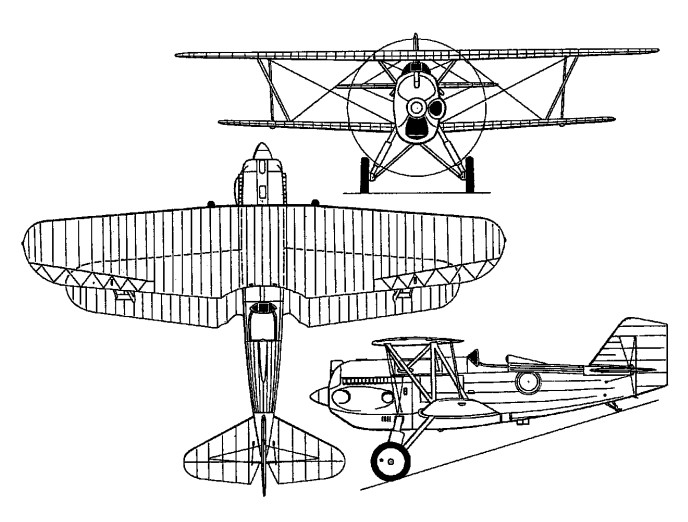
Armament on all biplane Hawks was the same: two 0.30 in (7.62 mm) Browning machine guns in the decking above the engine. (The only exception was the XP 6H, to which were added two 0.30 in (7.62 mm) guns in the upper wing and two in the lower wings.) Provision existed for the carriage of bombs beneath the fuselage
Total Hawk production for the USAAC was 243 aircraft; in addition, eight P 6s were sold to the Dutch East Indies and one P 6, for evaluation, to Mitsubishi in Japan. Also exported were several ‘Cuban Hawks’, powered by 450 hp Pratt & Whitney R 1340 radial engines.
Curtiss P-6 replica:
Sauser Aircraft Ltd P-6E replica
XP-6
Engine: 600hp Curtiss V-1570-1 Conqueror
XP-6A
Engine: 600hp Curtiss V-1570-1 Conqueror
XP-6B
Engine: 600hp Curtiss V-1570-1 Conqueror
P-6
Engine: 600hp Curtiss V-1570-17 Conqueror
Armament: two 7.62mm guns
P-6A
Engine: Curtiss V-1570-23 Conqueror
Wingspan: 9.60 m / 31 ft 6 in
Length: 7.19 m / 23 ft 7 in
Height: 2.62 m / 8 ft 7 in
Wing area: 23.41 sq.m / 251.98 sq ft
Take-off weight: 1439 kg / 3172 lb
Empty weight: 1083 kg / 2388 lb
Max. speed: 286 km/h / 178 mph
Armament: two 7.62mm guns.
P-6 / Hawk I
Export version
XP-6D
Engine: Curtiss turbo-supercharged V-1570-23 Conqueror
P-6D
Engine: Curtiss V-1570-23 Conqueror F-2F supercharged
Propeller: three-blade
Wingspan: 9.60 m / 31 ft 6 in
Length: 7.19 m / 23 ft 7 in
Height: 2.62 m / 8 ft 7 in
Wing area: 23.41 sq.m / 251.98 sq ft
Max speed: 306km/h at 3050m
Max speed: 317km/h at 3960m
Service ceiling: 9755m
Armament: two 7.62mm guns.
P-6E
Engine: one 600 hp (447 kW) Curtiss V-1570-23 Conqueror
Span: 31 ft 6 in (9,60 m).
Length: 23 ft 2 in (7,06 m).
Height: 8 ft 10 in (2,69 m).
Wing area: 252 sq ft (23,41 sq.m)
Empty weight: 2,699 lb (1 224 kg).
Loaded weight: 3,436 lb (1 558 kg).
Max speed: 193 mph (311 km/h) at sea level
Max speed: 180 mph (290 km h) at 15,000 ft (4570 m)
Cruising speed: 145 kts / 269 kph
Service ceiling: 26263 ft / 8005 m
Initial climb: 2,460 ft/min (12,49 m sec)
Normal range: 285 mls (458 km).
Armament: 2x MG .30 cal. (7,5mm)
Crew: 1
P 11
Engine: Curtiss Chieftain
Tailwheel
 All Aero