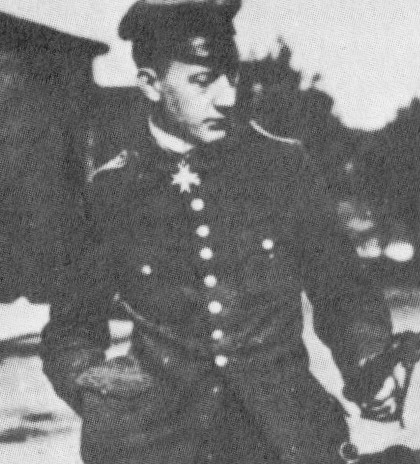
Born in Krefeld in 1897, Voss was the youngest of three sons and two daughters of an industrial dyer.
Voss enlisted in 1914 at the age of 17 in the 2nd Westphalian Hussar Regiment Nr. 11, serving on the Eastern Front. When his regiment was disbanded he transferred to the Luftstreitkräfte (German Air Service) in August 1915, joining FEA7 in Cologne. In September, he was sent to Egelsberg to learn to fly. A gifted pilot, he was immediately enrolled as an instructor at FEA 7 upon graduating in February 1916, before finally departing to the front on 10 March.
Vizefeldwebel Voss was posted to Kampfstaffel 20 of Kampfgeschwader IV, and served as an observer before he was allowed to fly as a pilot, receiving his pilot’s badge in May 1916. Commissioned in September, he then transferred to scout aircraft and was posted to Oswald Boelcke’s Jasta (Jagdstaffel) 2 in November 1916.
Voss scored his first two victories at the age of 18 on 27 November 1916. Scoring rapidly during February – March 1917, he was awarded the Pour le Merite on 8 April 1917, with his score already 24.
After 28 claims, Voss was sent to command Jasta 5 on 20 May, then briefly posted to Jasta 29 as temporary commander, before a similar posting to Jasta 14 on 3 July. On 30 July, Voss moved to permanent command of Jasta 10 in Richthofen’s Jagdgeschwader I (JG I) (or the “Flying Circus” as it became called by the Allies).
Voss had a gift for mechanical engineering, and was an avid rider of motorcycles. Voss also mechanically “tweaked” his aircraft, often being found in the hangar working on his motorcycle or his machine and its guns. Voss was known as a loner and an inspirational, rather than effective, unit leader. Modern writers often describe him as “mercurial”. He was a casual dresser, but when flying would wear full uniform, in case of a forced landing.
Voss was wounded on 6 June 1917 during a dogfight with 6 Naval Squadron Royal Naval Air Service, (possibly by Flt Sub-Lt Christopher Draper) but soon returned to duty. He was by now credited with 38 confirmed victories in his Albatros D.III, at the time decorated with a swastika and heart motif (for good luck).
In August, having tested a F.I prototype (103/17, Wk. Nr.1730) of the Fokker Dr.I triplane Voss adopted the rotary engine triplane as his personal aircraft. Voss had flown kites with his cousins in Krefeld and the kites gave him the inspiration to paint the nose of his Fokker Dr.I with two eyes, eyebrows and a moustache.
Voss rapidly claimed 10 more victories between 3 and 23 September to raise his total to 48, second only to the Red Baron.
After shooting down a No. 57 Squadron DH 4 bomber on 23 September, Voss went out on a further patrol and was engaged by six Royal Aircraft Factory S.E.5s of the elite 56 Squadron. In one of the most remarkable encounters in aerial history, Voss fought a single-handed dogfight against several aces: Capt. James McCudden, Lt. Richard Maybery Lt. Geoffrey Hilton Bowman, Capt. Reginald Hoidge, Lt. Arthur Rhys Davids. Keith Muspratt and Lt V.P. Cronyn, with Lt. Harold A. Hamersley and Lt. Robert L. Chidlaw-Roberts of 60 Squadron. The dogfight developed over Poelkapelle. Another German ace, Carl Menckhoff, attempted to assist Voss but was downed by Rhys-Davids, (though surviving). Voss fought the RFC aces for just 10 minutes, eluding them and achieving hits on nearly every S.E.5.
Using the triplane’s superior rate of climb and its ability to slip turn (using the rudder to turn quickly), Voss managed to evade his opponents. He was able to turn at high speeds and attack those behind him. After flying past McCudden in a head-on confrontation, however, Voss’s Fokker was hit with bullets on the starboard side by Hoidge. One round pierced his right side and passed through his lungs. Nearing death, Voss did not see Rhys-Davids approach from the 6 o’clock position, directly behind his tail.
Rhys-Davids got below him and poured two drums of Lewis fire into the underside of the triplane, then attacked again with both guns. The Fokker fell away, stalled and crashed into the British line. McCudden recalled: “I saw him go into a fairly steep dive and so I continued to watch, and then saw the triplane hit the ground and disappear into a thousand fragments, for it seemed to me that it literally went into powder.”
Voss crashed near Plum Farm north of Frezenberg in Belgium. Only the rudder, cowling, and parts of the undercarriage were salvaged; the new type of aircraft was the subject of an intelligence report by 2nd Lieutenant G. Barfoot-Saunt.
 All Aero