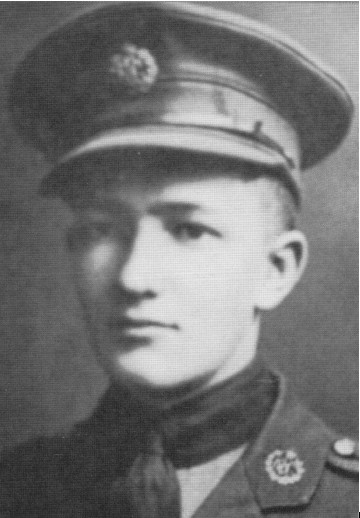
William Samuel Stephenson was born in Winnepeg, British Columbia, on 11 January 1896. He began the war in the Winnipeg Light Infantry, served as an engineer and survived being gassed in 1916. Stephenson applied to the RFC on 16 August 1917 and joined No.73 Sqn on 9 February 1918. He scored his first victory over an Albatros D.V on 22 March, followed by an LVG in flames two days later.
On 3 May Stephenson was credited with a Dr.1 near Ploegsteert but his next claim did not come until 9 July, west of Moncheaux. Twelve days later he shared in the destruction of a Dr.1 north-east of Oulchy le Chêteau with eight others.Stephenson claimed his fourth triplane, as well as a Fokker D.VII over Bazoches, the following day.
After sharing in the destruction of an LVG on 25 July, Stephenson went missing for three days. He was last seen battling seven Fokker D.VIIs, one in flames became his 12th victory. As he came down over German lines, he was hit by a machine gunner, force landed, and was taken prisoner.
Stephenson later escaped from the POW camp, taking note of every German installation of possible military value as he made his way back to join his squadron. In addition to the Military Cross, Stephenson was gazetted for the Distinguished Flying Cross.
Moving to England in 1924, Stephenson became a wealthy industrialist whose international business dealings allowed him to acquire information on Nazi rearmament which he passed on to opposition MP Winston Churchill as early as April 1936. In World War II he rose to prominence in the counterintelligence role in North America using the code name ‘Intrepid’. Nighted by King George VI and awarded the Presidential Medal for Merit by the Americans, in 1976 he wrote a best selling autobiography, ‘A Man Called Intrepid”.
Stephenson died in Paget, Bermuda, in January 1989. Ian Fleming, who used him as the model for ‘spymaster M’ in his novels, summed his career up in 1962 when he wrote ‘James Bond is a highly romanticised version of a true spy. The real thing is William Stephenson’,
 All Aero