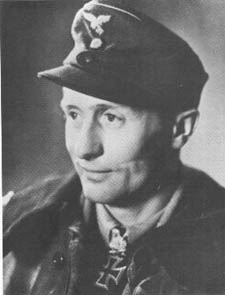
In December 1939, the RAF sent two dozen unescorted Wellington bombers to raid Wilhelmshaven. It was the first British loss of the war. The Staffelkapitan, a Lieutenant Steinhoff, scored two victories.
In 1945 Lt. Gen. Adolf Galland was fired as General of the Fighters and allowed to form JV 44, the “Squadron of Experts.” One of his first staff members was Lieutenant Colonel Steinhoff, who was put in charge of pilot recruiting. And one of Steinhoff’s first choices was a onetime member of his Battle of Britain staffel, Maj. Gerd Barkhorn,
The last six of Steinhoff’s 27 Western Front victories were scored in the Me 262, raising his final tally to 176. The end came for him on April 18, 1945.
Led by Galland, six jets were taking off across a bomb-pocked, hastily patched runway. Steinhoff, one of the last away, had reached some 125 mph when a wheel of his speeding fighter hit a partly filled crater. The plane yawed, shed a gear, skidded up an incline at the end of the runway, sailed 50 yards through the air and crashed in a bare field across a perimeter road. The jet promptly burst into flame.
Somehow, the flesh peeling off his body, he fought free and fled just as the four dozen R4M 55mm rockets slung under the wings began exploding.
Horribly burned about the face, Steinhoff never closed his eyes from 1945 until 1969. He had no eyelids, and was forced to wear a black bandage to sleep at night. Now an RAF surgeon has fashioned new eyelids for him from skin taken from an arm.
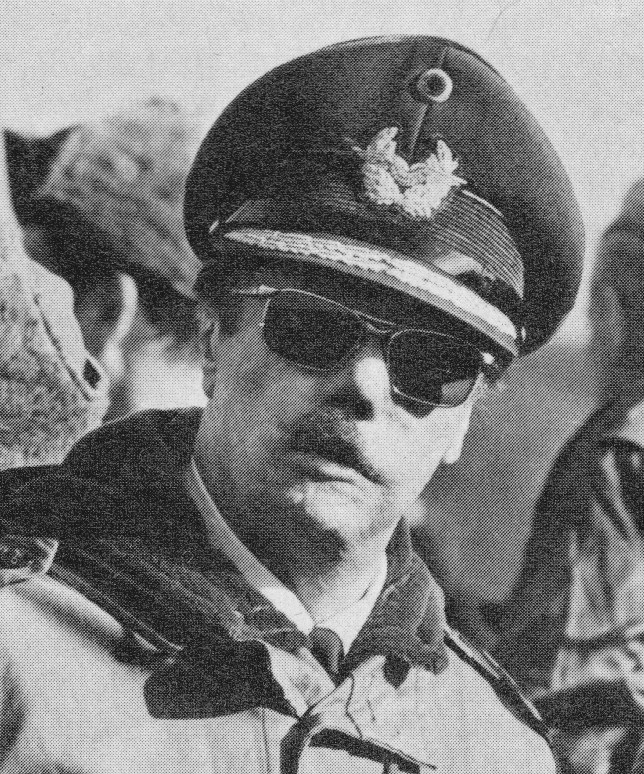
An enthusiastic jet pilot, Steinhoff personally selected the F-104 as the reconstituted Luftwaffe’s standard operational fighter of the 1960s. As Barkhom says, it’s like the 109.
Johannes Steinhoff was the chief of staff of the German Air Force in 1969.
 All Aero