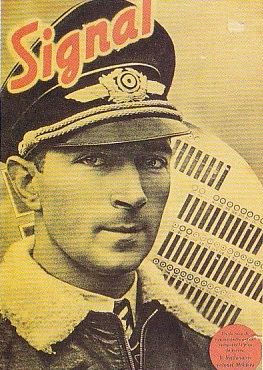
Werner Mölders (18 March 1913 – 22 November 1941) was a World War II German Luftwaffe pilot, wing commander, and the leading German fighter ace in the Spanish Civil War. He became the first pilot in aviation history to claim 100 aerial victories—that is, 100 aerial combat encounters resulting in the destruction of the enemy aircraft, and was highly decorated for his achievements. Mölders was instrumental in the development of new fighter tactics that led to the finger-four formation. He died in an air crash in which he was a passenger.
Mölders joined the Luftwaffe, the air force of Nazi Germany, in 1934. In 1938, he volunteered for service in the Condor Legion, which supported General Francisco Franco’s Nationalist side in the Spanish Civil War, and shot down 14 aircraft. With the start of World War II, he took part in the “Phoney War”, Battle of France, and the Battle of Britain.
On 5 June 1940, Werner Molders was flying to Amiens after a 5.15pm take-off. Encountering French Morane fighters, at about 2600 ft, his Messerschmitt was hit by 2nd Lt. Pomier-Layragues of 7 Squadron, 2nd Fighter Group of the French air force over Compiegne. Capt. Werner Molders. Molders, who was captured by an artillery soldier from a nearby French battery, expressed the wish to meet the man who shot him down, but was too late. While Molders was still dangling from hi parachute, Pomier-Layagues was tackling four Me 109s. He succeeded in shooting down one; then Pomier-Layragues himself was hit, and crashed with his machine near Marissel. The plane exploded at once and he did not have a chance to bail out.
With his tally standing at 68 victories, Mölders and his unit, the Jagdgeschwader 51 (JG 51), were transferred to the Eastern Front in June 1941 for the opening of Operation Barbarossa, achieving 101 victories by mid-July 1941.
On 30 June 1941 the Soviets lost 280 aircraft in all, 216 of them in aerial combats. German fighter wings led by Lt. Col. Molders and by Major Trautloff particularly distinguished themselves during the fighting by shooting down 110 and 65 planes respectively. The Molders fighter wing gave proof of superiority in the region east of Minsk and Bobruist, where large numbers of enemy formations sought to disrupt the movements of the advancing German troops. Of the approximately 100 attacking fighters and bombers, the Molders fighter wing destroyed 80. In the battle Lt.Col. Molders won his 82nd aerial victory.
Prevented from flying further combat missions for propaganda reasons, at the age of 28 Mölders was appointed Inspector of Fighters. He was inspecting the Luftwaffe units in the Crimea when he was ordered to Berlin to attend the state funeral of Ernst Udet, a Luftwaffe general and World War I flying ace. On the flight to Berlin, the He.111 in which he was traveling as a passenger attempted an emergency landing due to an engine failure. It crashed into a factory chimney in the outskirts of Breslau, killing Mölders and two others.
The Wehrmacht and the West German Bundeswehr both honoured him by naming two fighter wings, a destroyer and barracks after him. In 1998, the German Parliament decided that members of the Condor Legion such as Mölders, should “no longer be honoured”. In 2005, the German Ministry of Defence decided to remove the name “Mölders” from the fighter wing still bearing his name.
 All Aero