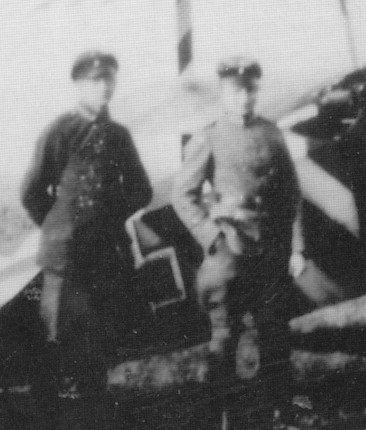
Born in Koblenz on 5 August 1896, Kirschstein served in the 3rd Pioneer Battalion in France and Galicia until May 1917, when he transferred into Aviation. Assigned to Flieger Abteilung 19, he took part in a bombing raid on Dover and straffed British tanks over Flanders. Kirschstein subsequently flew with Fl Abt 256 and Fl Abt 3, before joining Jasta 6 on 13 March 1918. He scored his first victory, a Camel flown by Capt. F.L.Luxmoore, commander of No.54 Sqn, RFC, five days later. On the 27th Kirschstein downed a two seat Armstrong Whitworth FK 8 of No. 2 Sqn RFC, and a Camel.
On 6 April, Kirschstein brought down a Camel from No.3 Sqn RAF, 2 Lt D.G.Gold being taken POW, and the next day he downed Lt. Ronald G. H. Adams of No.73 Sqn RAF.
On 10 May Jasta 6 caught No.80 Sqn’s Camels on a straffing mission and claimed three. Kirschstein downing 2Lt. G.A.Wateley.
His last Camel fell east of Demuin on 15 May, killing Lt. G.Wilson of No.209 Sqn RAF, and he added two Bristol F2Bs during the course of the day.
Ltn Hans Kirschstein was a Dr.1 exponent in the Red Baron’s Circus. Fifteen of his 27 victories, including six camels, were scored with the Dr.1.
Jasta 6 identified itself within JG 1 by black and white tailplane bands, but Kirschstein extended that motif to the after part of the fuselage, the upper wing and the interplane struts of his Dr.1 586/17 in a diagonal manner that Staffel mate Ltn Richard Wenzl called an ‘optische Täuschung’, or optical illusion.
Switching to the Fokker D.VII, which he completely overpainted in his diagonal black and white ‘optische Täuschng’ bands, Kirschstein had raised his tally to 24 by the time he was given command of Jasta 6 on 10 June. Exactly two weeks later, in addition to receiving the Orden Pour le Mérite, Kirschstein downed a Breguet 14 for his 27th victory.
On 16 July Kirschstein flew his D.VII to the aircraft park at Fismes for overhaul and Ltn Johannes Markgraf, who had joined the Staffel only five days earlier, arrived to fly him back to Jasta 6 in a Hannover CL.II. Markgraf had little experience in the Hannover and over controlled the machine. They crashed from an altitude of 50 metres and died soon afterwards.
 All Aero