He is one of the old stagers of the combat Luftwaffe, with experience extending from the Battle of Britain to the very eve of Germany’s collapse. He is one of his country’s most decorated soldiers.
The final World War II rank-
Maj. Erich Hartmann (352)
Maj. Gerhard Barkhom (301)
Maj. Guenther Rall (275)
Maj. Wilhelm Batz (237)
Barkhorn’s military flying career started in the spring of 1938, and a year later, he was introduced to fighters. He’s flown nothing else since. By1969 he had logged some 2,000 hours in the Messerschmitt 109, five hours in a Focke-Wulf Weihe instrument trainer, five hours in the Me 262 Schwalbe, the world’s first combat jet, and some 1,400 jet hours in the new Luftwaffe, which he rejoined in 1956.
He started with JG 2 “Richthofen” in the Battle of Britain, but experience came hard. “I was a very slow learner,” he says today. “I shot at two, but nothing.” Instead, he was himself twice shot down.
The first time he was over England when a Spitfire riddled his oil cooler. Nursing the crippled 109E back across the Channel, he cleared the cliffs between Dover and Folkestone and was just off the water when he was attacked again. Engine dead, Barkhorn bailed out, though he was still on the English side.
Another pilot from his squadron saw him bobbing in the water and notified a German E-boat nearby. The fast German speedboat and a British rescue crew raced each other to the downed flyer. The German crew won, but the narrow escape convinced Barkhorn there was little future in bailing out. He never did again, preferring eight times to ride his crippled 109 down instead.
He had not long to wait for the first one. His Staffel was converting from the E model to the new F, and Barkhom was flying to a field near Hamburg to turn in the older model when he found a scrap enroute. He crash-landed the shot-up fighter on the delivery field, saving him the paperwork of transferring it.
Assigned to II/JG 52 in August, 1940, Barkhorn took part in the invasion of Russia, but even then success eluded him. His first kill took nearly a month, when he scored in
July, 1941.
His personal drought continued for nearly a year, but in May and June, 1942, he bagged more than 20 Soviet aircraft, mostly fighters. “Then I really started. Then I could do it very, very easily. In winter of ’42, I had already 100. In December of ’43, 1 had 250′.
Despite the cold and the demands of operational flying, Barkhorn flew one F for more than 300 hours in 1941-42, with only routine maintenance required on the DB 601E. The plane finally was destroyed in a bombing raid.
Barkhorn flew 14 planes on operations during the entire war, not a bad record for a man grounded two days in 1940 for damaging a 109E-7 during takeoff. The Messerschmitt’s swinging tendencies and weak gear caught up with him again in 1944, during the evacuation of Sevastopol, when he bellied in a 109G he was landing. But most were lost by enemy action.
Once Barkhorn almost was lost as well. He was dueling a Yak 9 low over the Black Sea, when the Yak riddled his coolant radiators before it was downed. “I thought, 1 never will make it. 1 was sweating.”
Climbing to clear the hills of the Caucasus, he would shut down the dangerously overheating engine and glide nearly to treetop level then restart it and climb back to altitude.
He rates the Yak 9 as his most dangerous opponent, but says the 109’s speed edge over the Russian increased with altitude. “We always went up to get away from the Russians, in a shallow climb. Then we’d come back.”
Today, Barkhorn says the hardest Russian plane to fight was the 1-16, the Rata, world’s first low-wing retractable gear pursuit. A stubby unstable airplane, it was blooded in the Spanish Civil War and the SinoJapanese conflict of 1937-38 and was considered obsolete when the Germans invaded. Despite its slow speed, Barkhorn notes “It could turn like-” his English failed him and he, shrugged, spread his hands and finished, “oooh!’”
One widely used American plane in Russia was the Douglas A-20, which Barkhorn considered a satisfying target. The twin-engine attack bomber was caught “easily” by a 109, and he says, “It burned quite well.” He shot one down in the Black Sea near Sevastopol, he recalls. “It burned on the water. It was quite amazing”.
Luftwaffe veterans generally ‘rank RAF pilots as the most troublesome, Yanks next and Russians last. But occasionally, there were Red pilots high in the list. They were mostly Red Guards Regiment flyers, and Barkhorn met one once over Kharkov late in 1943, flying a LaGG-3 painted red from spinner to wing root. “This guy I did fight for half an hour and I couldn’t get him and he couldn’t get me. We both did everything we knew and some we just made up. 1 was wet like I had been in a bath. Never did I work so hard. Finally, we had to give up because of fuel starvation, so we both flew off.
The German fighters’ short range was one reason Luftwaffe pilots made so many sorties. Four a day were routine, and Barkhorn’s personal record is eight in one day. His total for the war is 1,104, more than 10 times the normal mission total of a USAAF pilot. Barkhorn’s averaged a 70 minute sortie time throughout the war. The Messerschmitt could be equipped with an 80-gallon centerline drop tank to augment internal fuel, but those flying on the Eastern -front didn’t like it. And as Barkhorn says, “In comparison with the Mustang, for example, forget it.”
The usual foe was a Pe-2, a Douglas A-20, one of several Russian-built or U. S. Lend-Lease fighters, or one of the endless stream of Il-2 Stormoviks operating on the 1,800-mile front. These were well armored and always caused trouble for German fighters. “Sometimes we shot away all our ammunition on one of them without any reaction, but they burned well if they were hit in the oil cooler,” Barkhom remembers. “Sometimes, too, you had to saw off a wing.” Since the plane was mostly wood, this could be done by a skilful and determined pilot.
For months, Barkhorn was the Luftwaffe’s leading ace. But one afternoon in May, 1944, his II/JG 52 was operating near Yashi, Rumania, in the slow, bitter retreat westward. Barkhom was homeward bound after escorting Stuka ace Hans-Ulrich Ruedel on a ground-support mission, and he was feeling frustrated because there had been no contact with the Reds on this sortie. The Gruppe Kommandeur’s score stood at 273 and he badly wanted to add a couple that day to round out the number.
The returning planes passed Eric Hartmann and his Staffel, heading out on a fighter sweep. Hartmann then was trailing Barkhorn’s lead closely and pressing hard to outscore him.
Suddenly Barkhorn heard Hartmann announce contact with a large fleet of Russian bombers. Barkhorn had been up since before dawn and was finishing his sixth mission of the day, “But when 1 heard that,” he says, “I turned around and started back there. It wasn’t far, and 1 had enough fuel. 1 headed straight for them, and suddenly 1 was headed for the ground.”
His fatigue had made him careless. He’d neglected to check his rear, “and this bloody Airacobra sneaked up behind me”.
He was wounded in the right leg and arm. The knee required corrective surgery, and Barkhorn spent four months hospitalised in Tegernsee. While he was laid up Hartmann took the scoring lead, never to be challenged.
Barkhorn rejoined JG 52 that fall in Hungary, but soon afterward he was tapped as wing commander of JG 6 Horst Wessel, in Sorau, Silesia. He took command of his new unit which was equipped with the 1ong nose” FW 190D-9 in January, 1945, and on January 5, he tallied his 300th kill. There was to be only one more, also in Silesia.
By then, the Luftwaffe was nearly grounded for lack of fuel. JG 6’s airstrip adjoined a Focke-Wulf assembly plant, so aircraft were no problem. “I had 160 brand-new birds and we were allowed to fly only four airplanes once a day due to lack of fuel.”
He tells of dispatching a lieutenant in a Fieseler Storch to find a train, reported stalled in Hungary and laden with aviation gasoline. The lieutenant found the train, sans locomotive. Ransacking Hungary, the lieutenant eventually found a locomotive and a crew to run it, connected it to the train and personally delivered the badly needed fuel to Sorau.
In 1945 Lt. Gen. Adolf Galland was fired as General of the Fighters and allowed to form JV 44, the “Squadron of Experts.” One of his first staff members was Lieutenant Colonel Steinhoff, who was put in charge of pilot recruiting. And one of Steinhoff’s first choices was a onetime member of his Battle of Britain staffel, Maj. Gerd Barkhorn,
Barkhorn’s association with JV 44 was very brief. After converting to the Me 262, he was attacking a USAAF bomber formation on 16 April 1945, on his second combat sortie when his right engine failed.
A flight of P-51s promptly jumped the crippled Swallow. With an engine. out, the jet was slightly slower than the American fighters. Lacking maneuverability to evade the P-51s, Barkhorn was forced to crash-land.
He dived for a clearing in the woods below, opened the canopy and prepared for his eighth crash landing. Like the 109, the jet’s canopy hinged to the side. As it bounced across the ground on its belly, Barkhorn was pitched out of his seat and the canopy slammed down across his neck. As usual, the 262 then caught fire and the semiconscious Barkhorn was slightly burned before he could get clear. Back he went to the hospital.
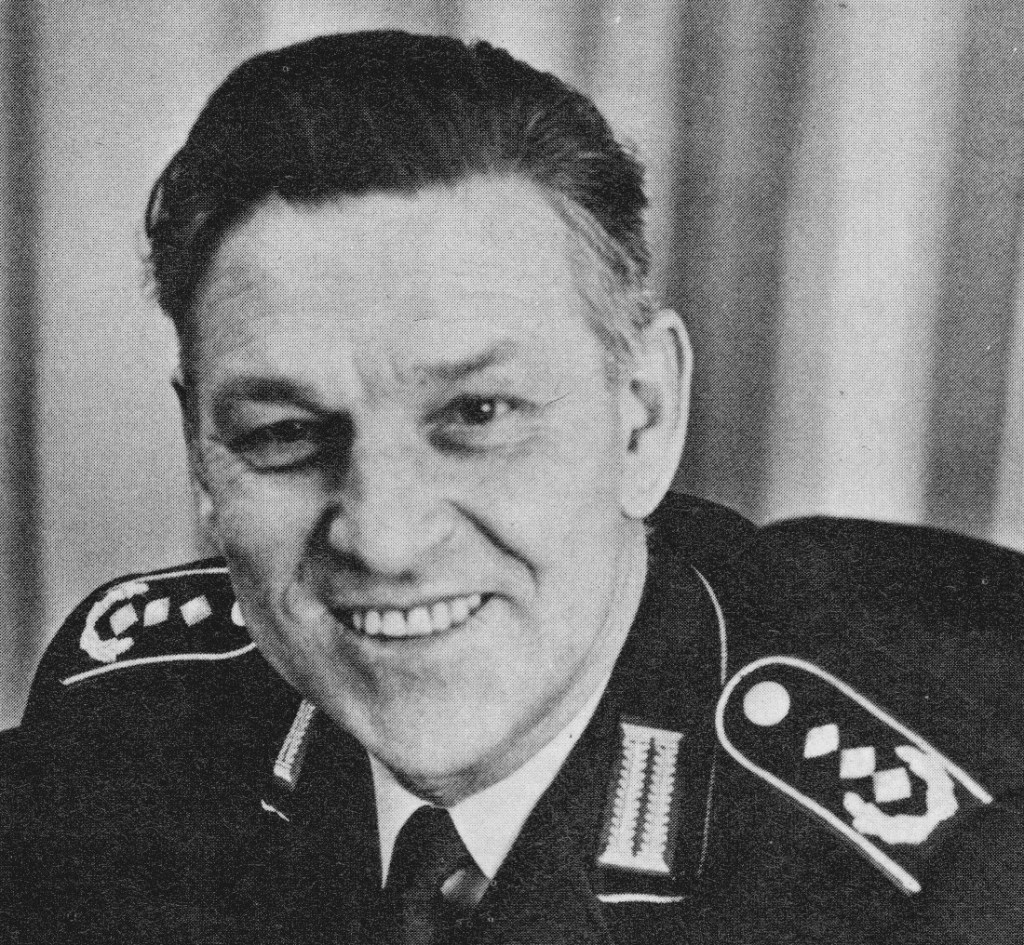
In 1969 Barkhorn, at 50, was still a fully qualified fighter pilot, this time on the Luftwaffe’s F104G. But he says, “I am a desk pilot since April last year,” and is limited to 15 hours’ fighter time a year for budgetary reasons. The man who survived five years’ combat over England, Russia, and the Reich.
 All Aero