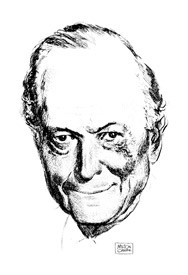
John Leland “Lee” Atwood, the son of a minister and educator, attended Wayland Baptist College in Plainview TX. He earned his Bachelor’s degree from Hardin-Simmons University and took postgraduate engineering courses at the University of Texas, then worked as a junior engineer with the Army’s Aircraft Branch at Wright Field. He later joined a fledgling aircraft manufacturer in Okay OK. The new company built a low-wing sportplane, but did not survive the Depression.
Atwood then was hired by Douglas Aircraft Co in Santa Monica, where he helped design the XTBD, a folding-wing torpedo bomber, and the Douglas DC-1 transport. He also helped upgrade the design to the DC-2 production version. He followed Dutch Kindelberger to fledgling North American Aviation in 1934 and became its chief engineer, then assistant general manager in 1938 and, in 1941, became first vice president of the company. He was elected president of the company in 1948 and, in 1960, became chief executive officer.
In 1937, Atwood’s design won the USAAC competition for a new kind of basic combat trainer with the attributes of a combat aircraft, the result being the BC-1. When the designations of Army aircraft were changed in 1940, the BC-1A became the AT-6 Texan, the most famous of all trainers—nearly 16,000 were built. Following this were other equally famous warcraft, P-51 Mustang and B-25 Mitchell. After WW2, Atwood led his company into the jet age with production of F-86 Sabrejet and its follow-on F-100 Super Sabre, B-45, X-15, and many other notable aircraft, then into the space age with the Apollo, Saturn, and space shuttle programs.
In 1962, he succeeded Kindelberger as chairman of the board. When North American merged with Rockwell-Standard in 1967, Atwood was named President and CEO of the new North American Rockwell Corp, retiring from this post in 1970, but remaining as a member of the Board of Directors and senior consultant. (— North American Co P/R)
Enshrined in National Aviation Hall of Fame 1984.
 All Aero