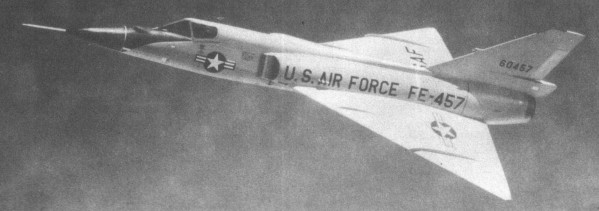
The Convair F-106 Delta Dart began its production life as a direct successor to the interim F-102 Delta Dagger, as the F-102B, built around the advanced Hughes-produced MA-1 fire control system. The F-106 retained many design elements of the F-102 including a small internal bomb bay. Nuclear capability with twin Genie nuclear-tipped missiles was a standard design initiative. An internal 20mm cannon would not be fitted to the system until 1973, when it was found throughout engagements in the Vietnam conflict that close-range fighting was still involved.
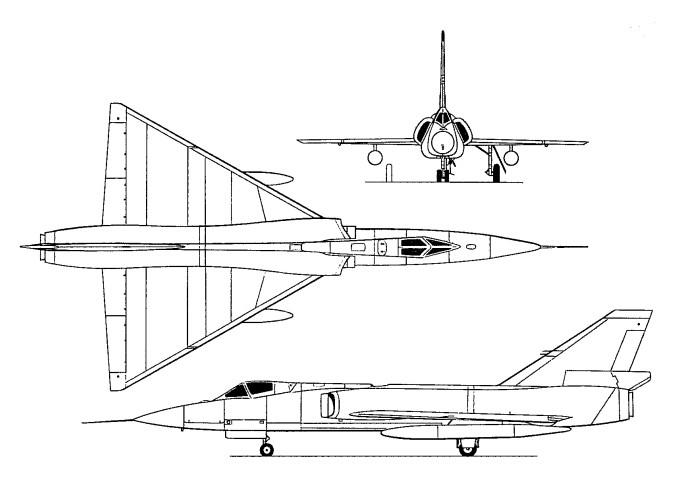
The F-106 has mid-set delta wings, with 60 degrees sweepback, no tailplane, and square-top fin and rudder.
Engine air intakes are on each side of the fuselage just forward of the wing leading edges.
The tricycle undercarriage has a single wheel on each main unit and twin nose-wheels. The nosewheels retract forward.
While development of the earlier fighter was delayed by various teething troubles in 1955-6, progress with the later machine became possible with the development of the Hughes MA-1 integrated fire-control system. In November 1955, the USAF placed an order for 17 F-102Bs and in December, a mock-up of the proposed cockpit with radically new equipment and pilot displays was completed. On 17 June 1956, the F-102B was redesignated F-106.
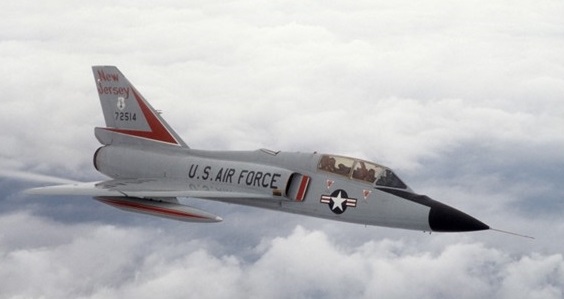
The first of two YF-106A service-test aircraft (56-451/452) flew on 26 December 1956 at Edwards AFB, California. Like most new fighter types in the ‘century series’, the F-106 was initially a disappointment. Maximum speed, rate of climb and overall acceleration were significantly below Air Defense Command expectations with the Pratt & Whitney J57-P-9 turbojet employed in the initial machines and the Wright J67, licence-built Olympus, being contemplated. When the latter powerplant failed to materialise, the USAF reduced its requirement from 1,000 to 360 of the new interceptors.
The first flight of the F-106B two-seat trainer was made in April 1958.
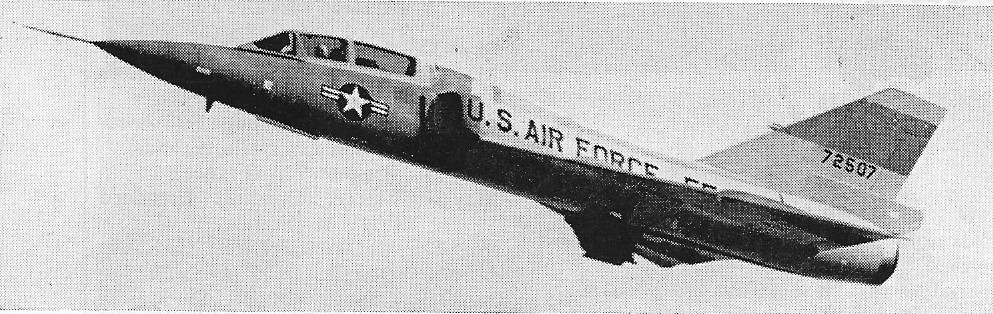
An F-106A held the world speed record of 1525.05 mph from 15 December 1959 until the autumn of 1961.
Performance was improved with the installation of the 7800kg thrust Pratt & Whitney J75-P-17 turbojet which could provide 11100kg thrust with afterburning.
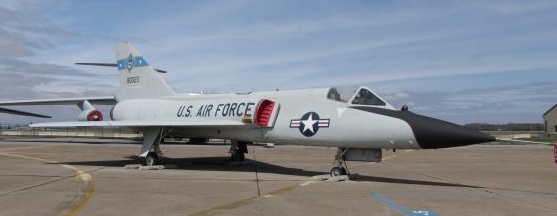
The F-106A attained its initial operating capability with the 498th Fighter-Interceptor Squadron at Geiger AFB, Washington, in October 1959 and subsequently served with 15 ADC and eight Air National Guard squadrons. Except for brief deployments to Europe and to Korea in 1968, the type served exclusively in North America. Totals of 277 F-106A single-seat interceptors served in company with 63 F-106B two-seat combat trainers, 340 machines actually being completed, and the types remained on active duty until 1982.
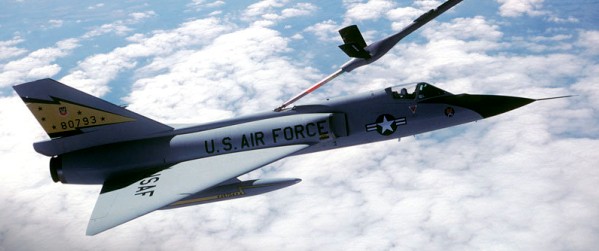
Convair F-106A Delta Dart
Engine: 1 x Pratt & Whitney J75-P-17 turbojet, 17,500 lb / 24,500 lb with afterburner.
Length: 70 ft 10 in (21.55m)
Wingspan: 38 ft 5 in (11.67m)
Wing area: 64.8 sq.m / 697.50 sq ft
Wing load: 55.76 lb/sq.ft / 272.00 kg/sq.m
Height: 20 ft 4 in (6.18m)
Wheel track: 15 ft 5.5 in
Wheelbase: 24 ft 1.5 in
Empty Weight: 24,859lbs (11,276kg)
Maximum Take-Off Weight: 41,831lbs (18,974kg)
Maximum Speed: 1,487mph (2,393kmh; 1,292kts)
Cruising speed: 529 kts / 980 km/h
Cruising altitude: 41011 ft / 12500 m
Maximum Range: 1,950miles (3,138km)
Rate-of-Climb: 30,000ft/min (9,144m/min)
Service Ceiling: 58,005ft (17,680m; 11.0miles)
Armament: 1 x 20mm cannon
Hardpoints: 4 for:
2 x AIR-2A Genie Nuclear Rockets or
4 x AIM-4 Falcon Air-to-Air Missiles
Accommodation: 1
 All Aero