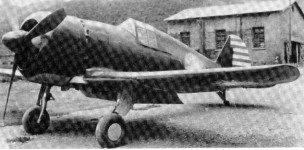
The reliance on foreign imports was not ideal, and so, despite having to pick up and move their comparatively new and basic aircraft industries further west as the Japanese advanced, the Chinese began to explore building their own aircraft designs. And this has led to two, known as the Chu XP-series.
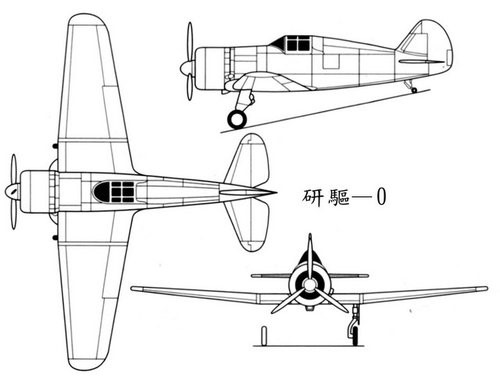
The first of these Chinese aircraft, the XP-0 was initiated in early 1941. Major General Chu Chia-Jen, who was Chief of the Air Force Technical Bureau, started development of an indigenous fighter that would be heavily based on the Curtis Hawk 75 export fighter.
This aircraft had been ordered in kit form from the United States and production had been attempted, but proved too much for the young aero industry, especially with the pressures of Japanese bombing and factory relocation. However, it was the most modern design that the Chinese had experience with, so it formed the basis of the XP-0.
Lacking modern aeronautical materials, the Chinese had to institute many compromises. Instead of the Hawk’s all metal structure, the XP-0 used a mixed construction, utilizing a welded tube metal fuselage which was clad in a plywood skin. The wings too were of wooden construction.
The engine was the Pratt & Whitney Twin Wasp that produced 1,200hp, an engine that was the most powerful available in any numbers to the Chinese.
A unique prototype was manufactured in 1943 by AFAMF-Yangling, using the tail surfaces of a Hawk 75, the centre section of the wing and the landing gear of a North American NA-6, the tailwheel from P-43 and the engine and cockpit of a P-66. The wings were built in wood/plywood.
There are some issues in the information on armament. Generally, it is stated that this aircraft had a rather heavy weapon load of either two or four 20mm cannons, which it carried in underwing fairings, and a centreline bomb rack. But for early 1941, that would be an extremely powerful punch for a single-engine fighter, and certainly a massive step up from the Hawk 75. As said, the available evidence is fragmentary. But it is possible that both may be correct. Because the design was initiated in early 1941, and the first prototype didn’t fly until 1943, it is conceivable that considering the development time involved, the weapon fit did evolve before that first flight.
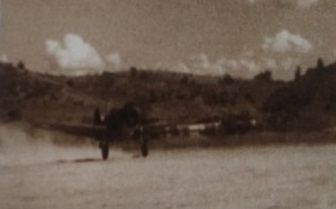
Apparently, the aircraft handled well in the air, but its performance as a fighter by 1943 standards was low. Top speed was reported as 313mph (c.503kp/h) and XP-0 seems to have been broadly comparable to aircraft of its generation.
How well it would have stood up to prolonged flight testing is also a question because on landing the aircraft ground looped and was written off. However, the pilot survived and his debrief apparently allowed at least one more prototype to be developed.
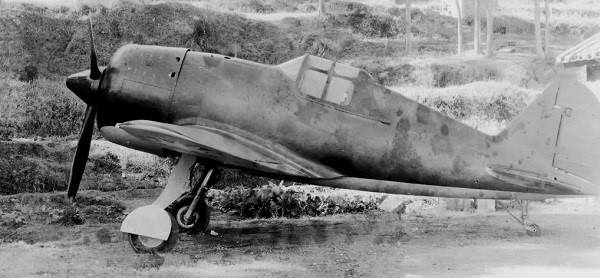
It is confusing as to how many other variants of the XP-0 were built, but some Chinese online sources assert that as many as nine improved models were built through 1944-46.
An upgraded X-P0 with different appearance was shown in 1944.
By mid-1941 China was the recipient of Lend-Lease aid from the United States, and though it would take a while to really build up the Nationalist forces, the massive influx of modern aircraft meant the need for a home-grown fighter was vastly diminished.
Engine: Pratt & Whitney Twin Wasp, 1,200hp
Wingspan: 11.4 m
Length: 8.8 m
Height: 3.70 m
Wing area: 22 sq.m
Max weight: 2,990 kg
est max speed: 504 kph
Range 1,400 km
 All Aero