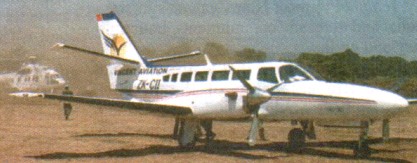
It was reported in July 1982 that with financial support from the French Government, Reims Aviation and Cessna were collaborating in the development of a new pressurised turboprop twin for utility and business use. A variant of the Cessna 400 series, it was known as the Reims-Cessna 406-5 and was to be powered by PT6A-112 engines derated to 500 shp each. Th gross weight was to be about 9260 lb / 4200 kg, of which 4410 lb / 2000 kg would be useful load, and the max range to be more than 1460 miles / 2350 km. The prototype was being built by Cessna, bu Reims Aviation was to be responsible for flight development and eventual production.
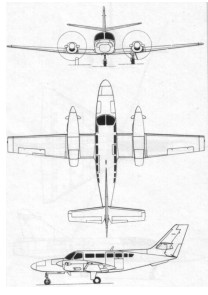
The Caravan II is a French-based design jointly developed by Cessna and the company’s European licensee, Reims Aviation. The twin-turboprop unpressurized aircraft uses Conquest II wings, a Titan-type fuselage with seating for up to 12 passengers and 500 shp (373 kW) Pratt & Whitney Canada PT6A-112s. As well as business use, the Caravan II is operated as a target tug by the French Army, as a freighter with side cargo door and as a coastal surveillance aircraft.
Engines: 2 x Pratt & Whitney Canada PT6A-112, 500 shp (373 kW).
Cruise: 235-240 kts.
Pax cap: 12.
 All Aero