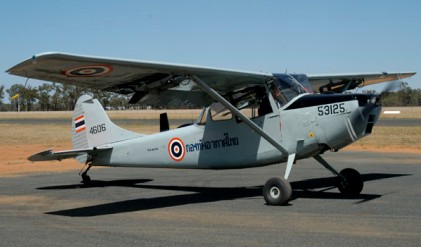
In 1950 five manufacturers entered a competition to replace the fleet of L-4 and L-5 observation planes. The specifications included takeoff and land within 600 feet, cruise at 89 mph, have an observation speed of 49 mph, climb at 800 fpm, three hour endurance, service ceiling of 16,000 ft, and weigh 1000 lb empty.
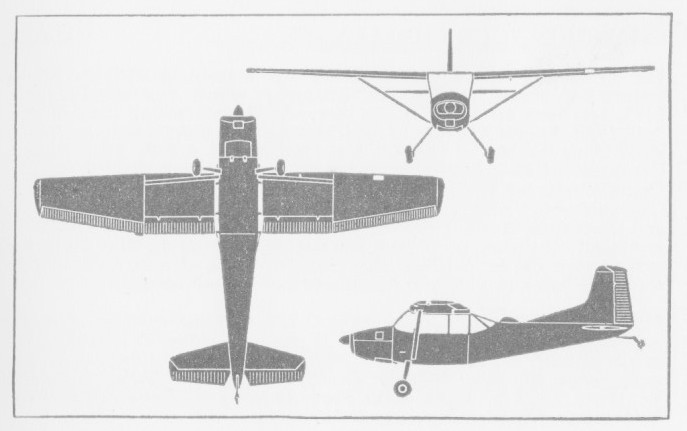
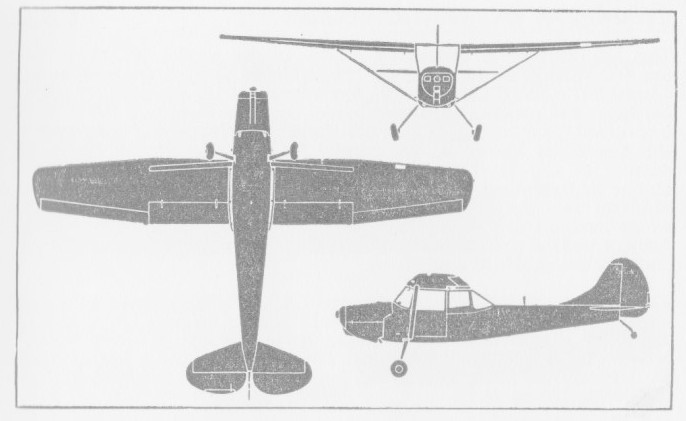
The Cessna engineers put together the wings from the 170, a tail from the 195 and a new fuselage with transparent panels in the roof and a wider access door and new landing gear, to make the Cessna 305. Cessna’s design was a light-weight strut-braced high-wing monoplane, which provided accommodation for a pilot and three passengers.
Power was from a Continental O-470 of 213hp / 108kW and fixed pitch prop.
The fixed pitch prop limited the cruise to 30% power so as not to overspeed the engine.
The Birddog moved from design sketches to first flight in just 90 days. The landing requirement required 60 degrees of flap and a full stall, three-point landing technique with a high rate of sink. The O-1 is not cleared for aerobatics.
Cessna CE-305 / O-1 Birddog Article
Cessna was awarded the contract with an initial order of 418 aircraft on 29 May 1950. The first military designated L-19s were delivered in December 1951 and sent to Korea, arriving there on 16 February 1951.
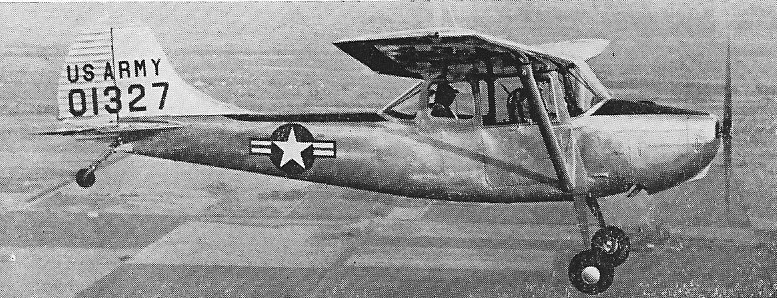
The Model 305A differed from the 170 by having the aft fuselage redesigned to give a clear view to the rear and by the provision of transparent panels in the wing centre-section, which formed the cabin roof. A wider access door gave room to load a standard stretcher, for which support brackets were installed. Spring steel landing gear and slotted high lift flaps were fitted along the trailing edge of each wing.
By June 1951 there were 166 L-16s in Korea, and they had amassed about 20,000 hours.
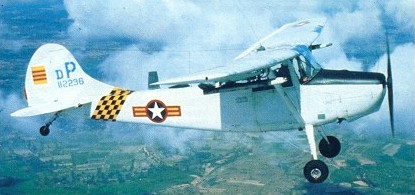
Deliveries of production aircraft began in December 1950, under the designation L-19A and with the name Bird Dog, and by October 1954, 2,486 had been delivered, of which 60 were diverted to the US Marine Corps which designated them OE-1.
An L-19A-IT instrument trainer version was developed in 1953. By 1954 a total of 2486 had been delivered, of which 60 were diverted to the US Marine Corp where they were e-designated OE-1.
In 1956, the Army ordered 100 TL-19D instrument trainers. This was a growth version of the original instrument trainer with a constant-speed prop and a higher gross weight — 2,400 pounds. The next year, the order was expanded by another 207 TL-l9Ds and an uprated version of the basic L-19 was ordered —the “E” model which boosted the higher gross weight and “some minor improvements.”
Sixty Bird Dogs were delivered to the USMC as the O-1B, and the TO-1D is a dual control training version of the O-1A.
The L-19E was the final version to bring total production of Bird Dogs to 3,431. With redesignation in 1962, the US Army’s L-19A, TL-19D and L-19E aircraft became O-1A, TO-1D and O-1E respectively. The US Marines’ OE-1 became O-1B and this service also acquired 25 of the higher-powered O-1C. US Army trainers, derived from standard production aircraft, had the designations TO-1A and TO-1E.
Some O-1 were manufactured by Fuji Heavy Industries for the Japanese Ground Self-Defence Force.
The model 321, or O-1C was an extensively redesigned version of the O-1B Bird Dog for the USMC. The prototype of the O-1C was first flown in 1955 and twenty-five were built. Pilot and observer were protected by flak curtains and seat armour, and all fuel tanks are self-sealing. A 250 lb bomb or three air to surface rockets may be carried beneath each wing. The structure of the O-1C is similar to the O-1B apart from some strengthening for the more powerful engine.
The US Air Force acquired many of the US Army’s O-1s for use by forward air controllers in Vietnam; former TO-1Ds and O-1As were redesignated O-1F and O-1G respectively when equipped for this role.
The O-1Fs were TO-1Ds modified to O-1D standard by deleting the dual controls and rear seat instrument panel and the modified to -F standard by fitting under-wing hard points and army communication gear.
The US Navy ordered 25 of a progressive development designated OE-2. These differ principally in having a longer nose to house a 260 hp Continental SO-370 engine, and taller, more angular tail surfaces.
Cessna had delivered 3,431 examples by the time production ceased including 126 for the French – the bulk of these had been built as O-1s (L-19As), with later variants introducing uprated equipment and the ability to carry wing stores like target marking rockets
Of these, one was a civil prototype and four were evaluation models for civilian use. These were put into service in aerial application and although they got high marks with the dusters, Cessna could not see enough of a market for the aircraft and never put it into production. As far as FAA is concerned, the Birddog is the Cessna 305A and all those converted to civilian use are so designated in FAA records.
O-1s were also built under licence by Fuji in Japan.
Ector Aircraft Co., of Odessa, Texas produced (until stocks of new parts are exhausted) the Ector L-19 Mountaineer and the standard Ector (Cessna) 305. The basic aircraft is delivered with a majored Continental 0-470-11 and the McCauley fixed-pitch prop or with a Continental 0-470-13 or Lycoming 0-540-A4B5, a constant-speed prop and manifold pressure gauge.
Although long since retired from USAF service, a modest number of O-1’s continue to thrive with a handful of air arms across the globe, whilst surplus Bird Dogs have recently enjoyed a renaissance across North America and Australia.
O-1C
Engine: 265 hp Continental O-470-2
Wingspan: 36 ft 0 in
Length: 26 ft 3 in
Height: 7 ft 10 in
Wing area: 174 sq.ft
Empty weight: 1853 lb
Max loaded weight: 2650 lb
Max speed: 185 mph
Econ cruise: 122 mph
ROC: 1300 fpm
Time to 20,000ft: 22.6 min
Range: 575 mi at 10,000 ft
CE-305A
Engine: Continental O-470-11, 213 hp.
Empty wt: 1700 lbs.
MTOW: 2100 lbs (optional): 2300 lbs.
Height: 7 ft 6 in.
Length: 25 ft 9.5 in.
Wing span: 36 ft.
Cruise: (@ 2300 rpm): 78 kts.
Stall: 42 kts.
Cessna L-19E / O-1E Bird Dog
Engine: 1 x Continental O-470-11, 213 hp, 159kW
Wingspan: 10.97 m / 35 ft 12 in
Length: 7.85 m / 25 ft 9 in
Height: 2.22 m / 7 ft 3 in
Wing area: 16.16 sq.m / 173.94 sq ft
Maximum Speed: 130mph (209kmh; 113kts)
Maximum Range: 530miles (853km)
Rate-of-Climb: 1,040ft/min (317m/min)
Service Ceiling: 20,341ft (6,200m; 3.9miles)
Accommodation: 2
Hardpoints: 2
Empty Weight: 1,614lbs (732kg)
Maximum Take-Off Weight: 2,401lbs (1,089kg)
L-19
Engine: Continental O-470-11B, 213 hp
Prop: McCauley 2 blade 90 in fixed pitch
Wingspan: 36 ft
Wing area: 174 sq.ft.
Length: 25 ft 9 in
Height: 7 ft 6 in
Seats: 2
Max gross wt: 2400 lb
Empty wt: 1480 lb
Useful load: 920 lb
Wing loading: 13.79 lb/sq.ft.
Power loading: 11.26 lb/hp
Toatl fuel cap: 42 USG
Useable fuel cap: 36 USG
Baggage cap: 100 lb
Max speed: 179 mph
Cruise 2300 rpm: 104 mph
Stall clean: 44 mph
Stall with flap: 40 mph
ROC SL: 1350 fpm
Service ceiling: 21,300 ft
Takeoff ground roll: 355 ft
Landing ground roll: 320 ft
Cessna L-19A Bird-Dog
Engine: 213 h.p. Continental O-470-11
Span: 36 ft
Length: 25 ft
Height: 7 ft 6 in
Wing area: 174 sq.ft
Empty weight: 1400 lb
Loaded weight: 2200 lb
Max speed: 146 mph at 5000 ft
Cruise: 115 mph
ROC: 1290 fpm
Service ceiling: 21,200 ft
Range: 620 mi
Seats: 2
Cessna O-1G Birddog
Engine: 213hp / 158 kW Continental O-470-11
Fuel: 100 Octane
Wingspan: 36 ft / 10.97 m
Length: 25 ft 9 in / 7.85 m
Height: 7 ft 6 in / 2.29 m
Empty weight: 1,400lbs / 635 kg
Maximum Take-off weight: 2,200lbs / 998 kg
Max speed: 115 mph / 185 kph
Service ceiling: 18,500 ft / 5638.8 m
Max range: 530 mi / 742.08 km
Armament: Eight 2.75 inch (70mm) smoke rockets
Maximum Speed: 131 knots / 151 mph / 243 km/h

 All Aero