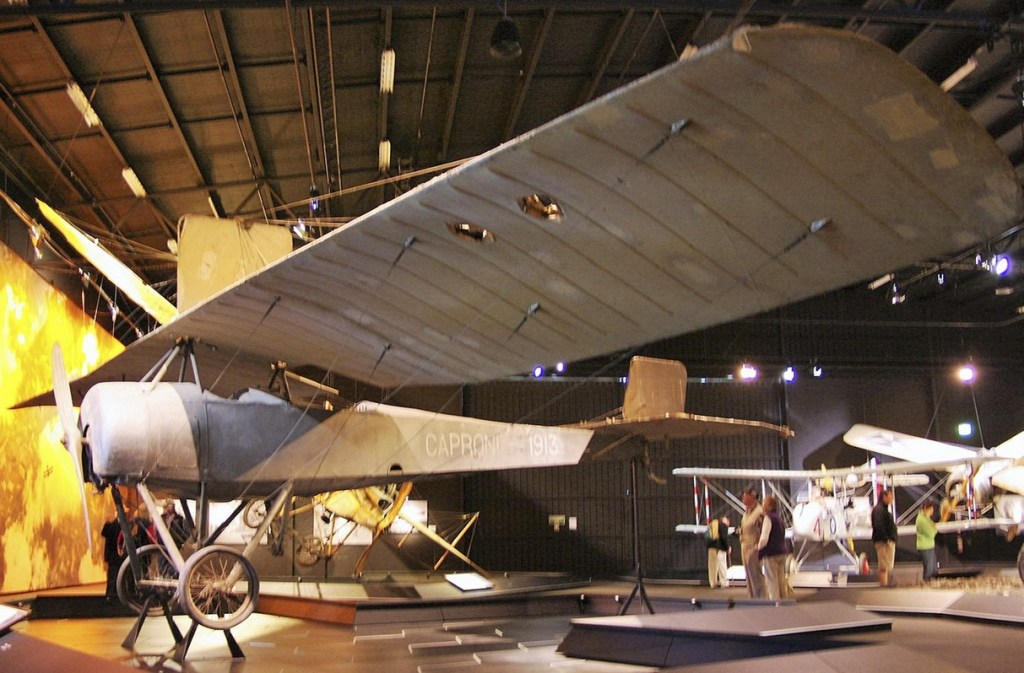
Development of the Caproni Ca.20 led to the Ca.22, a two-seat reconnaissance fighter of parasol wing configuration similar in appearance to the earlier type with a larger propeller spinner and a Le Rhone rotary engine, being either the 60 kw (80 hp) or 75 kw (100 hp) variants, but this was later replaced by a 104 kw (140 hp) Hispano Suiza.
The fin and rudder were of triangular type and were first introduced on the type L. One innovative feature of the design was the ability to tilt the wing to increase or decrease the angle of attack, varying the angle at which the wing surface met the oncoming air and thus varying the amount of lift produced. The machine was otherwise conventional for the time.
The CA.22 served as a two-seat observation aircraft with the Italian Army’s No 15 Squadron, which had used Bleriot monoplanes before the introduction of the Ca.22 in April 1915. It is known seven examples were issued to that unit, and it would appear that this was the complete production of the type. This unit operated near Piacenza with No III Group, being commanded by Captain Umberto Rossi and was involved in the reconnaissance role. On 30 June that year the Squadron’s aircraft were dis-assembled and conveyed to Pordenone near the Austrian border from where further reconnaissance flights were made, as well as commencing bombing operations over enemy territory.
The CA.22 became known as the BH when fitted with the Hispano engine. This engine had a water jacket surrounding the crank case. The Caproni BH was replaced in service by the Model P which was supplied to both the Royal Air Force and French Air Force.
Although not built in large numbers, one example has survived and has been imported to New Zealand, joining the collection of World War I aircraft on display at the Aviation Heritage Centre at Omaka. This example was held in storage by the Caproni Museum in Italy, which was set up by Gianni and Timina Caproni, from about 1929 until imported to New Zealand and is believed to be the only survivor. This machine has been described as a virtual ‘time capsule’ as it has changed very little in the 85 years it was held in storage.
Engine: 60 kw (80 hp) Gnome Rhone
Wingspan: 14.14 m (46 ft 4 in)
Length: 8 m (26 ft 3 in)
Height: 3.5 m (11 ft 6 in)
Wing area: 13.57 m² (144 sq ft)
Max speed: 125 km/h (76 mph)
Empty weight: 480 kg (|1,056 lb)
 All Aero