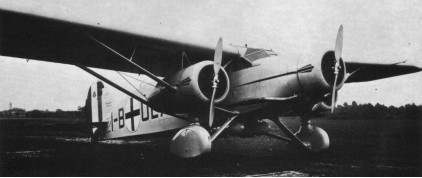
An improved version of the Ca.101, the Ca.133 introduced a number of drag-reducing features, including long-chord engine cowlings, faired undercarriage legs and spatted wheels. The design of the tail unit was also improved. The Ca 133 used three 450‑hp Piaggio Stella, RVII C 14 radial engines, installed in NACA cowlings and driving two‑blade metal propellers.
The transport payload (it was built for both civil and military transport use) was increased eventually to 18 passengers, compared with only eight in the Ca 101. In the bomber role, the maximum internal/external bombload was still restricted to 500 kg (1102 lb), and the defensive armament of 4 7.7‑mm (0.303‑in) machine‑guns remained basically unaltered.
The Ca 133 made its operational debut in Ethiopia in 1936. On 6 March 1936, a Ca.133 made the first photo-reconnaissance sortie over the Ethiopian capital, Addis Ababa, in support of Italian operations. About 10 served with the Nationalist forces in the Spanish Civil War, and others were used as paratroop transports when Albania was invaded in 1939. Several squadrons of the Regia Aeronautica remained equipped with these aircraft when Italy entered the Second World War, but after early heavy losses in North Africa they were mostly removed to the Eastern Front or allocated to ambulance or other transport duties, designated respectively as Ca 133 S (Sanitaria) and Ca 133 T (Trasporto). Less official designations, bestowed as a result of the aircraft’s flying qualities, included the nicknames Caprona (she‑goat) or Vacca (cow). Nevertheless, some Ca 133s survived to serve, after the Italian surrender in 1943, with both the Co‑Belligerent Air Force and the Aviazione della RSI.
Out of 419 Ca.133s produced for the Regia Aeronautica, 329 were Ca.133T transports and 21 Ca.133S ambulance aircraft.
One additional example was built with retractable landing gear, the Ca 142.
The 18‑passenger civil transport version, the Ca 148 (106 built), had a number of improvements including a modified fuselage and a strengthened landing gear for operation in East Africa. The Ca.148 differed from the Ca.133 in having Piaggio d’Ascanio variable-pitch propeller. Loaded weight was increased to allow a normal load of 7716 lb. The cabin can accommodate 16 passengers, and a crew of two. The structure is of welded steel-tube with metal and fabric covering. Many of these were impressed for war service, operating also with Luftwaffe transport units; and several survived to serve with the post-war Italian air force.
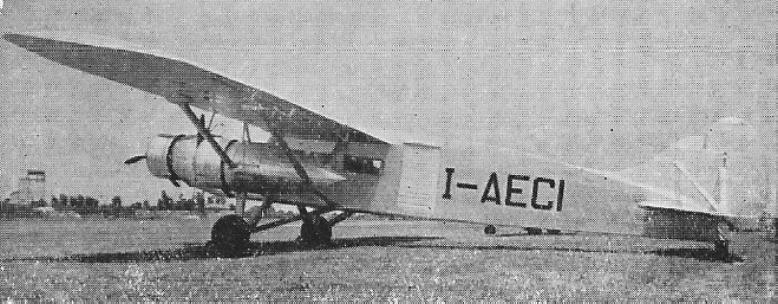
Engines: 3 x 460hp Piaggio Stella P.VII C.16 7-cylinder radial engines
Max take-off weight: 6700 kg / 14771 lb
Wingspan: 21.24 m / 69 ft 8 in
Length: 15.36 m / 50 ft 5 in
Height: 4.00 m / 13 ft 1 in
Max. speed: 265 km/h / 165 mph
Ceiling: 5500 m / 18050 ft
Range: 1350 km / 839 miles
Crew: 3
Armament: 4 x 7.7mm machine guns, 1200kg of bombs
Ca.148
Engines: 3 x Piaggio Stella VII R.C, 460 hp
Wing span: 69 ft 8 in
Wing area: 700 sq.ft
Length: 50 ft 4 in
Height: 13 ft 1 in
Empty weight: 8580 lb
Loaded weight: 14,700 lb
Max speed: 174 mph at 5575 ft
Ceiling: 21,320 ft
Range: 838 mi
 All Aero