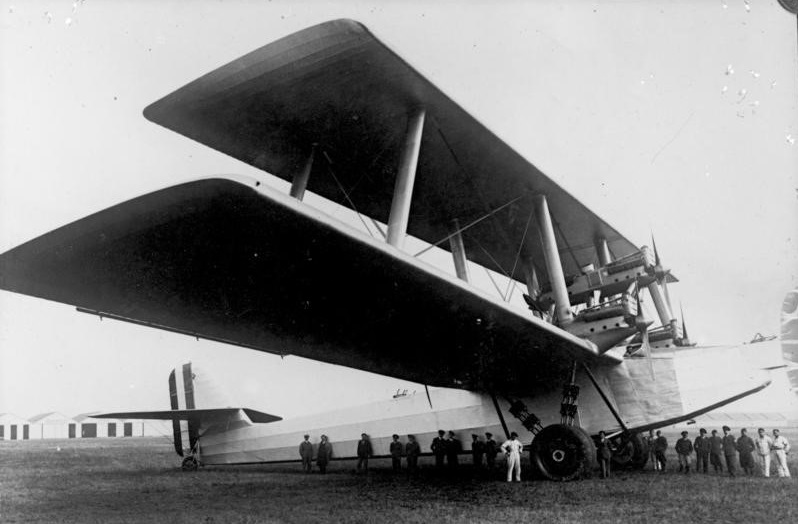
The Caproni Ca.90 was a heavy bomber biplane built by the Italian company Aeronautica Caproni in the late 1920s; while winning some world records relating to the transport of loads at high altitudes, it was built in a single specimen and remained in the prototype stage.
At the time of its construction, the Ca.90 was the largest land aircraft built up to then, a record it held until 1934, surpassed only by the construction of the Soviet Tupolev ANT-20.
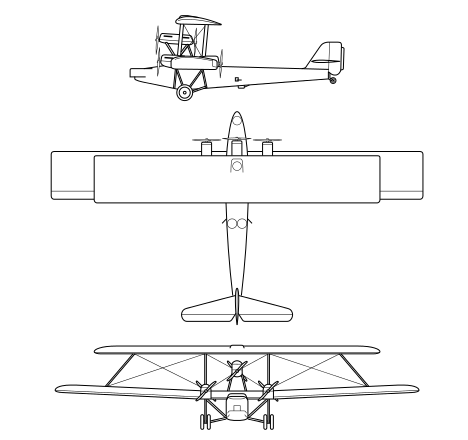
The structure of the Ca.90 was made entirely of steel tubes while the upholstery was in canvas, except in the bow section which was instead covered in corrugated sheet of duralumin. The fuselage, with a rectangular section, housed at the bow end a position for a machine gunner, below which was that of the bomber observer; immediately behind these positions was arranged a first part of the fuel tanks which was followed by the cockpit with dual controls with the two pilots arranged side by side. Other fuel tanks were arranged behind the pilots, followed by the compartments for the bomb launchers and three other positions for the machine gunners (two dorsal and one ventral).
The configuration of the wing planes was of the inverted sesquiplana type, characterized by the significantly greater opening of the lower wing than the upper one (almost 12 metres). The lower wing rested on the upper part of the fuselage and was connected to the upper wing plane by two pairs of uprights integrated by diagonally arranged and crossed metal cables. In the central part of the upper wing plane there was a cockpit position, armed with machine guns. The empennage was of the monoplane and cruciform type.
The landing gear was fixed, with double wheel main elements, of the interrupted axle type; supported by two legs equipped with oil-pneumatic shock absorbers and by two connecting struts with the lower part of the fuselage, it was integrated at the rear by a single-wheel, adjustable, elastically sprung element.
The engines were six Isotta Fraschini Asso 1000: they were liquid-cooled 18-cylinder W engines, each capable of delivering the power of 1,000 HP. They were arranged in groups of two, in tandem, in a push-pull configuration: two groups rested on the lower wings, in correspondence with the undercarriage attachments, while the third group was suspended between the two wing planes, supported by a steel tube frame. The front engines drove a two-bladed propeller, the rear ones a four-bladed type.
Armed with seven machine guns, the Ca.90 was designed to carry up to 8,000 kg of bombs, even if the transportable load could vary according to the flight range required for the type of mission.
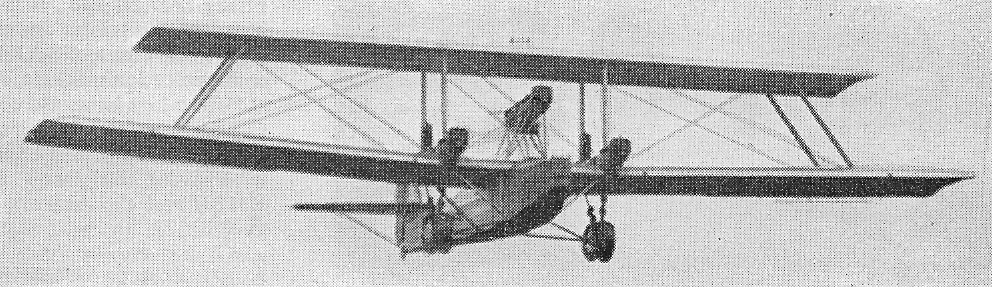
Taken in the air on 13 October 1929, although employed by the Regia Aeronautica in the ambit of the 62nd Squadron “Experimental Heavy Bombardment”, it was unable to fully express its potential: despite the conquest of some world records, it was not commercially successful and was built in a single copy. In essence it was the Air Ministry under the leadership of Italo Balbo that rejected the project, as Balbo was not a supporter of large-scale aerial bombing. Later Caproni attempted to commercialize the Ca.90 in the United States by starting a joint venture with the Curtiss Airplane and Motor Company, but this project also failed due to the great depression.
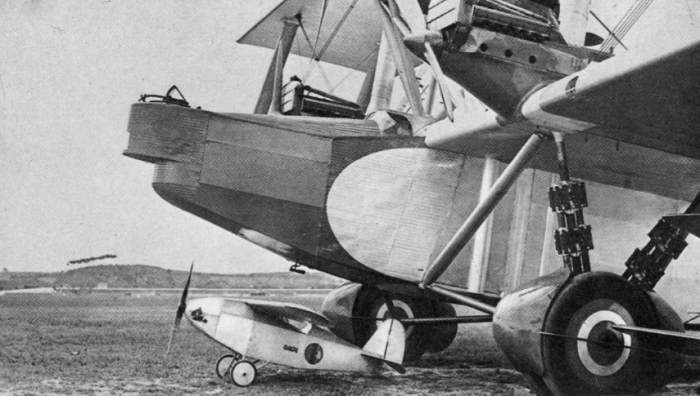
On February 22, 1930, piloted by Domenico Antonini, it won the endurance and climb-to-altitude records with a payload of 10 000 kg flying for 1 h and 31 min and reaching the maximum altitude of 3 231 m (a second, more recent source reports the maximum altitude of 3 256 m).
The operational use of the Ca.90 with the Regia Aeronautica was limited to the 62nd Squadron “Sperimentale Bombardamento Pesante” (also called “Squadriglia Bombardieri Giganti”) with the Italian air force.
From the Ca.90 project, a seaplane version was developed, called Ca.91.
Engines: 6 x Isotta Fraschini Asso 1000, 1000 hp
Wingspan Upper: 34,90 m / 114 ft 6 in
Wingspan Lower: 46,60 m / 153 ft 2.5 in
Length: 26,95 m / 89 ft 9 in
Height: 10,80 m
Wing area: 496,60 sq.m
Empty weight: 15 000 kg
MAUW: 30 000 kg / 66,140 lb
Max speed: 205 km/h / 130 mph
Endurance: 7 h 00 min
Range: 2796 mi
Ceiling: 4 500 m
Bombload: 8 000 kg
 All Aero